
NCERT Solutions for Class 8 – Complete Chapter-wise Study Material
2. Microorganisms : Friend And Foe is one of the most important chapters in the Class 8 Science English NCERT Solutions curriculum. This chapter plays a significant role in helping students build a strong conceptual foundation while preparing for school examinations, class tests, unit tests, half-yearly examinations, annual examinations, and CBSE board assessments. The chapter has been carefully designed according to the latest NCERT syllabus, making it an essential part of every student's study plan.
The 2. Microorganisms : Friend And Foe - Class 8 Science English NCERT Solutions available on ATP Education explain every question in a simple, accurate, and step-by-step manner. Each answer is prepared according to the latest CBSE guidelines so that students can understand the concepts clearly without confusion. Whether you are completing your homework, revising before examinations, or strengthening your understanding of the subject, these solutions provide reliable academic support throughout your learning journey.
One of the biggest advantages of studying 2. Microorganisms : Friend And Foe is that it helps students understand important concepts, definitions, examples, and textbook exercises in an organized way. Instead of memorizing answers, students learn how to develop logical thinking, improve analytical skills, and write well-structured answers in examinations. This chapter also helps improve problem-solving ability and encourages conceptual learning, which is essential for scoring higher marks in school and competitive examinations.
Our Class 8 Science NCERT Solutions cover all textbook questions, important exercise questions, and chapter-wise explanations in English Medium. Every solution is written in easy-to-understand language, allowing students to revise the chapter quickly before examinations. Regular practice of these solutions improves confidence, strengthens subject knowledge, and reduces examination stress.
Students preparing for school assessments should carefully study 2. Microorganisms : Friend And Foe because questions from this chapter are frequently asked in objective questions, short answer questions, long answer questions, competency-based questions, and case-study questions. Understanding the concepts explained in this chapter also helps students connect related topics from other chapters, making overall learning more effective and meaningful.
At ATP Education, we continuously update our Class 8 Science English NCERT Solutions according to the latest NCERT textbooks and CBSE curriculum. Students can confidently use these chapter-wise solutions for daily study, homework assistance, quick revision, examination preparation, and self-learning. By studying 2. Microorganisms : Friend And Foe thoroughly and practising every question regularly, students can strengthen their concepts, improve writing skills, and achieve better academic performance in both school and board examinations.
2. Microorganisms : Friend And Foe - Class 8 Science English NCERT Solutions
2. Microorganisms : Friend And Foe
Chapter Review
Chapter Review:
- There are other living organisms around us which we cannot see with eyes alone. These are called microorganisms or microbes.
- Microorganisms are classified into four major groups. These groups are bacteria, fungi, protozoa and some algae.
- Viruses are quite different from other microorganisms. They reproduce only inside the host organism; bacterium, plant or animal cell.
- Microorganisms are found in air, water and in the bodies of plants and animals.
- They can live in all kinds of environment, ranging from ice cold climate to hot springs and deserts to marshy lands.
- Some microorganisms are useful for commercial production of medicines and alcohol.
- Some microorganisms decompose the organic waste and dead plants and animals into simple substances and clean up the environment.
- There are some insects and animals which act as carriers of disease causing microbes. Like housefly.
- Disease causing agents are called pathogens.
- When a disease-carrying microbe enters our body, the body produces antibodies to fight the invader.
- Several diseases, including cholera, tuberculosis, smallpox and hepatitis can be prevented by vaccination.
- Process of conversion of sugar into alcohol is known as fermentation.
- Medicines which kill or stop the growth of the disease-causing microorganisms. Such medicines are called antibiotics.
- Microorganisms like amoeba can live alone, while fungi and bacteria may live in colonies.
- Microorganisms are used to increase soil fertility by fixing nitrogen.
- Lactobacillus bacteria are found in curd, which promotes the formation of curd.
- Sugar is converted into alcohol by yeast.
2. Microorganisms : Friend And Foe
Text Book Exercise
Text Book Exercise
Q1. Fill in the blanks:
(a) Microorganisms can be seen with the help of a ____________.
(b) Blue green algae fix __________ directly from air to enhance fertility of soil.
(c) Alcohol is produced with the help of __________.
(d) Cholera is caused by __________.
Ans :
(i) Microscope
(ii) Nitrogen
(iii) Yeast
(iv) bacterial
Q2. Tick the correct answer:
(a) Yeast is used in the production of
(i) sugar
(ii) alcohol
(iii) hydrochloric acid
(iv) oxygen
Ans: (ii) alcohol
(b) The following is an antibiotic
(i) Sodium bicarbonate
(ii) Streptomycin
(iii) Alcohol
(iv) Yeast
Ans:(ii) Streptomycin
(c) Carrier of malaria-causing protozoan is
(i) emale Anopheles mosquito
(ii) cockroach
(iii) housefly
(iv) butterfly
Ans: (i) emale Anopheles mosquito
(d) The most common carrier of communicable diseases is
(i) ant
(ii) housefly
(iii) dragonfly
(iv) spider
Ans: (ii)housefly
(e) The bread or idli dough rises because of
(i) heat
(ii) grinding
(iii) growth of yeast cells
(iv) kneading
Ans: (iii) growth of yeast cells
(f) The process of conversion of sugar into alcohol is called
(i) nitrogen fixation
(ii) moulding
(iii) fermentation
(iv) infection
Ans: (iii) fermentation
Q3. Match the organisms in Column I with their action in Column II.
Column I Column II
(i) Bacteria (a) Fixing Nitrogen
(ii) Rhizobium (b) Setting of curd
(iii) Lactobacillus (c) Baking of bread
(iv) Yeast (d) Causing Malaria
(v) A protozoan (e) Causing Cholera
(vi) A Virus (f) Causing AIDS
(g) Producing antibodies
Ans:
(i) - (e)
(ii) - (a)
(iii) - (b)
(iv) - (c)
(v) - (d)
(vi) - (f)
Que: Can microorganisms be seen with the naked eye? If not, how can they be seen?
Ans: No, we cannot see microorganism with unaided eyes. They can be seen with the help of a microscope.
Que: What are the major groups of microorganisms?
Ans: The major groups of microorganisms are bacteria, fungi, protozoa and some algae.
Que: Name the microorganisms which can fix atmospheric nitrogen in the soil?
Ans: They are Rhizobium, Azobacter, blue-green algae, etc.
Que: Write 10 lines on the usefulness of microorganisms in our lives?
Ans:
(i) They are used in winemaking, baking, pickling, and other food making processes.
(ii) Alcoholic fermentation by yeast is widely used in the preparation of wine and bread. A bacterium Lactobacillus, promotes the formation of curd.
(iii) Yeast reproduces rapidly and produces carbon dioxide during respiration. Bubbles of the gas fill the doughand increases its volume.
(iv) Microbes are used to reduce pollution. For example, decomposers such as bacteria and fungi break down dead bodies and excreta to form inorganic compounds, which can be absorbed by plants.
(v) They are used to increase the soil fertility by fixing the atmospheric nitrogen with the help of bacterium Rhizobium and some other blue-green algae.
(vi) Microbes also play an important role in the preparation of medicines.
(vii) Antibiotics are chemicals produced by micro-organisms to kill bacteria. Streptomycin, for example, is an antibiotic.
(viii) Certain microbes are also used in the biological treatment of sewage and industrial effluents.
(ix) Antibiotics are used to control many plant diseases.
(x) Antibiotics are mixed with the feed of livestock and poultry to check microbial infection in animals.
Que: Write a short paragraph on the harms caused by microorganisms?
Ans:
Harmful effects of micro-organisms:
(i) Micro-organisms cause diseases in animals. For example, in humans, bacteria cause diseases such as tuberculosis, cholera, typhoid, etc.
(ii) In cattle, the foot and mouth disease is caused by a virus.
(iii) Also, several microbes cause diseases in plants. For example, the productivity of wheat, orange, apple, etc. is reduced due to microbial diseases in plants.
(iv) Certain microbes, on entering into our body, produce toxic substances. This leads to food poisoning. Some micro-organisms such as fungus spoil our food. For example, bread when left unused under moist conditions gets spoilt by fungus, producing a white cotton-like growth on the bread.
Que: What are antibiotics? What precautions must be taken while taking antibiotics?
Ans: Antibiotics are medicines produced by certain micro-organisms to kill other disease-causing micro-organisms. These medicines are commonly obtained from bacteria and fungi. Streptomycin, tetracycline, penicillin, etc. are common antibiotics.
Precautions to be taken while using antibiotics:
(i) Antibiotics should be taken under the supervision of a well qualified doctor.
(ii) Course (intake) of antibiotics should be completed as per the prescription given by the doctor.
(iii) Antibiotics should be taken in the right amount and at the right time. A wrong dose of antibiotic makes the drug ineffective. Also, excessive consumption of drugs may kill the useful bacteria present in our body.
2. Microorganisms : Friend And Foe
Text Book Exercise
Text Book Exercise
Que: Can microorganisms be seen with the naked eye? If not, how can they be seen?
Ans: No, we cannot see microorganisms with unaided eyes. They can be seen with the help of a microscope.
Que: What are the major groups of microorganisms?
Ans: bacteria, protozoa, fungi and some algae are the major group of microorganism.
Que: Name the microorganisms which can fix atmospheric nitrogen in the soil.
Ans: These are Rhizobium, Azobacter, blue green algae.
Que: Write 10 lines on the usefulness of microorganisms in our lives.
Ans: Microorganisms are useful to us in many ways. For example:
- Bacteria like Lactobacillus convert milk into curd.
- Bacteria are also involved in the making of cheese.
- Acetobacter aceti is used for producing acetic acid from alcohol.
- Yeast is used in the commercial production of alcohol, wine and bakery products.
- Some specific microorganisms are helpful in manufacturing of antibiotics.
- Microorganisms act as cleansing agents and decompose the waste products into manure.
- Dead or weakened microbes are used in the preparation of vaccines.
- Some bacteria fix atmospheric nitrogen and increase soil fertility.
- Algae, yeast, fungi or bacteria may be used as an ingredient or a substitute for protein-rich foods that are suitable for human or animal consumption.
- Some microorganisms are taken as probiotics, that are believed to provide health benefits when consumed.
Que: Write a short paragraph on the harms caused by microorganisms.
Ans:
(i) Many infectious or communicable disease like tuberculosis, cholera, plague, flue, chicken pox are caused by microorganism.
(ii) Many protozoa cause disease like malaria, filaria, amoebiasis etc.
(iii) Funguses are causative organisms of many skin diseases.
(iv) Dengue and polio like dangerous diseases are caused by virus like microorganisms.
(v) Several microorganisms harm crops like vegetables, fruits and grains.
Que: What are antibiotics? What precautions must be taken while taking antibiotics?
Ans: The medicines which kill or stop the growth of the disease-causing microorganisms. Such medicines are called antibiotics.
Precautions:
(i) It must be taken under advised of a qualified doctor.
(ii) Body may develop resistance when we take it unnecessary.
The course of antibiotic must be completed.
2. Microorganisms : Friend And Foe
Additional Questions With Solutions
Additional Questions With Solutions
Que: What are the major groups of microorganisms?
Ans: (i) Bacteria (ii) Fungi (iii) Protozoa (iv) algae
Que: What are viruses?
Ans: Viruses are also microscopic. But they reproduce only inside the cells of the host organism, which may be bacteria, plant and animals etc. common cold influenza and cough are caused by viruses.
Que: Name three diseases caused by virus.
Ans: Polio, chicken pox and measles.
Que: Name three water born diseases.
Ans: Hepatitis, typhoid, cholera etc.
Que: How do microorganisms help us.
OR
Write the uses of microorganisms for various purposes.
Ans: The uses of microorganisms:-
(i) They are used in the preparation of curd, bread and cake.
(ii) They are also used in cleaning up of the environment.
(iii) They are used in the preparation of medicines.
(iv) They are used to increase soil fertility by fixing nitrogen.
Que: Name the microorganism which is found in curd.
Ans: Lactobacillus bacteria.
Que: Name the bacteria which promote the formation of curd.
Ans: Lactobacillus.
Que: What is fermentation?
Ans: The process of conversion of sugar of fruits juice into alcohol is known as fermentation.
Que: Name the gas produced by yeast during the process of fermentation.
Ans: Carbon dioxide.
Que: Name the microorganism which is used for large scale production of alcohol.
Ans: Yeast.
Que: What is food poisoning? What is its disadvantages.
Ans: Food poisoning could be due to the consumption of food spoilt by some microorganisms. Microorganisms that grow on our food sometimes produce toxic substances. These make the food poisonous causing serious illness and even death.
Que: What are antibiotics?
Ans: The medicines which kill or stop the growth of the disease causing bacteria such medicines are called antibiotics. Ex . streptomycin, penicillin and erythromycin etc.
Que: Name two antibiotics.
Ans:
(i) Streptomycin.
(ii) Penicillin
2. Microorganisms : Friend And Foe
Additional Questions With Solutions
Additional Questions With Solutions
Que: What is the role of nitrogen in living beings?
Ans: Nitrogen is used for the synthesis of amino acid, proteins and other nitrogenous molecules in the plants. When an animal take these plants as a food it get that proteins synthesise using nitrogen.
Que: Why are antibiotics mixed with the feed of the livestock and poultry?
Ans: Antibiotics are mixed with the feed of the livestock and poultry to check microbial infection in animals.
Que: What precautions must be taken while taking antibiotics?
Ans: Precautions are such as;
(i) Antibiotics should be taken only on the advised of a qualified doctor.
(ii) You must complete the course prescribed by the doctor.
Que: What is communicable diseases?
Ans: Microbial diseases that can spread from an infected person to a healthy person through air, water, food or physical contact are called communicable diseases.
Que: What is carriers?
Ans: There are some insects and animals which act as carriers of disease causing microbes like house fly and mosquito .
Que: What is biological nitrogen fixer?
Ans: Some bacteria and blue green algae are able to fix nitrogen from the atmosphere to enrich soil with nitrogen and increase its fertility. These microbes are commonly called biological nitrogen fixers.
Que: What are pathogens?
Ans: Some of the cause diseases in humans beings, plants, and animals . Such disease causing microorganisms are called pathogens.
Que: What is preservatives?
Ans: Salts and edible oils are the common chemicals generally used to check the growth of microorganisms. Therefore they are called preservatives.
Que: What is pasteurization?
Ans: The milk is heated to about 70C for 15 to 30 seconds and then suddenly chilled and stored. By doing so, it prevents the growth of microbes. This process is called pasteurization.
Que: Write the name of some preservatives.
Ans: Some preservatives are common salt ,sugar, oils, and Vinegar etc.
Que: Name the factors which are responsible for fixation of nitrogen.
Ans: Rhizobium, blue green algae and some times through the action of lightning.
Que: What do you understand by the fixation of nitrogen?
Ans: When Rhizobium and blue green algae present in the soil fix nitrogen from the atmosphere and convert it into compounds of nitrogen. Once nitrogen is converted into these usable compounds, it can be utilised by plants from the soil through their root system. This is known as fixation of nitrogen.
Que: What is fixation of nitrogen?
Ans: The conversation of nitrogen into its compounds is known as fixation of nitrogen.
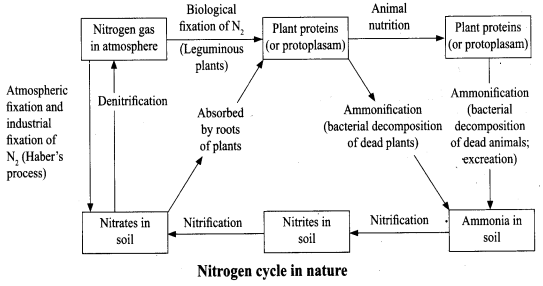
Que: What is nitrogen cycle?
Ans: Nitrogen is one of the essential constituents of all living organism as a part of proteins. Nitrogen is used by the various organisms and they convert it into nitrogen compounds or nitrogenous wastes, these are reused by the plants. Some other bacteria converted it into nitrogen gas which goes back into the atmosphere. As percentage of nitrogen in the atmosphere is remains constant. This makes a cycle of nitrogen.
Que: What is pasteurization?
Ans: Pasteurization is a method to preserve milk, in which the milk is heated to about 700C for 15 to 30 seconds and then suddenly chilled and stored. By doing so, it prevents the growth of microbes. This process was discovered by Louis Pasteur. It is called pasteurization.
Que: Name the bacteria responsible for the disease typhoid.
Ans: Salmonella typhi.
Que: Chicken pox is caused by ………. virus.
Ans: Varicella zoster.
Que: ………….. (disease) is caused by mycoplasma.
Ans: Pleuropneumonia.
Que: Name the toxin released by T.B. bacteria.
Ans: Tuberculin toxin is released by T.B. bacteria.
Que: Which microorganism is the cause of malaria?
Ans: A Protozoan, Plasmodium.
Que: Write two diseases caused by bacteria.
Ans: Two diseases caused by bacteria are tuberculosis and diphtheria.
Que: Name any two items that are prepared by using yeast.
Ans: Yeast is used to prepare bread and alcohol.
Que: Fill in the blanks:
1. Microorganisms can be seen with the help of a …………..
2. Blue-green algae fix ………… directly from air to enhance fertility of soil.
3. Alcohol is produced with the help of ………….
4. Cholera is caused by ……………
Ans:
1. Microscope
2. Nitrogen
3. Yeast
4. Bacteria.
Que: Match the organisms in Column I with their action in Column II.
| Column I | Column II |
| (a) Bacteria (b) Rhizobium (c) Lactobacillus (d) Yeast (e) A protozoan (f) A virus |
(i) Fixing nitrogen (ii) Setting of curd (iii) Baking of bread (iv) Causing malaria (v) Causing cholera (vi) Causing AIDS |
Ans:
| Column I | Column II |
| (a) Bacteria (b) Rhizobium (c) Lactobacillus (d) Yeast (e) A protozoan (f) A virus |
(i) Causing cholera (ii) Fixing nitrogen (iii) Setting of curd (iv) Baking of bread (v) Causing malaria (vi) Causing AIDS |
Que: Name the microorganisms which can fix atmospheric nitrogen in the soil.
Ans: Rhizobium, Clostridium md Azotobacter fix atmospheric nitrogen.
Que: Can microorganisms be seen with the naked eye ? If not, how can they be seen?
Ans: No, microorganisms cannot be seen with the naked eye. They can only be seen with the help of microscope.
Que: What are the major groups of microorganisms?
Ans:
- Bacteria
- Fungi
- Protozoa
- Algae.
Que: What are microorganisms?
Ans: Microorganisms are organisms that are so small that they can only be seen through a microscope.
Que: Name two diseases caused by viruses.
Ans: Influenza and cough.
Que: Name two diseases caused by protozoans.
Ans: Dysentery and malaria.
Que: Which microorganisms are unicellular?
Ans: Bacteria and protozoa are unicellular.
Que: Name two multicellular microorganisms.
Ans: Algae and fungi are multicellular.
Que: Name the bacterium used for production of acetic acid from alcohol.
Ans: Acetobacter aceti.
Que: Define fermentation.
Ans: The process of conversion of sugar into alcohol is called fermentation.
Que: Why antibiotics are not effective against cold and flu?
Ans: Cold and flu are caused by viruses, so the antibiotics are not effective against them.
Que: What are antibodies?
Ans: When a disease carrying microbe enters our body, the body produces antibodies to fight the invader.
Que: Name two diseases which can be prevented by vaccination.
Ans: Cholera and tuberculosis can be prevented by vaccination.
Que: Name the diseases for which oral drops are given as vaccination.
Ans: Polio.
Que: What are biological nitrogen fixers?
Ans: Some bacteria and blue-green algae are able to fix nitrogen from the atmosphere to enrich soil with nitrogen and increase fertility, are known as biological nitrogen fixers.
Que: What are pathogens?
Ans: Diseases-causing microorganisms are called pathogens.
Que: What are communicable diseases?
Ans: Microbial diseases which can spread from an infected person to a healthy person through air, water, food or physical contact are known as communicable diseases.
Que: Name two communicable diseases.
Ans: Chicken pox and tuberculosis.
Que: Name two carriers of disease-causing microbes.
Ans: Housefly and female Anopheles mosquito.
Que: Name the causative microorganism of tuberculosis and its mode of transmission.
Ans: Causative microorganisms – Bacteria.
Mode of transmission – Air.
Que: How are cholera and typhoid transmitted?
Ans: Cholera is transmitted through water or food.
Typhoid is transmitted through water.
Que: Which microorganism causes foot and mouth disease of cattle?
Ans: Virus.
Que: Name one plant disease caused by bacteria and its mode of transmission.
Ans: Citrus canker is caused by bacteria and transmitted through air
Que: Name one plant disease transmitted by insects and caused by virus.
Ans: Yellow vein mosaic of bhindi.
Que: Name one plant disease caused by fungi and its mode of transmission.
Ans: Rust of wheat. It is transmitted through air and seeds.
Que: What is meant by food poisoning?
Ans: Food poisoning is caused by consuming food that has bean spoilt by some microorganisms.
Que: What are preservatives?
Ans: Chemicals (salts, etc.) that check the growth of microorganisms are called preservatives.
Que: How are pickles preserved?
Ans: Pickles are preserved by adding salt or acid.
Que: Name the chemicals used to preserve jams and squashes.
Ans: Sodium benzoate and sodium metabisulphite are added to jams and squashes to preserve them.
Que: How are meat and fish preserved?
Ans: Meat and fish are preserved by covering them with dry salt to check the growth of bacteria.
Que: Describe the role of blue-green algae in fertility of soil.
Ans: Blue-green, algae, also called cyanobacteria, can fix atmospheric nitrogen into usable , compounds. These are then used as fertilizers.
Que: Name three habitats of microorganisms.
Ans: Microorganisms are present in soil, water, outer space and inside the body of animals.
Que: Name the bacterium found in the roots of pea plant. How is this bacterium useful for human beings?
Ans: Rhizobium is the bacterium found in the roots of pea plant. The. bacterium absorbs the atmospheric nitrogen and converts it to nitrates.
Que: What is a vaccine? Why is it important to vaccinate small children?
Ans: Vaccine is prepared from weak or dead disease-causing microbe. Vaccine is given to healthy persons to prevent occurrence of disease. It is important to vaccinate small children because it creates antibodies in blood.
Que:
- Give full form of ORS.
- What is vaccination?
Ans:
- ORS — Oral Rehydration Solution.
- Vaccination is a method to immunise the body against diseases by making the body’s immune system produce antibodies against the disease-causing microbe in the vaccine.
Que: Mention two important uses of fungi.
Ans: Uses of fungi:
- They convert dead organic matter into simple soluble minerals and gases, which can be used again by plants.
- Fungi like yeast is used in bread, beer and wine.
Que: How is pasteurised milk obtained?
Ans: In pasteurisation, the milk is heated to 62.5°C for 30 minutes or to 71.5°C for 15 seconds. It is then rapidly cooled to 10°C and packed in airtight containers.
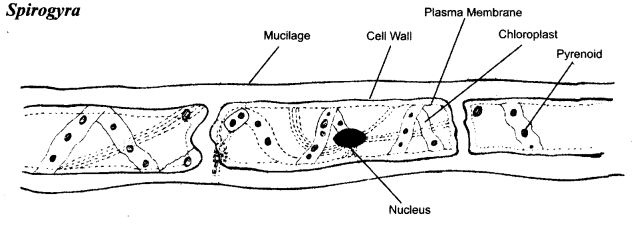
Que: Draw a neat and well-labelled diagram of Spirogyra.
Ans:
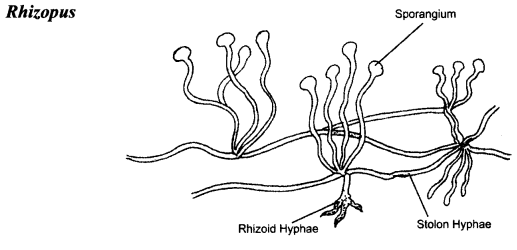
Que: Draw a labelled diagram of Rhizopus.
Ans:
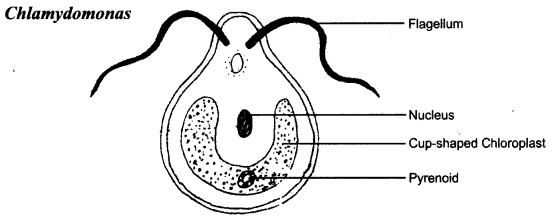
Que: Draw a labelled diagram of Chlamydomonas.
Ans:
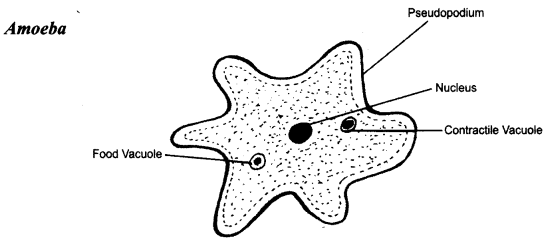
Que: Draw a labelled diagram of Amoeba.
Ans:
Que: How are viruses different from other microorganisms?
Ans: Viruses reproduce only inside the host organisms that is, bacterial, plant or animal cell.
Que: Give two examples where microorganisms are useful at home.
Ans: At home microorganisms are used for preparation of curd and cakes.
Que: How are microorganisms useful commercially?
Ans: Microorganisms are used for the large scale production of alcohol, wine and acetic acid (vinegar).
Que: How do microorganisms clean the environment?
Ans: Microorganisms degrade the harmful substances and clean the environment.
Que: How can we prevent a person from getting Hepatitis B?
Ans:
- By giving boiled water for drinking.
- By vaccination.
Que: Name one disease caused by bacteria and one disease caused by virus in cattle.
Ans:
- Bacteria – Anthrax.
- Virus – Foot and mouth disease.
Que: How can we control plant diseases?
Ans: Plant diseases can be controlled by chemicals which kill the microbes.
Que: Why do we use oil and vinegar to preserve vegetables and fruits?
Ans: Use of oil and vinegar prevents spoilage of vegetables and fruits because bacteria cannot live in such an environment.
Que: Why do we keep milk in the refrigerator during summers?
Ans: The low temperature in the refrigerator inhibits the growth of microbes.
Que: Why do we boil milk before storing?
Ans: Boiling kills the microorganisms.
Que: How are dry fruits preserved?
Ans: Dry fruits are preserved by keeping them sealed in airtight packets to prevent the attack of microbes.
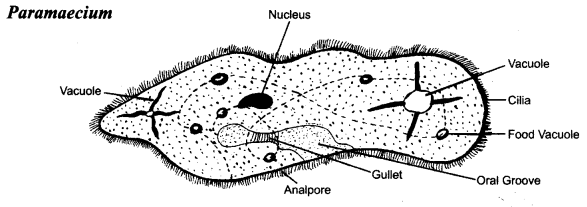
Que: Draw a well-labelled diagram of Paramecium.
Ans:
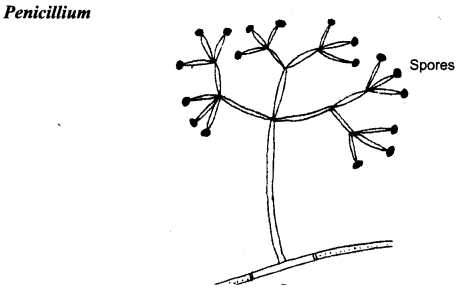
Que: Draw a labelled diagram of Penicillium.
Ans:
Que:
- Name the scientist who discovered the vaccine for smallpox.
- Who discovered the bacterium which causes anthrax disease?
Ans:
- Edward Jenner
- Robert Koch
Que:
- Tuberculosis is a highly infectious disease. Justify the statement.
- Which vitamin helps in the prevention of common cold?
Ans:
- Tuberculosis is a highly infectious disease. TB is transmitted through minute droplets of infected sputum on phelgm, by drinking milk of an infected animal.
- Common cold is prevented by taking vitamin C.
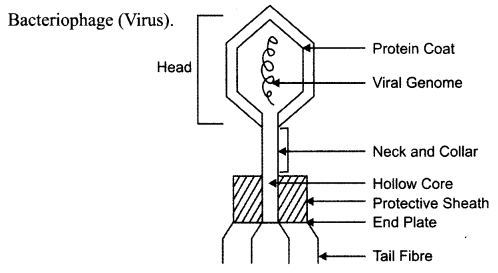
Que: Draw a labelled diagram of virus.
Ans:
Que: Can you store pickles in iron containers? Why?
Ans: We can not store pickles in iron containers because the acid present in the pickles reacts with iron. This can cause food poisoning, if consumed.
Que: What precautions must be taken while taking antibiotics?
Ans: Antibiotics should be taken after consulting a doctor. The complete dose of the antibiotics should be taken as prescribed. They should not be taken unnecessarly because they will kill the useful bacteria.
Que:
- Write the causal organism of cholera.
- Write any two symptoms of this disease.
- Why ORS should be given to the patients suffering from cholera?
Ans:
- Cholera is caused by Vibrio cholerae.
- Two symptoms of cholera are :
- profuse and painless watery diarrhoea.
- muscular cramps.
- ORS should be given to the patients suffering from cholera to avoid excessive loss of body fluids.
Que: Why are viruses considered to be on the borderline between living organisms and non-living things?
Ans: Viruses cannot reproduce, respond to changes or use energy to grow. Since viruses reproduce in the host cell, scientist regard viruses as a link between living and non-living.
Que: How are bacteria beneficial for us?
Ans: Bacteria are useful to us as :
- Nitrogen fixing bacteria increase the fertility of the soil.
- They can be used to form curd, alcohol, etc.
- They can decompose organic matter.
Que: Write three types of bacteria on the basis of their shape. Give one example of each.
Ans: Three types of bacteria are:
- Bacillus or rod-shaped, e.g., Lactobacillus.
- Coccus or spherical, e.g., Streptococcus.
- Spirillum or spiral, e.g., Vibrio.
Que:
(a) Are bacteria plants or animals ? Give reasons in support of your answer.
(b) Write two differences between autotrophic and heterotrophic bacteria.
Ans:
(a) Bacteria is considered as plant due to the presence of a rigid cell wall in it.
(b)
| Autotrophic bacteria | Heterotrophic bacteria |
| (i) Chlorophyll is present. (ii) Synthesize their own food. |
(i) Chlorophyll is absent. (ii) Depend on readymade food from other sources. |
Que: How does a housefly transmit diseases?
Ans: A housefly gets attracted towards garbage and excreta. The harmful microorganisms present in excreta and garbage easily stick to its fine array of body hair and are thus, transferred to food stuffs whenever they sit on them and a result food gets poisoned.
Que:
- What are antibiotics ?
- How are antibiotics manufactured ?
- Name two important antibiotics.
Ans:
- Medicines which kill or stop the growth of the disease causing microorganisms are called antibiotics.
- The antibiotics are manufactured by growing specific microorganisms.
- Two important antibiotics are Tetracycline and Bacitracin.
Que: What will happen if you take antibiotics when not needed?
Ans: If you take antibiotics when not needed, you help bacteria in your body to develop resistance to them. Next time when you fall ill and need these antibiotics, they would be less effective.
Que: How does a vaccine act?
Ans: The vaccine acts by making the body’s immune system to produce antibodies against the disease-causing microbe in the vaccine. The antibodies attack and destroy the weakened microbe as it enters the body.
Que: How is common cold spread?
Ans: When a person suffering from common cold sneezes, fine droplets of moisture carrying thousands of viruses causing common cold are spread in the air. The viruses may enter the body of a healthy person while breathing.
Que: How can you prevent the spread of communicable diseases?
Ans: It is better to avoid contact with the infected person. We should keep distance from infected persons.
Que: Give the methods of prevention of cholera.
Ans: Cholera can be prevented by :
- Vaccination.
- Maintaining good personal hygiene.
- Consuming properly cooked food and drinking boiled water.
Que: How does food become ‘poison’ ?
Ans: Microorganisms that grow on our food sometimes produce toxic substances. These make the food poisonous causing serious illness and even death.
Que: What will happen if yeast powder is put in sugar solution and kept for few hours ? Name the process.
Ans: When yeast powder is put in sugar solution and kept for few hours, fermentation takes place. The sugar is converted into alcohol by yeast and this process is known as Fermentation.
Que: Describe the nitrogen cycle with the help of a neat and labelled diagram.
Ans:
Que: Write 10 lines on the usefulness of microorganisms in our lives.
Ans: Microorganisms are useful in our lives in the following ways :
- Bacteria cause the decay of dead plants and animals.
- Nitrogen fixing bacteria convert the atmospheric nitrogen into nitrates.
- Bacteria are used in the production of vinegar, curd, cheese, etc.
- Bacteria are used in sewage disposal plants.
- Scientists have discovered ways to change bacteria so that they produce valuable medical, agricultural and industrial products.
Que: Write a short paragraph on the harms caused by microorganisms.
Ans:
- Microorganisms cause diseases in human beings, plants and animals.
- Microorganisms spoil food and cause food poisoning.
Que: How can we control the spread of malaria or dengue?
Ans: All mosquitoes breed in water. Hence, by keeping the surroundings clean and dry, we can prevent mosquitoes from breeding. We should not allow water to collect in coolers, flower pots, etc. We should wear full sleeves shirts in the evenings and at night. We can also use mosquito repellant creams and mosquito nets.

Science
Class 8 (English Medium)
NCERT Science Textbook
Chapter-wise NCERT Solutions for Class 6 to 12 prepared according to the latest CBSE syllabus.
English Medium
NCERT Solutions Class 8 Science
Chapter 1. Crop Production And Management Solutions
1. Crop Production And Management Open Chapters
Explore Now →
NCERT Solutions Class 8 Science
Chapter 2. Microorganisms : Friend And Foe Solutions
2. Microorganisms : Friend And Foe Open Chapters
Explore Now →
NCERT Solutions Class 8 Science
Chapter 3. Synthetic Fibres And Plastics Solutions
3. Synthetic Fibres And Plastics Open Chapters
Explore Now →
NCERT Solutions Class 8 Science
Chapter 4. Materials : Metals And Non-Metals Solutions
4. Materials : Metals And Non-Metals Open Chapters
Explore Now →
NCERT Solutions Class 8 Science
Chapter 5. Coal And Petroleum Solutions
5. Coal And Petroleum Open Chapters
Explore Now →
NCERT Solutions Class 8 Science
Chapter 6. Combustion And Flame Solutions
6. Combustion And Flame Open Chapters
Explore Now →
NCERT Solutions Class 8 Science
Chapter 7. Conservation of Plants And Animals Solutions
7. Conservation of Plants And Animals Open Chapters
Explore Now →
NCERT Solutions Class 8 Science
Chapter 8. Cell-Structure and functions Solutions
8. Cell-Structure and functions Open Chapters
Explore Now →
NCERT Solutions Class 8 Science
Chapter 9. Reproduction in animals Solutions
9. Reproduction in animals Open Chapters
Explore Now →
NCERT Solutions Class 8 Science
Chapter 10. Reaching the age of adolescence Solutions
10. Reaching the age of adolescence Open Chapters
Explore Now →
NCERT Solutions Class 8 Science
Chapter 11. Force And Pressure Solutions
11. Force And Pressure Open Chapters
Explore Now →
NCERT Solutions Class 8 Science
Chapter 12. Friction Solutions
12. Friction Open Chapters
Explore Now →
NCERT Solutions Class 8 Science
Chapter 14. Chemical Effects of Electric Current Solutions
14. Chemical Effects of Electric Current Open Chapters
Explore Now →
NCERT Solutions Class 8 Science
Chapter 15. Some Natural Phenomena Solutions
15. Some Natural Phenomena Open Chapters
Explore Now →
NCERT Solutions Class 8 Science
Chapter 17. Stars And The Solar System Solutions
17. Stars And The Solar System Open Chapters
Explore Now →
NCERT Solutions Class 8 Science
Chapter 18. Pollution of Air and Water Solutions
18. Pollution of Air and Water Open Chapters
Explore Now →
Class 8 NCERT Book Solutions
Chapter-wise NCERT Solutions for Class 6 to 12 prepared according to the latest CBSE syllabus.
ENGLISH MEDIUM
NCERT Solutions Class 8 Its So Happened (English)
Class 8 Its So Happened (English) Book Solutions
Open Book
Explore Now →
NCERT Solutions Class 8 Honey Dew (English)
Class 8 Honey Dew (English) Book Solutions
Open Book
Explore Now →
NCERT Solutions Class 8 HoneyDew (English Poem)
Class 8 HoneyDew (English Poem) Book Solutions
Open Book
Explore Now →Benefits of Studying NCERT Solutions
Studying from NCERT Solutions helps students build strong conceptual understanding and improve problem-solving skills. These solutions are especially useful for revision because every answer is written according to the marking scheme followed by CBSE.
- Improve conceptual understanding.
- Learn correct answer-writing techniques.
- Prepare effectively for school examinations.
- Complete syllabus revision in less time.
- Practice important textbook questions.
- Build confidence before examinations.
Prepared According to the Latest CBSE Syllabus
All NCERT Book Solutions for Class 8 available on ATP Education are updated according to the latest CBSE curriculum. Whenever NCERT introduces changes in textbooks or syllabus, our study materials are revised accordingly so that students always receive accurate and updated content.
Helpful for Competitive Examinations
NCERT textbooks form the foundation of many competitive examinations. Students preparing for Olympiads, NTSE, CUET, UPSC Foundation, SSC and several entrance examinations can strengthen their basics through these chapter-wise solutions. Understanding NCERT concepts also improves analytical thinking and logical reasoning.
Simple and Student-Friendly Explanations
Our experts prepare every answer in a simple, clear and student-friendly format. Difficult concepts are explained step by step with proper reasoning so that students of every learning level can understand them easily. This approach helps students remember concepts for a longer period and perform confidently during examinations.
Start Learning with ATP Education
Explore the complete collection of NCERT Solutions for Class 8 and begin your preparation with confidence. Every chapter is available online for free and can be accessed anytime. Whether you want to complete homework, revise important chapters or prepare for examinations, ATP Education provides reliable and high-quality study resources to help you achieve academic success.
Explore Subjects







Why Students Choose Us
Free Study Materials
Get completely free NCERT solutions, notes and board preparation resources.
Updated Notes
Latest CBSE and NCERT syllabus based notes for all major classes.
Practice Tests
Improve performance with chapter-wise MCQ tests and quizzes.
Trending Study Materials
2M+
Monthly Students
50K+
Study Notes
10K+
MCQ Questions
500+
Mock Tests