1. Chemical Reactions and Equations - Class 10 Science English CBSE Notes
CBSE Notes for Class 10 are one of the most useful study resources for students who want to understand every chapter clearly and perform well in school examinations. At ATP Education, we provide carefully prepared chapter-wise CBSE Notes for Class 10 based on the latest CBSE syllabus and NCERT curriculum. These notes are designed to simplify learning, improve conceptual understanding, and help students revise important topics quickly before examinations.
CBSE Notes for Class 10 – Chapter-wise Revision Notes
Every chapter is explained in a simple and student-friendly manner so that learners can understand difficult concepts without confusion. Whether you are preparing for class tests, periodic assessments, half-yearly examinations, annual examinations, or board-oriented assessments, our Class 10 CBSE Notes help you revise the complete syllabus in less time while covering all the important concepts.

1. Chemical Reactions and Equations - Class 10 Science English CBSE Notes
1. Chemical Reactions and Equations
Chemistry:
The theoretical and experimental study of nature, composition, preparation, isolation, properties and uses of matter is known as Chemistry.
Chemical Reaction: Such a process in which there produces substances of new property is known as chemical reaction. Ex.
2H2 + O2 → 2H2O
(Here H2 and O2 take part in chemical reaction and produce a product of new property i.e. H2O.)
In other hand, we can also say that Chemical changes are also known as chemical reaction. There are many chemical changes which occur around us.
Like,
- Iron rod comes in contact of moisture and gets rusted.
- Grapes get fermented.
- Food is cooked.
- Food gets digested in our body.
- We respire.
Determination of Chemical Reaction:
We should have a criteria to determine the chemical reaction has taken place.
e.i
- change in state
- change in colour
- evolution of a gas
- Change in temperature.
Above four points are identifications of chemical reaction which indicate that the reaction has taken place.
Chemical Equation
when a magnesium ribbon is burnt in oxygen, it gets converted to magnesium oxide. This is the statement form of a chemical reaction but it can be write as a following manners
Magnesium + Oxygen → magnesium oxide
(Reactants) (product)
To write the equation in such manner is called as word equation.
Another method to write chemical reaction;
Mg + O2 → MgO
This is symbolic form to write chemical equations.
There are two part of a chemical reaction
- Reactants: The substances that undergo chemical change in the reaction are the reactants. Example from above equation. Mg and O are reactants.
- Procducts: The new substance, formed during the reaction, is the product. Ex. MgO is product, which newer substance produced in reaction.
1. Chemical Reactions and Equations
Chemical Equation:
when a magnesium ribbon is burnt in oxygen, it gets converted to magnesium oxide. This is the statement form of a chemical reaction but it can be write as a following manners
Magnesium + Oxygen → magnesium oxide
(Reactants) (Product)
To write the equation in such manner is called as word equation.
Another method to write chemical reaction;
Mg + O2 → MgO
This is symbolic form to write chemical equations.
There are two part of a chemical reaction
- Reactants: The substances that undergo chemical change in the reaction are the reactants. Example from above equation. Mg and O are reactants.
- Procducts: The new substance, formed during the reaction, is the product. Ex. MgO is product, which newer substance produced in reaction.
Writing A chemical equation
A chemical equation represents a chemical reaction. So reactants are on the left hand side (LHS) of arrow and there is written (+) Sign between them. Similarly, Products are on the Right hand side (RHS) of arrow with a plus (+) sign between them.
Consider this;
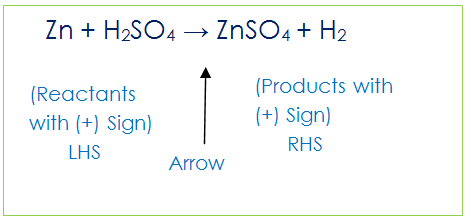
Skeletal Chemical Equation
Mg + O2 → MgO
Observe this equation, count and compare the number of atoms of each element on the LHS and RHS of the arrow. There is no equal numbers of atoms of each element on both sides. There is a little unbalance in number of atoms of Oxygen. There are 2 on left and 1 on the right of arrow. Unbalance chemical equation is called skeletal equation. hi
1. Chemical Reactions and Equations
Balancing a Chemical Equation.
Here we would learn the method how to balance a chemical reaction.0
The method which we apply e.i hit and trail or inspecting method. Here we take Equation Fe + H2O → Fe3O4 + H2 as example I:
Steps;
(i) Write each formula in box or imagine that each formula is in box. It is so that you have to mind no changes should be made inside the box.

(ii) Count and list the numbers of atom of different element that present in unbalanced equation. Like this
Elements Reactant Product
Fe 1 3
O 1 4
H 2 2
First observe that what element has the maximum number of atoms. It may be from reactant and from product. Using this criteria we find that Fe3O4 is that compound and element is O that have maximum 4 atoms.
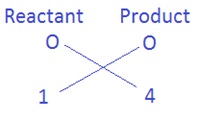
To equalise the number of atoms of oxygen, we can put the coefficient 4 with H2O as 4H2O. Then we get the equation as,
Fe + 4H2O → Fe3O4 + H2
(iii) The next maximum number of atoms having Fe. Which can be equalised
by same process.
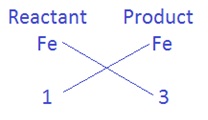
Putting the coefficient 3 with Fe as 3Fe in reactant side. Now, the equation will be
3Fe + 4H2O → Fe3O4 + H2
(iv) Finally we come to equalise Hydrogen atom of both side. We observe that 4H2 in reactant and H2 in product. Total atom of hydrogen in reactant side is 4 × 2 = 8 and 2 in product. Then,
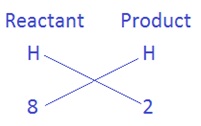
Here we cannot put 2 on LHS and 8 on RHS. (8 ÷ 2 ) =4 , the coefficient will be 4 that equalises hydrogen atom on RHS. So finally equation will be.
3Fe + 4H2O → Fe3O4 + 4H2 (balanced equation)
Example II. We take,
HNO3 + Ca(OH)2 → Ca(NO3)2 + H2O
Steps:
(i) On observing the above chemical equation we see NO3 has maximum number of atoms/molecules. To equalise it we have on LHS 1 molecule and on RHS 2 molecules. So
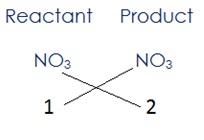
Here Nitrogen and oxygen have been balanced, then Equation will be;
2HNO3 + Ca(OH)2 → Ca(NO3)2 + H2O
(ii) Next calcium is already balanced, now we have to balance only hydrogen atoms.
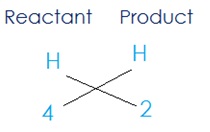
Product need 2 as coefficient because (4 ÷ 2) = 2 , then equation will be;
2HNO3 + Ca (OH)2 → Ca(NO3)2 +2H2O
(iii) On counting and listing the numbers of atom of different element that present in equation above.
Elements Reactant Product
O 8 8
N 2 2
Ca 1 1
H 4 4
Hence we get a balanced equation
2HNO3 + Ca (OH)2 → Ca(NO3)2 +2H2O
I think now you have learnt how to balance a skeletal equation.
1. Chemical Reactions and Equations
Writing Symbols of physical states
Physical states tell us about the visible forms of elements/compound. Above both the balanced equations do not tell us anything about the physical state of elements / molecules of reactant and product.
To make a chemical equation more informative, the physical states of the reactants and products are mentioned along with their chemical formulae. The gaseous, liquid, aqueous and solid states of reactants and products are represented by the notations (g), (l), (aq) and (s), respectively.
The word aqueous (aq) is used when reactant or product is soluble in water or dissolve in water.
Now applying these symbols of physical state we have the balanced equation – I
3Fe (s) + 4H2O (g) → Fe3O4 (s) + 4H2(g)
// Here we see that H2O is gaseous state it means it is water vapour or steam. //
Writing medium/condition in presence of which reaction takes place
Sometimes we write the reaction conditions like temperature, pressure and catalyst etc. i.e. heat, sunlight, catalyst like nickel, palladium, chlorophyll etc.
Examples:
(i)

(ii)

Precipitation Reaction:
Any reaction that produces a precipitate can be called a precipitation reaction.
Na2SO4(aq) + BaCl2(aq) → BaSO2(s) + 2NaCl(aq)
(Sodium sulphate) + (Barium chloride) → (Barium sulphate) + (Sodium chloride)
The white precipitate of BaSO4 is formed by the reaction of SO4 and Ba. The other product formed is sodium chloride which remains in the solution.
This white precipitate BaSO4 is insoluble in water;
Precipitate: This insoluble substance formed is known as a precipitate.
1. Chemical Reactions and Equations
Types of Chemical Reaction
Chemical reactions involve the breaking and making of bonds between atoms to produce new substances. Ex. The breaking of water molecule produces oxygen and hydrogen, while making of bond between carbon and oxygen produce carbon dioxide.
The types of reaction are as follow;
(1) Combination reaction
(2) Decomposition reaction
(3) Displacement reaction
(4) Double displacement reaction
(5) Oxidation and reduction reaction
1. Combination Reaction
Definition;
A reaction in which a single product is formed from two or more reactants is known as a combination reaction.
General form : A + B → AB
CaO(s) + H2O(l) → Ca(OH)2 (aq)
(Quick lime) (Slaked lime)
According to definition to comparison with reaction equation we see calcium oxide and water are two reactants which form a single product calcium hydroxide.
** Calcium hydroxide is used for white washing on walls. This is a precipitate reaction, when calcium hydroxide is painted on walls it reacts with CO2 present in air to form a thin layer of calcium carbonate and also produce water which get evapourated.
Some Other Examples of Combination reactions.
Burning of coal:
(i) C(s) + O2(g) → CO2(g)
Formation of water:
(ii) 2H2(g) + O2(g) → 2H2O(l)
Formation of sulphur dioxide:
(iii) S(s) + O2(g) → SO2(g)
Rusting (Formation of Ferrous oxide):
(iv) 2Fe + O2(g) → 2FeO
2. Decomposition Reaction
The reaction in which a single reactant breaks down into two or more than two simpler products is known as decomposition reaction.
General form: A → B + C
Example of Decomposition Reaction

(Ferrous sulphate) (Ferric oxide) (sulphur dioxide) (sulphur trioxide)
Ferrous sulphate crystals (FeSO4, 7H2O) lose water when heated and the colour of the crystals changes. It then decomposes to ferric oxide (Fe2O3),
sulphur dioxide (SO2) and sulphur trioxide (SO3). Ferric oxide is a solid,
while SO2 and SO2 are gases.
Another Example of Decomposition Reaction

(Limestone) (Quick lime)
On heating calcium carbonate decomposes to calcium oxide and carbon dioxide.
Calcium Oxide: It's common name is quick lime or burnt lime. It is white in colour, caustic, alkaline and crystalline. It obtained from thermal decomposition of calcium carbonate (limestone).
Uses of Calcium oxide:
(I) Manufacturing of cement
(II) Manufacturing of various types of glass.
(III) In agriculture It is used for treating acidic soils.
(IV) White washing: it is used with water
Thermal Decomposition: When a decomposition reaction is carried out by heating, it is called thermal decomposition.
Decomposition of Silver chloride:

white silver chloride turns grey in sunlight. This is due to the decomposition of silver chloride into silver and chlorine by light.
* This Reaction is used in black and white photography.
* All decomposition reactions require energy either in the form of heat, light or electricity for breaking down reactants.
On the basis of heat there are two kinds of reaction.
A. Exothermic Reactions: Reactions in which heat is released along with the formation of products are called exothermic.
- During the reaction large amount of heat (energy) is evolved
- This heat makes the reaction mixture warm.
Examples of exothermic reactions:
(i) Burning of natural gas
CH4(g) + 2O2 (g) → CO2 (g) + 2H2O (g)
(ii) Respiration is also an exothermic reaction.
When we take food to get energy to stay alive. During digestion, food is broken down into simpler substances likes carbohydrates and other nutrients. These carbohydrates further broken down to form glucose. This glucose combines with oxygen in cells of our body in the process of cellular respiration and provide energy. Therefore respiration is also an exothermic reaction.
(iii) The decomposition of vegetable matter into compost is also an
example of an exothermic reaction.
B. Endothermic Reactions: Reactions in which energy is absorbed are known as endothermic reactions.
3. Displacement Reaction:
The reaction in which the highly reactive element displaces the less reactive element from the reaction, such reaction is known as displacement reaction.
General formulla for displacement reaction:
Ab + C → Cb + A
Here C is highly reactive element which displace A from the reaction and joins b.
Example:
When a iron nail is placed in the equous solution of copper sulphate Iron displaces copper from the reaction or its compound and blue colour of copper sulphate turns grey brown because Iron is highly reactive metal than copper.
The reaction is as follows;
(i) CuSO4(aq) + Fe(s) → FeSO4(aq) + Cu(s)
When solid zinc is placed in the equous solution of copper sulphate zinc displaces copper from the reaction or its compound because zinc is highly reactive metal than copper.
Equation of this reaction;
(ii) CuSO4(aq) + Zn(s) → ZnSO4(aq) + Cu(s)
Other example:
(iii) CuCl2(aq) + Pb(s) → PbCl2(aq) + Cu(s)
4. Double Displacement Reaction:
Such a reaction in which there is an exchange of ions between the reactants are called double displacement reactions.
General formulla for double displacement reaction:
Ab + Cd → Ad + Cb
Example:
(i) Na2SO4 + BaCl2 → BaSO4 + 2NaCl
(ii) NaOH + H2SO4 → Na2SO4 + H2O
(iii) NaCl + AgNO3 → AgCl + NaNO3
(iv) BaCl2 + H2SO4 → BaSO4 + HCl
(v) BaCl2 + KSO4 → BaSO4 + KCl2
5. Oxidation And Reduction:
Oxidation Reaction: Oxidation is the gain of oxygen or loss of hydrogen.
In other words:
The addition of oxygen to a substance or the removal of hydrogen from a substance or both is called oxidation.
Examples of Oxidation:
Gain of Oxygen;
(i)

[Carbon gains oxygen and gets oxidised in carbon dioxide]
(ii)

[Phosporous gains oxygen and gets oxidised in Phosporous pentaoxide]
(iii)

[Copper gains oxygen and gets oxidised in copper oxide]
Removal of Hydrogen:
Examples of Oxidation:
(i)

[Sulpher gives/looses Hydrogen and gets oxidised]
(ii)

[Sulpher gives/looses Hydrogen and gets oxidised]
(iii)

[Carbon gives/looses Hydrogen and gets oxidised]
Here carbon gains oxygen and gets oxidised.
Reduction Reaction: Reduction is the loss of oxygen or gain of hydrogen.
In other words:
The addition of hydrogen to a substance or removal of oxygen from a substance or both is called reduction.
Example of reduction:
(i)

(ii)

(iii)

However both oxidation and reduction occur together.
Redox Reaction: Such reaction in which one reactant gets oxidised while the other gets reduced during a reaction is called redox reaction.
In other words;
When oxidation and reduction both take place in same reaction is known as redox reaction.
Example;

Here oxidation and reduction both reaction take place in same reaction.
Oxidising Agent/Oxidants/Oxidisers:
The substance which gives oxygen for oxidation or removes hydrogen for reduction is called oxidising agent.
Reducing agent:
The substances which is responsible for removing oxygen or gives Hydrogen for reduction called reducing agent.
Example:

Here in above example CuO is reduced to Cu so reduced substance is CuO. Hence CuO (copper oxide) gives oxygen for oxidation to oxidised H2 therefore It is a Oxidising Agent.
And H2 is oxidised to H2O so H2 Is Oxidised and it is responsible for removing oxygen from CuO (copper oxide) Therefore H2 (Hydrogen) is Reducing Agent.
Summary:
(a) Oxidised substance : H2 // Which gains in Oxygen
(b) Reduced substance: CuO // Which looses Oxygen
(c) Oxidising Agent :CuO // which provides Oxygen for oxidation
(d) Reducing Agent : H2 // Which is responsible for removal of Oxygen
Effects oxidation reaction:
There are many reactions are going on around us in our everyday life in which corrosion of metals and rancidity of foods are common example due to oxidation reaction.
1. Corrosion
The process in which metals looses their surface gradually by the action of air, water and moisture is called corrosion.
In other words:
The process in which metals surface get corroded by reaction with air, water and moisture is called corrosion.
***** Corrosion is not a rusting while rusting causes corrosion.
Preventing Corrosion:
There are following method to prevent corrosion:
(i) By galvonisation
(ii) By painting metal surfaces
(iii) By oiling or greesing metal surfaces
Galvonisation: Coating of thin layer of zinc (Zn) on metal surface by electro-plating is called galvonisation.
2. Rancidity
The condition produced by aerail (airborne) oxidation of fats and oils in foods marked by unpleasant smell and taste is called rancidity.
Rancidity is an event, when fat/oil containing foods get oxidised after a long time their taste and smell change.
- Rancidity spoils the food materials prepared in fat/oil. like, chips, Bhuiya and Sabji etc.
- Oxidised food materials' taste and smell are changed.
- Rancid food is unfit for eating.
Preventing fat/oil containing foods from rancidity:
Fat/oil containing food can be preveneted or the rate of rancidity can be retarded by using following methods:
(i) Rancidity can be prevented by adding anti-oxidants to fat/oil containing foods.
(ii) Rancidity can be prevented to remove oxygen gas from container and filling nitrogen gas during packaging.
(iii) Rancidity can be retarded by keeping food in air tight containers that helps to slow down oxidation.
(iv) Rancidity can be retarded by storing food items away from heat and light.
(v) Rancidity can be retarded by keeping food in a refrigerator that cause to slow down oxidation.
Why Choose CBSE Notes for Class 10?
Reading the complete textbook is essential for building knowledge, but revision notes help students organize that knowledge effectively. Our CBSE Revision Notes for Class 10 summarize every chapter by highlighting important concepts, definitions, keywords, formulas, examples, and important points that students should remember during examinations. This approach saves valuable study time and makes revision much easier.
Students often find it difficult to revise lengthy chapters before examinations. Our notes solve this problem by presenting important information in a structured format that is easy to understand and remember. Regular revision using these notes helps improve confidence and strengthens conceptual clarity.
Chapter-wise Study Material
Each chapter included in the CBSE Notes for Class 10 section is prepared according to the latest academic session. Every topic is explained in simple language while maintaining accuracy and completeness. Students can easily revise important concepts, learn key points, and strengthen their understanding of each chapter.
The notes are suitable for daily classroom learning, homework preparation, revision before examinations, and self-study. They also serve as an excellent companion to NCERT textbooks by presenting the most important information in an organized manner.

Explore CBSE Notes Class 10 Science
Chapter-wise NCERT Solutions for Class 6 to 12 prepared according to the latest CBSE syllabus.
English Medium

CBSE Notes Class 10 Science
Chapter 1. Chemical Reactions and Equations (CBSE NOTES)
1. Chemical Reactions and Equations ()
Explore Now →
CBSE Notes Class 10 Science
Chapter 2. Acids, Bases and Salts (CBSE NOTES)
2. Acids, Bases and Salts ()
Explore Now →
CBSE Notes Class 10 Science
Chapter 3. Metals and Non-metals (CBSE NOTES)
3. Metals and Non-metals ()
Explore Now →
CBSE Notes Class 10 Science
Chapter 4. Carbon and its Compounds (CBSE NOTES)
4. Carbon and its Compounds ()
Explore Now →
CBSE Notes Class 10 Science
Chapter 5. Periodic Classification of Elements (CBSE NOTES)
5. Periodic Classification of Elements ()
Explore Now →
CBSE Notes Class 10 Science
Chapter 6. Life Processes (CBSE NOTES)
6. Life Processes ()
Explore Now →
CBSE Notes Class 10 Science
Chapter 6. Life Processes (CBSE NOTES)
6. Life Processes (Science)
Explore Now →
CBSE Notes Class 10 Science
Chapter 7. Control and Coordination (CBSE NOTES)
7. Control and Coordination (Science)
Explore Now →
CBSE Notes Class 10 Science
Chapter 7. Control and Coordination (CBSE NOTES)
7. Control and Coordination ()
Explore Now →
CBSE Notes Class 10 Science
Chapter 8. How do Organisms Reproduce (CBSE NOTES)
8. How do Organisms Reproduce ()
Explore Now →
CBSE Notes Class 10 Science
Chapter 9. Heredity and Evolution (CBSE NOTES)
9. Heredity and Evolution ()
Explore Now →
CBSE Notes Class 10 Science
Chapter 10. Light-Reflection and Refraction (CBSE NOTES)
10. Light-Reflection and Refraction ()
Explore Now →
CBSE Notes Class 10 Science
Chapter 11. Human Eye and Colourful World (CBSE NOTES)
11. Human Eye and Colourful World ()
Explore Now →
CBSE Notes Class 10 Science
Chapter 13. Magnetic Effects of Electric Current (CBSE NOTES)
13. Magnetic Effects of Electric Current ()
Explore Now →
CBSE Notes Class 10 Science
Chapter 14. Sources of Energy (CBSE NOTES)
14. Sources of Energy ()
Explore Now →
CBSE Notes Class 10 Science
Chapter 15. Our Environment (CBSE NOTES)
15. Our Environment ()
Explore Now →
CBSE Notes Class 10 Science
Chapter 16. Management of Natural Resources (CBSE NOTES)
16. Management of Natural Resources ()
Explore Now →Benefits of Using ATP Education Notes
- Latest CBSE syllabus based notes.
- Chapter-wise revision material.
- Easy-to-understand explanations.
- Important concepts and key points.
- Quick revision before examinations.
- Useful for school tests and annual exams.
- Available in Hindi and English Medium.
- Free educational resources for every student.
Your CBSE Notes Library Class 10:
Chapter-wise CBSE Notes for Class 6 to 12 prepared according to the latest CBSE syllabus.
HINDI MEDIUM
CBSE Class 10 Economics
Class 10 Economics CBSE Notes
Arthik Vikas ki Samajh Open Notes
Explore Now →
Your CBSE Notes Library For Class 10
Chapter-wise CBSE Notes for Class 6 to 12 prepared according to the latest CBSE syllabus.
ENGLISH MEDIUM
NCERT Solutions Class 10 SOCIAL SCIENCE-HISTORY
Class 10 SOCIAL SCIENCE-HISTORY CBSE Notes
India and the Contemporary World-II Open Book
Explore Now →
NCERT Solutions Class 10 History
Class 10 History CBSE Notes
India and the Contemporary World-II Open Book
Explore Now →
NCERT Solutions Class 10 Economics
Class 10 Economics CBSE Notes
Understanding Economic Development Open Book
Explore Now →Prepare with Confidence
Success in examinations depends on regular practice, conceptual understanding, and effective revision. Our Class 10 CBSE Notes are designed to help students study smarter instead of studying longer. By revising chapter-wise notes regularly, learners can improve their understanding, remember important concepts for a longer period, and write better answers during examinations.
Along with these notes, students can also explore NCERT Solutions, MCQ Questions, Online Tests, Important Questions, Study Materials, and other learning resources available on ATP Education. Together, these resources provide complete academic support for effective learning and better examination preparation.
Start exploring the CBSE Notes for Class 10 today and make your learning journey easier with well-organized chapter-wise notes, quick revision material, and reliable study resources prepared especially for CBSE students.
Benefits of Studying with Our CBSE Notes
- Chapter-wise Coverage: Every chapter is explained in a structured and easy-to-follow format.
- Latest CBSE Syllabus: Notes are prepared according to the latest CBSE curriculum and NCERT guidelines.
- Quick Revision: Revise important concepts, formulas, definitions, and key points in less time.
- Simple Language: Difficult topics are explained in clear and student-friendly language for better understanding.
- Concept-Based Learning: Focus on understanding concepts instead of memorizing answers.
- Exam-Oriented Preparation: Helps students prepare effectively for class tests, unit tests, half-yearly, annual, and board examinations.
- Subject-wise Organization: Easily access notes for Mathematics, Science, English, Hindi, Social Science, Physics, Chemistry, Biology, Economics, and more.
- Time-Saving Study Material: Well-organized notes reduce study time and improve learning efficiency.
- Improves Answer Writing: Learn important points and present answers in a better and more organized manner.
- Boosts Confidence: Regular revision strengthens concepts and increases confidence before examinations.
- Free Learning Resource: Access high-quality CBSE Notes without any subscription or hidden charges.
- Available in Hindi & English Medium: Study comfortably in your preferred medium with chapter-wise notes.