
NCERT Solutions for Class 8 – Complete Chapter-wise Study Material
1. Crop Production And Management is one of the most important chapters in the Class 8 Science English NCERT Solutions curriculum. This chapter plays a significant role in helping students build a strong conceptual foundation while preparing for school examinations, class tests, unit tests, half-yearly examinations, annual examinations, and CBSE board assessments. The chapter has been carefully designed according to the latest NCERT syllabus, making it an essential part of every student's study plan.
The 1. Crop Production And Management - Class 8 Science English NCERT Solutions available on ATP Education explain every question in a simple, accurate, and step-by-step manner. Each answer is prepared according to the latest CBSE guidelines so that students can understand the concepts clearly without confusion. Whether you are completing your homework, revising before examinations, or strengthening your understanding of the subject, these solutions provide reliable academic support throughout your learning journey.
One of the biggest advantages of studying 1. Crop Production And Management is that it helps students understand important concepts, definitions, examples, and textbook exercises in an organized way. Instead of memorizing answers, students learn how to develop logical thinking, improve analytical skills, and write well-structured answers in examinations. This chapter also helps improve problem-solving ability and encourages conceptual learning, which is essential for scoring higher marks in school and competitive examinations.
Our Class 8 Science NCERT Solutions cover all textbook questions, important exercise questions, and chapter-wise explanations in English Medium. Every solution is written in easy-to-understand language, allowing students to revise the chapter quickly before examinations. Regular practice of these solutions improves confidence, strengthens subject knowledge, and reduces examination stress.
Students preparing for school assessments should carefully study 1. Crop Production And Management because questions from this chapter are frequently asked in objective questions, short answer questions, long answer questions, competency-based questions, and case-study questions. Understanding the concepts explained in this chapter also helps students connect related topics from other chapters, making overall learning more effective and meaningful.
At ATP Education, we continuously update our Class 8 Science English NCERT Solutions according to the latest NCERT textbooks and CBSE curriculum. Students can confidently use these chapter-wise solutions for daily study, homework assistance, quick revision, examination preparation, and self-learning. By studying 1. Crop Production And Management thoroughly and practising every question regularly, students can strengthen their concepts, improve writing skills, and achieve better academic performance in both school and board examinations.
1. Crop Production And Management - Class 8 Science English NCERT Solutions
1. Crop Production And Management
Chapter Review
Chapter Review:
- Plants of the same kind are grown and cultivated at one place on a large scale, it is called a crop.
- Khurpi, sickle, shovel, plough, etc. are some agricultures tools.
- Crops are of different types like cereals, vegetables and fruits.
- According to season there are two type of crops – (i) Rabi crops and (ii) Kharif Crops.
- Rabi crops are wheat, gram, pea, mustard and linseed.
- Paddy, maize, soyabean, groundnut, cotton, etc., are kharif crops.
- The process of loosening and turning of the soil is called tilling or ploughing.
- The levelling of soil is done with the help of a leveller.
- Nowadays ploughing is done by tractor driven cultivator.
- The use of cultivator saves labour and time.
- The substances which are added to the soil in the form of nutrients for the healthy growth of plants are called manure and fertilisers.
- Manure is an organic substance obtained from the decomposition of plant or animal wastes.
- Rhizobium bacteria are present in the nodules of the roots of leguminous plants.
- Rhizobium bacteria fix atmospheric nitrogen.
- A fertiliser is an inorganic salt which is prepared in factories.
- Fertilisers are very rich in plant nutrients like nitrogen, phosphorus and potassium.
- The supply of water to crops at different intervals is called irrigation.
- The sources of irrigation are— wells, tubewells, ponds, lakes, rivers, dams and canals.
- The traditional ways of irrigation are moat, chain pump, Dhekali and Rahat.
- Modern methods of irrigation help us to use water economically.
- Modern methods of irrigation are sprinkler system and drip system.
- These undesirable plants are called weeds.
- The removal of weeds is called weeding.
- Weeds are also controlled by using certain chemicals, called weedicides, like 2,4-D.
- The cutting of crop after it is mature is called harvesting.
- The grain seeds need to be separated from the chaff. This process is called threshing.
1. Crop Production And Management
Text Book Exercise
Text Book Exercise
Que: Select the correct word from the following list and fill in the blanks. float, water, crop, nutrients, preparation
(a) The same kind of plants grown and cultivated on a large scale at a place is called _____________.
(b) The first step before growing crops is _____________ of the soil.
(c) Damaged seeds would _____________ on top of water.
(d) For growing a crop, sufficient sunlight and ________ and ________from the soil are essential.
Ans:
(a) Crops
(b) Preparation of soil.
(c) Float
(d) water, nutrients
Que: Match items in column A with those in column B.
| A | B | |
| (i) | Kharif crops | (a) Food for cattle |
| (ii) | Rabi crops | (b) Urea and super phosphate |
| (iii) | Chemical fertilisers urine and plant waste | (c) Animal excreta, cow dung |
| (iv) | Organic manure |
(d) Wheat, gram, pea (e) Paddy and maize |
Ans:
| A | B | |
| (i) | Kharif crops | (e) Paddy and maize |
| (ii) | Rabi crops | (d) Wheat, gram, pea |
| (a) Food for cattle | ||
| (iii) | Chemical fertilisers |
(b) Urea and super phosphate urine and plant waste |
| (iv) | Organic manure | (c) Animal excreta, cow dung |
Que: Give two examples of each.
(a) Kharif crop
(b) Rabi crop
Ans:
(a) Kharif crop – Paddy and Maize
(b) Rabi crop – Wheat and gram.
Que: Write a paragraph in your own words on each of the following.
(a) Preparation of soil
(b) Sowing
(c) Weeding
(d) Threshing
Ans:
(a) Preparation of soil – The preparation of soil is the first step before growing a crop. One of the most important tasks in agriculture is to turn the soil and loosen it. This allows the roots to penetrate deep into the soil. The process of loosening and turning of the soil is called tilling or ploughing. This is done by using a plough. Ploughs are made of wood or iron. The ploughed field may have big pieces of soil called crumbs. It is necessary to break these crumbs with a plank. The levelling of soil is done with the help of a leveller.
(b) Sowing – Sowing is a process of putting seeds into soil, in this process there is used a traditional funnel. It helps to put seeds into soil. Sowing is the most important part of crop production. Before sowing, good quality seeds are selected. Seed must be at appropriate distance and be avoided overcrowding.
(c) Weeding - Many other undesirable plants may grow naturally along with the crop. These undesirable plants are called weeds. Weeds are harmful for crops. These take all nutrients water and light from soils which are added for crops. Weeds can be removed manually or by using weedicides. Manually there is used a Khurpi while by using weedicides we use chemical substances like 2, 4-D, which damage only weeds and do not harm to crops
(d) Threshing – After harvesting the crops, the crops are threshed for removing grain seeds from the chaff. This is carried out with the help of a machine called ‘combine’ which is in fact a combined harvester and thresher.
Que: Explain how fertilisers are different from manure.
Ans: The substance which are added to the soil in the form of nutrients for the healthy growth of plants are called manure and fertiliers.
Differrence:
| Fertilizer | Manure |
| (i) Fertilizer are prepared in factories. | (i) Manure are prepared in the fields. |
| (ii) Fertilizer no provide humus to the soil. | (ii) Manure provides a lot of humus to the soil. |
| (iii) Fertilizers are very rich in plants. | (iii) Manure are not rich in plants. |
Que: What is irrigation? Describe two methods of irrigation which conserve water.
Ans: The supply of water to crops at differenet intervals is called irritating.
(i) Sprinkler system: This system is more useful on uneven land, having fewer water supplies. In this method, water is supplied using pipes to one or more central locations within the field. When water is allowed to flow under high pressure with the help of a pump, it gets sprinkled on the crops.
b) Drip system: In this system, water is delivered at or near the roots of plants, drop by drop. This is the most efficient method of irrigation as there is no wastage of water at all. This method is important in areas where water availability is poor.
Que: If wheat is sown in kharif season, what would happen? Discuss.
Ans: In kharif season there have lot of rainfall, whereas wheat need winter (cold) so in kharif season not sown wheat.
Que: Explain how soil gets affected by the continuous plantation of crops in a field?
Ans: Continous growing of crops makes the soil deficient in certain nutrients.
Que: What are weeds? How can we control them?
Ans: The undesirable plants in the fields that grow naturaly are called weeds. weeds must be removed,otherwise our own crop plants may not get sufficent water,nutrients,space and lights. so, they are removed either by manual method or by using weedicides.
The manual removal includes physical removal of weeds by uprooting or cutting them close to the ground from time to time. this is done with the help of a khurpi or a harrow. by using weedicides also,we can remove weeds. These weedicides damage only weeds and do not harm crop.
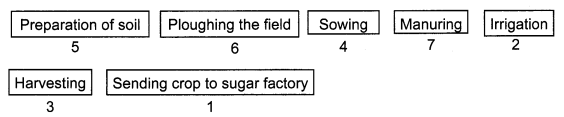
Q10. Arrange the following boxes in proper order to make a flow chart of sugarcane crop production.

Ans:
1. Crop Production And Management
Text Book Exercise
Text Book Exercise
Ques: Explain how fertilisers are different from manure.
Ans: Fertilisers are different from manure in following manner.
|
Manure |
Fertilizer |
|
(i) It is prepared by organic substances. (ii) It is rich in all nutrients. (iii) ex. Compost Manure. |
(i) It is prepared by chemical substances. (ii) It is rich in particular nutrients. (iii) Urea, Potash and ammonium sulphate etc. |
Ques: What is irrigation? Describe two methods of irrigation which conserve water.
Ans : The supply of water to crops at different intervals is called irrigation.
There are two modern methods of irrigation which conserve water.
(i) Sprinkler system – This system is more useful on the uneven land where sufficient water is not available.
(ii) Drip system – In this system, the water falls drop by drop just at the position of the roots. So it is called drip system. It is the best technique for watering fruit plants, gardens and trees.
Ques: If wheat is sown in the kharif season, what would happen? Discuss.
Ans: In kharif season, there have a lot of rainfall. Where, wheat does not need the heavy rainfall. It will be destroyed as well as water logging.
Ques: Explain how soil gets affected by the continuous plantation of crops in a field.
Ans: Continuous plantation of crops makes the soil deficient in certain nutrient in a field. Further the crops do not grow well. To avoid this, the following practices should be done.
(i) Crop rotation.
(ii) Manuring the soil
(iii) Leaving field fallow.
Ques: What are weeds? How can we control them?
Ans : Many other undesirable plants may grow naturally along with the crop. These undesirable plants are called weeds. Weeds are harmful for crops. These take all nutrients water and light from soils which are added for crops. Weeds can be removed manually or by using weedicides. Manually there is used a Khurpi while by using weedicides we use chemical substances like 2, 4-D, which damage only weeds and do not harm to crops.
1. Crop Production And Management
Additional Questions With Solutions
Additional Questions With Solutions
Ques: What is crop?
Ans: When a plant of same kind are grown and cultivated at one place on a large scale. It is called crop.
Ques: Write differences between Kharif crops and Rabi crops.Ans: Differences between Kharif crops and Rabi crops:
|
Kharif crops |
Rabi crops |
|
|
Ques: Write agricultural practices activities which are used by farmers.
Ans: Agricultural practices activities: -
- Preparation of soil.
- Sowing
- Adding manure and fertilizers
- Irrigation
- Protecting from weeds
- Harvesting
- Storage
Ques:what is HOE ?
Ans: It is a simple too which is used for removing weeds and for loosening the soil.
Ques: Why is turning and loosening of soil very important for cultivation of crops?
Ans: Since only a few centimeters of the top layer of soil supports plant growth. Turning and loosening of soil brings the nutrient-rich soil to the top so that plants can use these nutrients. Thus turning and loosening of soil very important for cultivation of crops.
Ques: What is tilling or ploughing?
Ans: The process of loosening and turning of the soil is caller tilling or ploughing.
Ques: What is cultivator?
Ans: Nowadays ploughing is done by tractor driven cultivator. The use of cultivator saves labour and time.
Ques: What is manure and fertilizers?
Ans: The substances which are added to nutrients for the healthy growth of plants are called manure and fertilizers.
1. Crop Production And Management
Additional Questions With Solutions
Additional Questions With Solutions
Ques: Define irrigation.
Ans: The supply of water to crops at different intervals is called irrigation.
Ques: Write the advantages of Manure.
Ans: The advantages of Manure.
- It enhances the water holding capacity of the soil.
- it makes the soils porous due to which exchange of gases becomes easy.
- it improves the texture of the soil.
- It increases the number of friendly microbes.
Ques: Write five sources of irrigation.
Ans: The sources of irrigation are – wells, tubewells, ponds, rivers and canals etc.
Ques: Write any four traditional methods of irrigation.
Ans: (i) moat (ii) chain pump (iii) Dhekli and (iv) Rahat
Ques: Write the modern method of irrigation.
Ans: (i) Sprinkler System (ii) Drip systemQues: Name the modern method of irrigation which is the best technique for watering fruits plants, gardens and trees.
Ans: Drip system.
Ques: What are weeds?
Ans: Many other undesirable plants may grow naturally along with the crops. These undesirable plants are called weeds.
Ques: What is combine? Write its two benefits.
Ans: Combine is a machine which helps for harvesting and threshing.
Benefits of combine:
(i) It completes work in a very few times
(ii) It saves money and labour.
Que: What is crop rotation?
Ans: Crop rotation is a process in which we sow the different crops in each different season. Such manner of cropping is called crop rotation.
Que: how do weeds harmful for crops?
ORWrite three disadvantages of weeds.
Ans: Disadvantages of weeds.
(i) It takes all nutrient, water and light from soil.
(ii) They affect the growth of the crop.
(iii) Weeds interfere even in harvesting and may be poisonous for animals and human beings.
Que: How can the deficient of certain nutrient be avoided in a field.
Ans: The deficient of certain nutrient can be avoided in a field using the following process.
(i) Crop rotation
(ii) Manuring the field
(iii) To leave the field uncultivated (fallow) in between two crops.
Que: What are crops?
Ans: Crops are plants of the same kind grown in large quantities for food.
Que: What is the basis of classification of crops in our country?
Ans: In our country, crops are classified on the basis of the season in which they grow.
Que: What are kharif crops?
Ans: The crops which are sown in the rainy season and harvested in September/October are called kharif crops.
Que: What are summer crops?
Ans: The crops which are grown in the summer season and harvested before rainy season are called summer crops or zayed crops.
Que: Name two summer season crops.
Ans: Moong and muskmelon are summer season crops.
Que: What are rabi crops?
Ans: The crops which are grown in the winter season and harvested in March/April are called rabi crops.
Que: Why paddy cannot be grown in the summer season?
Ans: Paddy requires a lot of water, so it can only be grown during rainy season.
Que: What is meant by agricultural practices?
Ans: The activities undertaken by farmers over a period of time for cultivation of crops are known as agricultural practices.
Que: Write a paragraph in your own words on preparation of soil.
Ans: Soil is prepared by tilling i.e., loosening and turning of soil.
Que: Name the tool used for tilling of soil.
Ans: A plough is used for tilling of soil.
Que: What are crumbs?
Ans: A ploughed field may have big pieces of soil called crumbs.
Que: How are crumbs broken?
Ans: The crumbs are broken with the help of a plank.
Que: Why should loose soil be levelled?
Ans: Loose soil be levelled for sowing and irrigation.
Que: How is levelling of soil done?
Ans: Levelling of soil is done with the help of a leveller.
Que: How is ploughing done these days?
Ans: Now a days ploughing is done by tractor having a multipronged plough.
Que: What is meant by sowing?
Ans: Sowing is the process of putting seeds in the soil.
Que: What is meant by good quality seeds?
Ans: The good quality seeds means clean and healthy seeds of a good variety free from diseases.
Que: What is the advantage of sowing seeds with a seed drill?
Ans: The advantage of sowing seeds with a seed drill is that the seeds are sown at a proper depth under the soil and the distance between them is uniform.
Que: What are manure and fertilisers?
Ans: The substances which are added to the soil in the form of nutrients for the healthy growth of plants are called manure and fertilisers.
Que: What is organic manure?
Ans: Manure obtained from animal or plant waste such as cattle dung, droppings is called organic manure.
Que: What is meant by crop rotation?
Ans: Growing crops alternatively to prevent depletion of any one nutrient from soil is called crop rotation.
Que: What is meant by irrigation?
Ans: The supply of water to crops in the fields at different intervals is called irrigation.
Que: What is the drip system of irrigation?
Ans: Falling of water drop by drop at the roots of the plant is called drip irrigation.
Que: Why should weeds be removed?
Ans: Weeds compete with the crop plants for water, nutrients, space and light and thus affect the growth of the crop. So, they should be removed.
Que: Name the process of removal of weeds.
Ans: Weeding is the process of removal of weeds.
Que: How is harvesting done in our country?
Ans: Harvesting in our country is done either manually by sickle or by a machine called harvester.
Que: Name the farm machine used for harvesting and threshing both.
Ans: Combine.
Que: What is meant by winnowing?
Ans: After threshing, the grain is separated from the chaff, with the help of wind. This is known as winnowing.
Que: How are food grains stored?
Ans: Food grains are dried in the sun to remove the excess moisture and then stored.
Que: Why should grains be dried before storage?
Ans: Grains should be dried before storage to remove the excess moisture in them, so that microbes are not able to attack the grains.
Que: What is meant by animal husbandry?
Ans: The study of the care of animals is known as animal husbandry.
Que: Name some animals from whom milk can be obtained.
Ans: Milk can be obtained from cow, buffalo, she goat and she camel.
Que: How is fish useful for us?
Ans: Fish is highly nutritious and easily digestible food. Cod liver oil from fish is also a rich source of vitamin D.
Que: Name some animals which are reared for their meat.
Ans: Sheep, goat, pigs, chicken and fish are reared for their meat.
Que: Why is honey so useful?
Ans: Honey is an antiseptic and its enzymes help in digestion. It is also used for making several ayurvedic medicines.

Science
Class 8 (English Medium)
NCERT Science Textbook
Chapter-wise NCERT Solutions for Class 6 to 12 prepared according to the latest CBSE syllabus.
English Medium
NCERT Solutions Class 8 Science
Chapter 1. Crop Production And Management Solutions
1. Crop Production And Management Open Chapters
Explore Now →
NCERT Solutions Class 8 Science
Chapter 2. Microorganisms : Friend And Foe Solutions
2. Microorganisms : Friend And Foe Open Chapters
Explore Now →
NCERT Solutions Class 8 Science
Chapter 3. Synthetic Fibres And Plastics Solutions
3. Synthetic Fibres And Plastics Open Chapters
Explore Now →
NCERT Solutions Class 8 Science
Chapter 4. Materials : Metals And Non-Metals Solutions
4. Materials : Metals And Non-Metals Open Chapters
Explore Now →
NCERT Solutions Class 8 Science
Chapter 5. Coal And Petroleum Solutions
5. Coal And Petroleum Open Chapters
Explore Now →
NCERT Solutions Class 8 Science
Chapter 6. Combustion And Flame Solutions
6. Combustion And Flame Open Chapters
Explore Now →
NCERT Solutions Class 8 Science
Chapter 7. Conservation of Plants And Animals Solutions
7. Conservation of Plants And Animals Open Chapters
Explore Now →
NCERT Solutions Class 8 Science
Chapter 8. Cell-Structure and functions Solutions
8. Cell-Structure and functions Open Chapters
Explore Now →
NCERT Solutions Class 8 Science
Chapter 9. Reproduction in animals Solutions
9. Reproduction in animals Open Chapters
Explore Now →
NCERT Solutions Class 8 Science
Chapter 10. Reaching the age of adolescence Solutions
10. Reaching the age of adolescence Open Chapters
Explore Now →
NCERT Solutions Class 8 Science
Chapter 11. Force And Pressure Solutions
11. Force And Pressure Open Chapters
Explore Now →
NCERT Solutions Class 8 Science
Chapter 12. Friction Solutions
12. Friction Open Chapters
Explore Now →
NCERT Solutions Class 8 Science
Chapter 14. Chemical Effects of Electric Current Solutions
14. Chemical Effects of Electric Current Open Chapters
Explore Now →
NCERT Solutions Class 8 Science
Chapter 15. Some Natural Phenomena Solutions
15. Some Natural Phenomena Open Chapters
Explore Now →
NCERT Solutions Class 8 Science
Chapter 17. Stars And The Solar System Solutions
17. Stars And The Solar System Open Chapters
Explore Now →
NCERT Solutions Class 8 Science
Chapter 18. Pollution of Air and Water Solutions
18. Pollution of Air and Water Open Chapters
Explore Now →
Class 8 NCERT Book Solutions
Chapter-wise NCERT Solutions for Class 6 to 12 prepared according to the latest CBSE syllabus.
ENGLISH MEDIUM
NCERT Solutions Class 8 Its So Happened (English)
Class 8 Its So Happened (English) Book Solutions
Open Book
Explore Now →
NCERT Solutions Class 8 Honey Dew (English)
Class 8 Honey Dew (English) Book Solutions
Open Book
Explore Now →
NCERT Solutions Class 8 HoneyDew (English Poem)
Class 8 HoneyDew (English Poem) Book Solutions
Open Book
Explore Now →Benefits of Studying NCERT Solutions
Studying from NCERT Solutions helps students build strong conceptual understanding and improve problem-solving skills. These solutions are especially useful for revision because every answer is written according to the marking scheme followed by CBSE.
- Improve conceptual understanding.
- Learn correct answer-writing techniques.
- Prepare effectively for school examinations.
- Complete syllabus revision in less time.
- Practice important textbook questions.
- Build confidence before examinations.
Prepared According to the Latest CBSE Syllabus
All NCERT Book Solutions for Class 8 available on ATP Education are updated according to the latest CBSE curriculum. Whenever NCERT introduces changes in textbooks or syllabus, our study materials are revised accordingly so that students always receive accurate and updated content.
Helpful for Competitive Examinations
NCERT textbooks form the foundation of many competitive examinations. Students preparing for Olympiads, NTSE, CUET, UPSC Foundation, SSC and several entrance examinations can strengthen their basics through these chapter-wise solutions. Understanding NCERT concepts also improves analytical thinking and logical reasoning.
Simple and Student-Friendly Explanations
Our experts prepare every answer in a simple, clear and student-friendly format. Difficult concepts are explained step by step with proper reasoning so that students of every learning level can understand them easily. This approach helps students remember concepts for a longer period and perform confidently during examinations.
Start Learning with ATP Education
Explore the complete collection of NCERT Solutions for Class 8 and begin your preparation with confidence. Every chapter is available online for free and can be accessed anytime. Whether you want to complete homework, revise important chapters or prepare for examinations, ATP Education provides reliable and high-quality study resources to help you achieve academic success.
Explore Subjects






Why Students Choose Us
Free Study Materials
Get completely free NCERT solutions, notes and board preparation resources.
Updated Notes
Latest CBSE and NCERT syllabus based notes for all major classes.
Practice Tests
Improve performance with chapter-wise MCQ tests and quizzes.
Trending Study Materials
2M+
Monthly Students
50K+
Study Notes
10K+
MCQ Questions
500+
Mock Tests