
NCERT Solutions for Class 8 – Complete Chapter-wise Study Material
17. Stars And The Solar System is one of the most important chapters in the Class 8 Science English NCERT Solutions curriculum. This chapter plays a significant role in helping students build a strong conceptual foundation while preparing for school examinations, class tests, unit tests, half-yearly examinations, annual examinations, and CBSE board assessments. The chapter has been carefully designed according to the latest NCERT syllabus, making it an essential part of every student's study plan.
The 17. Stars And The Solar System - Class 8 Science English NCERT Solutions available on ATP Education explain every question in a simple, accurate, and step-by-step manner. Each answer is prepared according to the latest CBSE guidelines so that students can understand the concepts clearly without confusion. Whether you are completing your homework, revising before examinations, or strengthening your understanding of the subject, these solutions provide reliable academic support throughout your learning journey.
One of the biggest advantages of studying 17. Stars And The Solar System is that it helps students understand important concepts, definitions, examples, and textbook exercises in an organized way. Instead of memorizing answers, students learn how to develop logical thinking, improve analytical skills, and write well-structured answers in examinations. This chapter also helps improve problem-solving ability and encourages conceptual learning, which is essential for scoring higher marks in school and competitive examinations.
Our Class 8 Science NCERT Solutions cover all textbook questions, important exercise questions, and chapter-wise explanations in English Medium. Every solution is written in easy-to-understand language, allowing students to revise the chapter quickly before examinations. Regular practice of these solutions improves confidence, strengthens subject knowledge, and reduces examination stress.
Students preparing for school assessments should carefully study 17. Stars And The Solar System because questions from this chapter are frequently asked in objective questions, short answer questions, long answer questions, competency-based questions, and case-study questions. Understanding the concepts explained in this chapter also helps students connect related topics from other chapters, making overall learning more effective and meaningful.
At ATP Education, we continuously update our Class 8 Science English NCERT Solutions according to the latest NCERT textbooks and CBSE curriculum. Students can confidently use these chapter-wise solutions for daily study, homework assistance, quick revision, examination preparation, and self-learning. By studying 17. Stars And The Solar System thoroughly and practising every question regularly, students can strengthen their concepts, improve writing skills, and achieve better academic performance in both school and board examinations.
17. Stars And The Solar System - Class 8 Science English NCERT Solutions
17. Stars And The Solar System
Chapter Review
Chapter Review:
- The stars, the planets, the moon and many other objects in the sky are called celestial objects.
-
The day on which the whole disc of the moon is visible is known as the full moon day.
-
The various shapes of the bright part of the moon as seen during a month are called phases of the moon.
-
On the fifteenth day the moon is not visible. This day is known as the new moon day.
-
The next day of the new moon day, only a small portion of the moon appears in the sky. This is known as the crescent moon.
-
The distance travelled by light in one year known as light year.
-
The stars forming a group that has a recognisable shape is called a constellation.
-
A body revolving around another body is called a satellite.
-
A planet has a definite path in which it revolves around the Sun. This path is called an orbit.
-
The movement of planets around the sun on their orbit is called revolution.
-
The planets move on their own axis like top, Such movement s known as rotation.
-
Mars appears slightly reddish and, therefore, it is also called the red planet.
-
Moon revolving round the Sun.
-
The smallest planet is mercury.
-
The mass of Jupiter is about 318 times that of our Earth.
-
On July 21, 1969 (Indian time) the American astronaut Neil Armstrong
landed on the moon for the first time. -
There is a large gap in between the orbits of Mars and Jupiter. This gap is occupied by a large number of small objects that revolve around the Sun. These are called asteroids.
-
However we may see a bright streaks of light falling in the sky. These are commonly known as shooting stars, although they are not stars. They are called meteors.
-
The Sun is nearly 150,000,000 kilometres (150 million km) away from
the Earth. -
The artificial satellites revolve around the Earth. They are much closer than the moon.
-
Venus is the brightest planet in the night sky.
17. Stars And The Solar System
Text Book Exercise
Exercise NCERT Book
Que: Choose the correct answer in Questions 1-3 :
Q1. Which of the following is NOT a member of the solar system?
(a) An asteroid
(b) A satellite
(c) A constellation
(d) A comet
Ans: (c) A constellation|
2. Which of the following is NOT a planet of the sun?
(a) Sirius
(b) Mercury
(c) Saturn
(d) Earth
Ans: (a) Sirius|
3. Phases of the moon occur because
(a) we can see only that part of the moon which reflects light towards us.
(b) our distance from the moon keeps changing.
(c) the shadow of the Earth covers only a part of moon’s surface.
(d) the thickness of the moon’s atmosphere is not constant.
Ans: (a) we can see only that part of the moon which reflects light towards us|
Que: Fill in the blanks:
(a) The planet which is farthest from the Sun is ____________ .
(b) The planet which appears reddish in colour is ____________ .
(c) A group of stars that appear to form a pattern in the sky is known as a ____________ .
(d) A celestial body that revolves around a planet is known as __________.
(e) Shooting stars are actually not ____________.
(f) Asteroids are found between the orbits of _________ and _________
Ans:
(a) Neptune
(b) Mars
(c) constellation
(d) satellite
(e) stars
(f) Mars, Jupiter
Que: Mark the following statements as true (T) or false (F):
(a) Pole Star is a member of the solar system. ( )
(b) Mercury is the smallest planet of the solar system. ( )
(c) Uranus is the farthest planet in the solar system. ( )
(d) INSAT is an artificial satellite. ( )
(e) There are nine planets in the solar system. ( )
(f) Constellation Orion can be seen only with a telescope. ( )
Ans:
(a) False
(b) True
(c) False
(d) True
(e) False
(f) False
Que: Match items in column A with one or more items in column B: A B
(i) Inner planets (a) Saturn
(ii) Outer planets (b) Pole Star
(iii) Constellation (c) Great Bear
(iv) Satellite of the Earth (d) Moon
(e) Earth (f) Orion
(g) Mars
Ans:
(i) - (e), (g)
(ii) - (a)
(iii) - (c), (f)
(iv) - (d)
Que: In which part of the sky can you find Venus if it is visible as an evening star?
Ans: In west side of the sky.
Que: Name the largest planet of the solar system.
Ans: jupiter|
Que: What is a constellation? Name any two constellations.
Ans: A group of stars which has a recognizable shape is called a constellation.
Example: Ursa Major, Orion
17. Stars And The Solar System
Text Book Exercise
Exercise - Question:
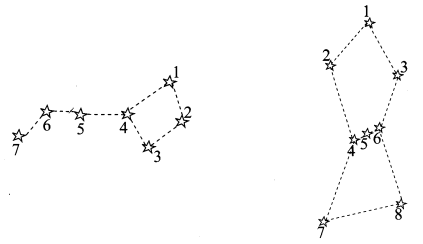
Que: Draw sketches to show the relative positions of prominent stars in
(a) Ursa Major and
(b) Orion
Ans:
(i) Ursa Major
(ii) Orion
Que: Name two objects other than planets which are members of the solar system.
Ans: Comets and asteroids.
Que: Explain how you can locate the Pole Star with the help of Ursa Major.
Ans: Pole star can be located with the help of two stars at the end of Ursa Major. Imagine a straight line passing through these stars. Extend the imaginary line in North direction. This line is about five times the distance between two stars. A star is seen in this direction which is called Pole star.
Que: Do all the stars in the sky move? Explain.
Ans: No, all the stars do not move in the sky. Due to the rotation of the Earth on its own axis stars seem to move in the sky.
Que: Why is the distance between stars expressed in light years? What do you understand by the statement that a star is eight light years away from the Earth?
Ans: The stars are very far away from the Earth and it is not convenient to express such distances in kilo¬metres. Thus, such large distances are expressed in unit known as light year.
If we say that a star is eight light years away from Earth, it means that the light from star will reach the Earth in eight years.
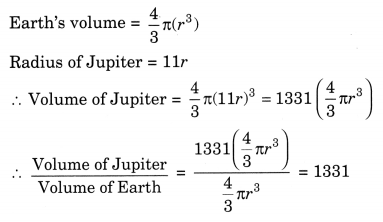
Que: The radius of Jupiter is 11 times the radius of the Earth. Calculate the ratio of the volumes of Jupiter and the Earth. How many Earths can Jupiter accomodate?
Ans: Let the radius of Earth be r units.
Que: Boojho made the following sketch (Fig. 17.6) of the solar system. Is the sketch correct or not, correct it.
Ans: No, the sketch made by Boojho is not correct. The correct sketch is given below:
17. Stars And The Solar System
Additional Questions With Solutions
Additional Questions With Solutions
Que: What are celestial object?
Ans: The stars, the planets, the moon and many other objects in the sky are called celestial objects.
Que: Why the village skylooks clear from the night sky inbig cities?
Ans: In big cities is rarely clear due to bright light, smoke and dust, sky. There are no bright lights in the village sky and the atmosphere is clear.
Que: Define full moon day.
Ans: The day on which the whole disc of the moon is visible is known as the full moon day.
Que: What are phages of the moon?
Ans: The various shapes of the bright part of the moon as seen during a month are called phases of the moon.
Que: What is the new moon day?
Ans: On the fifteenth day the moon is not visible. This day is known as the new moon day.
Que: What is the crescent moon?
Ans: The next day of the new moon day, only a small portion of the moon appears in the sky. This is known as the crescent moon.
Que: The moon has not it own light as stars but how do we able to see the moon?
Ans: We see the moon because the sunlight falling on it gets reflected towards us.
Que: Why is the life not possible on the moon?
Ans: The moon has no useful substances for living like atmosphere and it has no water.
Que: Define Light year?
Ans: The distance travelled by light in one year known as light year.
Que: What is a constellation?
Ans: The stars forming a group that has a recognisable shape is called a constellation.
Que: Write the situation of pole stare.
Ans: The Pole star lies close to the axis of rotation of the Earth.
Que: When can you see the Great bear constellation or Saptarishi Tara Mandal?
Ans: We can see Great bear constellation or Saptarishi Tara Mandal during the summer time in the early part of the night.
Que: Which constellation moves around the pole star?
Ans: Ursa Major Or Great Bear.
Que: When can the Orion see in the sky?
Ans: Orion is another well-known constellation that can be seen during winter in the late evenings
Que: What is satellite?
Ans: A body revolving around another body is called a satellite.
Que : Write the type of satellites.
Ans: There are two type of satellites.
1. Natural satellite – The moon
2. Artificial Satelite – Aryabhatt, INSAT, IRS and KalpanAns : I etc.
Que: Name the first natural satellite of India.
Ans: Aryabhatta.
Que: Differentiate between natural and artificial satellite.
Ans:
| Natural Satellite |
Artificial Satellite |
|
|
Que: Define orbit?
Ans: A planet has a definite path in which it revolves around the Sun. This path is called an orbit.
Que: Write the use of artificial satellites.
Ans:
1. They are used for forecasting weather, transmitting television and radio signals.
2. They are also used for telecommunication and remote sensing.
Que: Explain Period of revolution.
Ans: The time taken by a planet to complete one revolution is called its period of revolution.
Que: What is revolution?
Ans: The movement of planets around the sun on their orbit is called revolution.
Que: What is rotation?
Ans: The planets move on their own axis like top, Such movement s known as rotation.
17. Stars And The Solar System
Additional Questions With Solutions
Additional - Question:
Que: Which planet is the nearest to the sun?
Ans: Mercury.
Que: which planet of solar system is smallest.
Ans: mercury.
Que: Which planet is known as morning star?
Ans: Venus.
Que: Which planet is nearest to the earth?
Ans: Mars.
Que: On which planet of solar system life exist?
Ans: Earth.
Que: Which factors are responsible for the existence and continuation of life on the Earth.
Ans: these are followings
1. the right distance from the Sun.
2. it has the right temperature range.
3. the presence of water and suitable atmosphere.
4. A blanket of ozone.
Que: Why does the Earth look blue and green in appearance from sky?
Ans: From space, the Earth appears bluegreen due to the reflection of light from water and landmass on its surface.
Que: What is responsible for the change of seasons on the Earth?
Ans: The tilt is responsible for the change of seasons on the Earth. As the axis of rotation of the Earth is not perpendicular to the plane of its orbit.
Que: Which planet is known as red planet?
Ans: Mars.
Que: Why is Mars called red planet?
Ans: Mars appears slightly reddish and, therefore, it is also called the red planet.
Que: How many satelites does Mars have?
Ans: Mars has two small natural satellites.
Que: Name the largest planet of the solar system?
Ans: Jupiter.
Que: Why is the Saturn called a unique planet of the solar system.
Ans: It has a beautiful ring which rotate apposite to its rotation. This makes it a unique planet of the solar system.
Que: What are asteroids?
Ans: There is a large gap in between the orbits of Mars and Jupiter. This gap is occupied by a large number of small objects that revolve around the Sun. These are called asteroids.
Que: What are comets?
Ans: Comets are also members of our solar system. They revolve around the Sun in highly elliptical orbits. A Comet appears generally as a bright head with a long tail.
Que: What are meteors?
Ans: However we may see a bright streaks of light falling in the sky. These are commonly known as shooting stars, although they are not stars. They are called meteors.
Que: Define light year?
Ans: The distance covered by the light in one years is called light year.

Science
Class 8 (English Medium)
NCERT Science Textbook
Chapter-wise NCERT Solutions for Class 6 to 12 prepared according to the latest CBSE syllabus.
English Medium
NCERT Solutions Class 8 Science
Chapter 1. Crop Production And Management Solutions
1. Crop Production And Management Open Chapters
Explore Now →
NCERT Solutions Class 8 Science
Chapter 2. Microorganisms : Friend And Foe Solutions
2. Microorganisms : Friend And Foe Open Chapters
Explore Now →
NCERT Solutions Class 8 Science
Chapter 3. Synthetic Fibres And Plastics Solutions
3. Synthetic Fibres And Plastics Open Chapters
Explore Now →
NCERT Solutions Class 8 Science
Chapter 4. Materials : Metals And Non-Metals Solutions
4. Materials : Metals And Non-Metals Open Chapters
Explore Now →
NCERT Solutions Class 8 Science
Chapter 5. Coal And Petroleum Solutions
5. Coal And Petroleum Open Chapters
Explore Now →
NCERT Solutions Class 8 Science
Chapter 6. Combustion And Flame Solutions
6. Combustion And Flame Open Chapters
Explore Now →
NCERT Solutions Class 8 Science
Chapter 7. Conservation of Plants And Animals Solutions
7. Conservation of Plants And Animals Open Chapters
Explore Now →
NCERT Solutions Class 8 Science
Chapter 8. Cell-Structure and functions Solutions
8. Cell-Structure and functions Open Chapters
Explore Now →
NCERT Solutions Class 8 Science
Chapter 9. Reproduction in animals Solutions
9. Reproduction in animals Open Chapters
Explore Now →
NCERT Solutions Class 8 Science
Chapter 10. Reaching the age of adolescence Solutions
10. Reaching the age of adolescence Open Chapters
Explore Now →
NCERT Solutions Class 8 Science
Chapter 11. Force And Pressure Solutions
11. Force And Pressure Open Chapters
Explore Now →
NCERT Solutions Class 8 Science
Chapter 12. Friction Solutions
12. Friction Open Chapters
Explore Now →
NCERT Solutions Class 8 Science
Chapter 14. Chemical Effects of Electric Current Solutions
14. Chemical Effects of Electric Current Open Chapters
Explore Now →
NCERT Solutions Class 8 Science
Chapter 15. Some Natural Phenomena Solutions
15. Some Natural Phenomena Open Chapters
Explore Now →
NCERT Solutions Class 8 Science
Chapter 17. Stars And The Solar System Solutions
17. Stars And The Solar System Open Chapters
Explore Now →
NCERT Solutions Class 8 Science
Chapter 18. Pollution of Air and Water Solutions
18. Pollution of Air and Water Open Chapters
Explore Now →
Class 8 NCERT Book Solutions
Chapter-wise NCERT Solutions for Class 6 to 12 prepared according to the latest CBSE syllabus.
ENGLISH MEDIUM
NCERT Solutions Class 8 Its So Happened (English)
Class 8 Its So Happened (English) Book Solutions
Open Book
Explore Now →
NCERT Solutions Class 8 Honey Dew (English)
Class 8 Honey Dew (English) Book Solutions
Open Book
Explore Now →
NCERT Solutions Class 8 HoneyDew (English Poem)
Class 8 HoneyDew (English Poem) Book Solutions
Open Book
Explore Now →Benefits of Studying NCERT Solutions
Studying from NCERT Solutions helps students build strong conceptual understanding and improve problem-solving skills. These solutions are especially useful for revision because every answer is written according to the marking scheme followed by CBSE.
- Improve conceptual understanding.
- Learn correct answer-writing techniques.
- Prepare effectively for school examinations.
- Complete syllabus revision in less time.
- Practice important textbook questions.
- Build confidence before examinations.
Prepared According to the Latest CBSE Syllabus
All NCERT Book Solutions for Class 8 available on ATP Education are updated according to the latest CBSE curriculum. Whenever NCERT introduces changes in textbooks or syllabus, our study materials are revised accordingly so that students always receive accurate and updated content.
Helpful for Competitive Examinations
NCERT textbooks form the foundation of many competitive examinations. Students preparing for Olympiads, NTSE, CUET, UPSC Foundation, SSC and several entrance examinations can strengthen their basics through these chapter-wise solutions. Understanding NCERT concepts also improves analytical thinking and logical reasoning.
Simple and Student-Friendly Explanations
Our experts prepare every answer in a simple, clear and student-friendly format. Difficult concepts are explained step by step with proper reasoning so that students of every learning level can understand them easily. This approach helps students remember concepts for a longer period and perform confidently during examinations.
Start Learning with ATP Education
Explore the complete collection of NCERT Solutions for Class 8 and begin your preparation with confidence. Every chapter is available online for free and can be accessed anytime. Whether you want to complete homework, revise important chapters or prepare for examinations, ATP Education provides reliable and high-quality study resources to help you achieve academic success.
Explore Subjects



Why Students Choose Us
Free Study Materials
Get completely free NCERT solutions, notes and board preparation resources.
Updated Notes
Latest CBSE and NCERT syllabus based notes for all major classes.
Practice Tests
Improve performance with chapter-wise MCQ tests and quizzes.
Trending Study Materials
2M+
Monthly Students
50K+
Study Notes
10K+
MCQ Questions
500+
Mock Tests