
NCERT Solutions for Class 8 – Complete Chapter-wise Study Material
16. Light is one of the most important chapters in the Class 8 Science English NCERT Solutions curriculum. This chapter plays a significant role in helping students build a strong conceptual foundation while preparing for school examinations, class tests, unit tests, half-yearly examinations, annual examinations, and CBSE board assessments. The chapter has been carefully designed according to the latest NCERT syllabus, making it an essential part of every student's study plan.
The 16. Light - Class 8 Science English NCERT Solutions available on ATP Education explain every question in a simple, accurate, and step-by-step manner. Each answer is prepared according to the latest CBSE guidelines so that students can understand the concepts clearly without confusion. Whether you are completing your homework, revising before examinations, or strengthening your understanding of the subject, these solutions provide reliable academic support throughout your learning journey.
One of the biggest advantages of studying 16. Light is that it helps students understand important concepts, definitions, examples, and textbook exercises in an organized way. Instead of memorizing answers, students learn how to develop logical thinking, improve analytical skills, and write well-structured answers in examinations. This chapter also helps improve problem-solving ability and encourages conceptual learning, which is essential for scoring higher marks in school and competitive examinations.
Our Class 8 Science NCERT Solutions cover all textbook questions, important exercise questions, and chapter-wise explanations in English Medium. Every solution is written in easy-to-understand language, allowing students to revise the chapter quickly before examinations. Regular practice of these solutions improves confidence, strengthens subject knowledge, and reduces examination stress.
Students preparing for school assessments should carefully study 16. Light because questions from this chapter are frequently asked in objective questions, short answer questions, long answer questions, competency-based questions, and case-study questions. Understanding the concepts explained in this chapter also helps students connect related topics from other chapters, making overall learning more effective and meaningful.
At ATP Education, we continuously update our Class 8 Science English NCERT Solutions according to the latest NCERT textbooks and CBSE curriculum. Students can confidently use these chapter-wise solutions for daily study, homework assistance, quick revision, examination preparation, and self-learning. By studying 16. Light thoroughly and practising every question regularly, students can strengthen their concepts, improve writing skills, and achieve better academic performance in both school and board examinations.
16. Light - Class 8 Science English NCERT Solutions
16. Light
Chapter Review
Chapter Review:
- Light is reflected from all surfaces.
- The light ray, which strikes any surface, is called the incident ray.
- The ray that comes back from the surface after reflection is known as the reflected ray.
- Reflection from a smooth surface like that of a mirror is called regular reflection.
- When all parallel rays reflected from a plane surface are not parallel, the reflection is known as diffused or irregular reflection.
- The angle between the normal and incident ray is called the angle of incidence (∠i).
- The angle between the normal and the reflected ray is known as the angle of reflection (∠r).
- The incident ray, the normal at the point of incidence and the reflected ray all lie in the same plane.
- The angle of incidence is always equal to the angle of reflection. This is known as the law of reflection.
- An image formed by a mirror the left of the object
appears on the right and the right appears on the left. This is known as lateral inversion. - The objects which shine in the light of other objects are called illuminated objects.
- The objects which emit their own light are known as luminous objects.
- Splitting of light into its colours is known as dispersion of light.
- Outer coat of the eye is white. Its transparent front part is called cornea.
- Behind the cornea a dark muscular structure called iris.
- The size of the pupil is controlled by the iris.
- The lens focuses light on the back of the eye, on a layer called retina.
- At the junction of the optic nerve and the retina, there are no sensory cells, so no vision is possible at that spot. This is called the blind spot.
- A normal eye can see nearby and distant objects clearly.
- The most popular resource for visually challenged persons is known as Braille.
- Sunlight, called white light but consists of seven
colours.
16. Light
Text Book Exercise
Exercise - Question:
Que: Suppose you are in a dark room. Can you see objects in the room? Can you see objects outside the room. Explain.
Ans: When we are in a dark room then we cannot see objects in the room. We can see the objects outside the room, because out of the room the light is available and the rays of light can enter our eyes after reflection from the objects.
Que: Differentiate between regular and diffused reflection. Does diffused reflection mean the failure of the laws of reflection?
Ans:
| Regular Reflection | Diffused Reflection |
| (i) All the reflected rays are parallel. | (i) The reflected rays are not parallel. |
| (ii) It occurs on a smooth and polished surface. | (ii) It occurs on the rough surface. |
| (iii) Reflected rays are in one direction. | (iii) Reflected rays are scattered in different directions. |
No, diffuse reflection doesn’t mean the failure of laws of reflection.
Que: Mention against each of the following whether regular or diffused reflection will take place when a beam of light strikes. Justify your answer in each case.
(a) Polished wooden table
(b) Chalk powder
(c) Cardboard surface
(d) Marble floor with water spread over it
(e) Mirror
(f) Piece of paper
Ans:
1. Regular reflection will take place because the surface is plane and polished.
2. Diffused reflection will take place because the surface is rough.
3. Diffused reflection will take place because the surface is rough.
4. Regular reflection will take place because the surface is smooth and plane.
5. Regular reflection will take place because the surface is plane and polished.
6. Diffused reflection will take place because the surface is rough.
Que: State the laws of reflection.
Ans: The laws of reflections are:
- The incident ray, the normal and the reflected ray, all lie in the same plane.
- The angle of incidence is equal to the angle of reflection.
Que: Describe an activity to show that the incident ray, the reflected ray and the normal at the point of incidence lie in the same plane.
Ans: Activity: To show that the incident ray, reflected ray and the normal at the point of incidence lie in the same plane.
Materials Required: Plane mirror, holder, ray box, etc.
Procedure: Fix sheet of white paper, a little beyond the edge of the board. Place a plane mirror strip vertically to the paper using a stand. Throw light from a ray box on the mirror. Look at the reflected ray. Mark the incident ray, normal ray and reflected ray. Fold the paper which is beyond the edge of the board. You will observe that the reflected ray is not seen in the folded portion of the chart paper. Now bring the folded portion back to its original position. The reflected ray of light is again seen on the page Conclusion: The sheet on the board can be considered as a plane. The incident ray, the reflected ray, the normal at the point of incidence lie in the same plane.
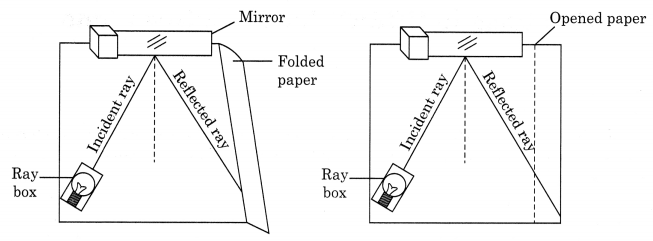
Incident ray, reflected ray and normal at the point of incidence lie in the same plane.
Que: Fill in the blanks in the following:
(a) A person 1 m in front of a plane mirror seems to be _______________ m from his image.
(b) If you touch your ____________ ear with right hand in front of a plane mirror it will be seen in the mirror that your right ear is touched with ____________
(c) The size of the pupil becomes ____________ when you see in dim light.
(d) Night birds have ____________ cones than rods in their eyes.
Ans:
(a) 2
(b) left, left hand
(c) larger
(d) lesser
16. Light
Text Book Exercise
Exercise - Question:
Choose the correct option in Questions 7 – 8 7.
Que: Angle of incidence is equal to the angle of reflection
(a) Always
(b) Sometimes
(c) Under special conditions
(d) Never
Ans: (a) Always|
Que: Image formed by a plane mirror is
(a) virtual, behind the mirror and enlarged
(b) virtual, behind the mirror and of the same size as the object
(c) real at the surface of the mirror and enlarged
(d) real, behind the mirror and of the same size as the object.
Ans: (b) virtual, behind the mirror and of the same size as the object|
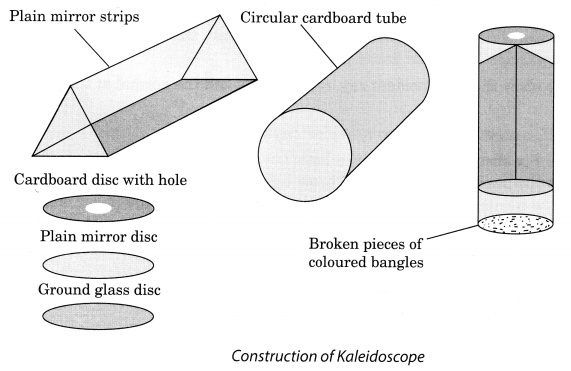
Que: Describe the construction of a kaleidoscope.
Ans: Kaleidoscope is a device based on the principle of multiple reflections. It consists of three long and narrow strips of plane mirrors inclined at an angle of 60° to one another forming prism. This is fitted in a tube. One end of this tube is closed by a cardboard disc having a hole at its centre. To the other end touching the mirrors plane glass plate is fixed on which broken pieces of coloured bangles are placed. This end of the tube is closed by a ground glass plate.
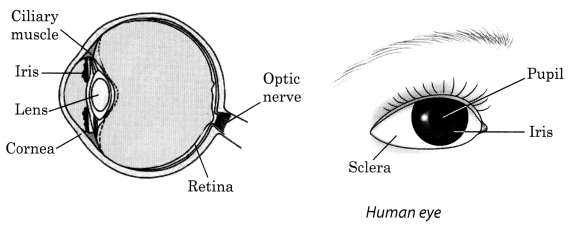
Que: Draw a labeled sketch of the human eye.
Ans:
Que: Gurmit wanted to perform Activity 16.8 using a laser torch. Her teacher advised her not to do so. Can you explain the basis of the teachers advise?
Ans: Teacher has advised Gurmit not to do so because laser light is very harmful for her eyes and can cause a permanent defect in the eye. Person can even lose his or her eyesight if laser torch is directed over the eyes.
Que: Explain how you can take care of your eyes.
Ans: Eyes are very precious. We must take proper care of them. We must
- always sit straight while reading or writing.
- if advised, use suitable spectacles.
- wash our eyes with clean water frequently.
- not look at the sun directly.
- always read or write in a proper light.
Que: What is the angle of incidence of a ray if the reflected ray is at an angle of 90° to the incident ray?
Ans: Here, the angle of reflection is 90°. As we know, according to the laws of reflection that angle of incidence is equal to angle of reflection.
Here, the angle between the incident ray and reflected ray is 90°.
i.e., ∠i + ∠r = 90°
Since, ∠i = ∠r
We can write, ∠i + ∠i = 90°
⇒ 2∠i = 90°
⇒ ∠i = 45°
Angle of incidence = 45°.
Que: How many images of a candle will be formed if it is placed between two parallel plane mirrors separated by 40 cm?
Ans: Here, mirrors are placed parallel to each other 40 cm apart. Therefore, the infinite number of images will be formed.
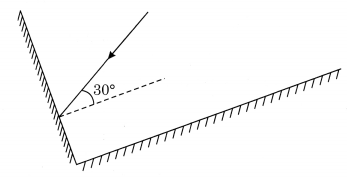
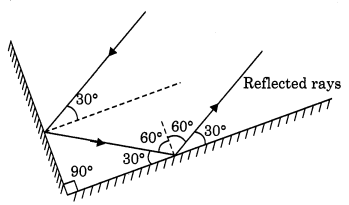
Que: Two mirrors meet at right angles. A ray of light is incident on one at an angle of 30° as shown in Fig. 16.19. Draw the reflected ray from the second mirror.
Ans:
Que: Fig. 16.19 16. Boojho stands at A just on the side of a plane mirror as shown in Fig. 16.20. Can he see himself in the mirror? Also can he see the image of objects situated at P, Q and R? Fig. 16.20
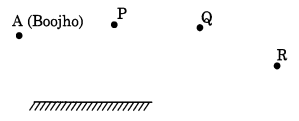
Ans: No, Boojho can’t see himself in the mirror. He can see the image of the object at P and Q but not of R.
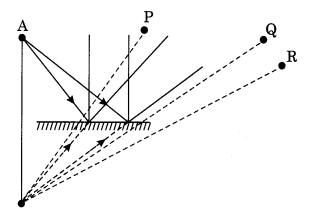
Que: (a) Find out the position of the image of an object situated at A in the plane mirror (Fig. 16.21).
(b) Can Paheli at B see this image?
(c) Can Boojho at C see this image?
(d) When Paheli moves from B to C, where does the image of A move.
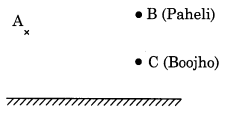
Ans: (a) It is shown in the following figure.
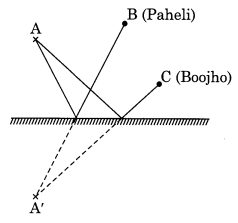
(b) Yes, Paheli can see the image of A.
(c) Yes, Boojho can see the image of A.
(d) Image of the object at A will not move as an object is not moving.
16. Light
Additional Questions With Solutions
Additional Questions And Answer:
Ques: What is incident ray?
Ans: The light ray, which strikes any surface, is called the incident ray.
Ques: What is reflected ray?
Ans: The ray that comes back from the surface after reflection is known as the reflected ray.

Ques: Write the law of reflection.
Ans:
(i) Angle of incidence is always equal to the angle of reflection.
(ii) The incidence ray, the normal at the point of incidence and the reflected ray all lie in the same plane.
Ques: What is diffused or irregular reflection?
Ans: When all parallel rays reflected from a plane surface are not parallel, the reflection is known as diffused or irregular reflection.
Ques: What is regular reflection?
Ans: Reflection from a smooth surface like that of a mirror is called regular reflection.
Ques: What is called the phenomenon, in an image formed by a mirror the left of the object appears on the right and the right appears on the left?
Ans: This phenomenon is called lateral inversion.
Ques: Write the use of Periscopes.
Ans: Periscopes are used in submarines, tanks and also by soldiers in bunkers to see things outside.
Ques: What is Kaleidoscope? Write its one use.
Ans: Kaleidoscope is an idea or a device that is made to combine the mirrors at an angle to one another to get number of images. It is used to make numerous beautiful patterns.
Ques: Write the nature of image of plane mirror.
Ans: The nature of image of plane mirror is real, behind the mirror and equal to object.
Ques: What is the angle of incidence of a ray if the reflected ray is at an angle of 90° to the incident ray?
Ans: 45o
.Sol : AOB = 90o
While
∠AOB = 90o
⇒ ∠i + ∠r = 90o
⇒∠i + ∠i = 90o (∠i = ∠r)
⇒2∠i = 90o
⇒∠i = 90o/2
⇒∠i = 45o
Ques: what is the colour of sun light?
Ans: White
Ques: What is dispersion of light?
Ans: Splitting of light into its colours is known as dispersion of light.
Ques: How does white sunlight look while passing through prism?
Ans: It looks like seven colour of rainbow.
Ques: Name a natural phenomenon to show the splitting of light.
Ans: Formation of rainbow.
Ques:What is retina? Write its function?
Ans: The lens focuses light on the back of the eye, on a layer called retina.
Function of retina;
(i) Images are formed on retina.
16. Light
Additional Questions With Solutions
Additional Questions And Answers
Ques: What is cornia?
Ans: Outer coat of the eye is white. Its transparent front part is called cornea.
Ques: What is iris? Write the function of iris?
Ans: Behind the cornea, we find a dark muscular structure called iris.
Function;
(i) The iris controls the size of the pupil.
Ques: Give regions;
(i) The outer most covering of eyes are white and hard.
Ans: As it can prevent the inner most part of eyes by accidents.
Ques: Differentiate between regular and diffused reflection. Does diffused reflection mean the failure of the laws of reflection?
Ans:
|
Irregular reflection |
Regular reflection |
|
|
No, diffused reflection is not due to the failure of the laws of reflection
Ques: Fill in the blanks in the following :
(i) A person 1 m in front of a plane mirror seems to be __1__________ m from his image.
(i) If you touch your ____________ ear with right hand in front of a plane mirror it will be seen in the mirror that your right ear is touched with ____________ .
(iii) The size of the pupil becomes ____________ when you see in dim light.
(iv) Night birds have ____________ cones than rods in their eyes..
Que: Draw a labeled sketch of the human eye.
Ans:

Ques: What is blind spot?
Ans: At the junction of the optic nerve and the retina, there are no sensory cells, so no vision is possible at that spot. This is called the blind spot.
Ques: write kinds of optic nerves.
Ans: There are two kinds of nerve cells
(i) Cones, which are sensitive to bright light.
(ii) Rods, which are sensitive to dim light.

Science
Class 8 (English Medium)
NCERT Science Textbook
Chapter-wise NCERT Solutions for Class 6 to 12 prepared according to the latest CBSE syllabus.
English Medium
NCERT Solutions Class 8 Science
Chapter 1. Crop Production And Management Solutions
1. Crop Production And Management Open Chapters
Explore Now →
NCERT Solutions Class 8 Science
Chapter 2. Microorganisms : Friend And Foe Solutions
2. Microorganisms : Friend And Foe Open Chapters
Explore Now →
NCERT Solutions Class 8 Science
Chapter 3. Synthetic Fibres And Plastics Solutions
3. Synthetic Fibres And Plastics Open Chapters
Explore Now →
NCERT Solutions Class 8 Science
Chapter 4. Materials : Metals And Non-Metals Solutions
4. Materials : Metals And Non-Metals Open Chapters
Explore Now →
NCERT Solutions Class 8 Science
Chapter 5. Coal And Petroleum Solutions
5. Coal And Petroleum Open Chapters
Explore Now →
NCERT Solutions Class 8 Science
Chapter 6. Combustion And Flame Solutions
6. Combustion And Flame Open Chapters
Explore Now →
NCERT Solutions Class 8 Science
Chapter 7. Conservation of Plants And Animals Solutions
7. Conservation of Plants And Animals Open Chapters
Explore Now →
NCERT Solutions Class 8 Science
Chapter 8. Cell-Structure and functions Solutions
8. Cell-Structure and functions Open Chapters
Explore Now →
NCERT Solutions Class 8 Science
Chapter 9. Reproduction in animals Solutions
9. Reproduction in animals Open Chapters
Explore Now →
NCERT Solutions Class 8 Science
Chapter 10. Reaching the age of adolescence Solutions
10. Reaching the age of adolescence Open Chapters
Explore Now →
NCERT Solutions Class 8 Science
Chapter 11. Force And Pressure Solutions
11. Force And Pressure Open Chapters
Explore Now →
NCERT Solutions Class 8 Science
Chapter 12. Friction Solutions
12. Friction Open Chapters
Explore Now →
NCERT Solutions Class 8 Science
Chapter 14. Chemical Effects of Electric Current Solutions
14. Chemical Effects of Electric Current Open Chapters
Explore Now →
NCERT Solutions Class 8 Science
Chapter 15. Some Natural Phenomena Solutions
15. Some Natural Phenomena Open Chapters
Explore Now →
NCERT Solutions Class 8 Science
Chapter 17. Stars And The Solar System Solutions
17. Stars And The Solar System Open Chapters
Explore Now →
NCERT Solutions Class 8 Science
Chapter 18. Pollution of Air and Water Solutions
18. Pollution of Air and Water Open Chapters
Explore Now →
Class 8 NCERT Book Solutions
Chapter-wise NCERT Solutions for Class 6 to 12 prepared according to the latest CBSE syllabus.
ENGLISH MEDIUM
NCERT Solutions Class 8 Its So Happened (English)
Class 8 Its So Happened (English) Book Solutions
Open Book
Explore Now →
NCERT Solutions Class 8 Honey Dew (English)
Class 8 Honey Dew (English) Book Solutions
Open Book
Explore Now →
NCERT Solutions Class 8 HoneyDew (English Poem)
Class 8 HoneyDew (English Poem) Book Solutions
Open Book
Explore Now →Benefits of Studying NCERT Solutions
Studying from NCERT Solutions helps students build strong conceptual understanding and improve problem-solving skills. These solutions are especially useful for revision because every answer is written according to the marking scheme followed by CBSE.
- Improve conceptual understanding.
- Learn correct answer-writing techniques.
- Prepare effectively for school examinations.
- Complete syllabus revision in less time.
- Practice important textbook questions.
- Build confidence before examinations.
Prepared According to the Latest CBSE Syllabus
All NCERT Book Solutions for Class 8 available on ATP Education are updated according to the latest CBSE curriculum. Whenever NCERT introduces changes in textbooks or syllabus, our study materials are revised accordingly so that students always receive accurate and updated content.
Helpful for Competitive Examinations
NCERT textbooks form the foundation of many competitive examinations. Students preparing for Olympiads, NTSE, CUET, UPSC Foundation, SSC and several entrance examinations can strengthen their basics through these chapter-wise solutions. Understanding NCERT concepts also improves analytical thinking and logical reasoning.
Simple and Student-Friendly Explanations
Our experts prepare every answer in a simple, clear and student-friendly format. Difficult concepts are explained step by step with proper reasoning so that students of every learning level can understand them easily. This approach helps students remember concepts for a longer period and perform confidently during examinations.
Start Learning with ATP Education
Explore the complete collection of NCERT Solutions for Class 8 and begin your preparation with confidence. Every chapter is available online for free and can be accessed anytime. Whether you want to complete homework, revise important chapters or prepare for examinations, ATP Education provides reliable and high-quality study resources to help you achieve academic success.
Explore Subjects





Why Students Choose Us
Free Study Materials
Get completely free NCERT solutions, notes and board preparation resources.
Updated Notes
Latest CBSE and NCERT syllabus based notes for all major classes.
Practice Tests
Improve performance with chapter-wise MCQ tests and quizzes.
Trending Study Materials
2M+
Monthly Students
50K+
Study Notes
10K+
MCQ Questions
500+
Mock Tests