NCERT Solutions for Class 6 – Complete Chapter-wise Study Material
Chapter 5. What Books And Burials Tell Us is one of the most important chapters in the Class 6 History English NCERT Solutions curriculum. This chapter plays a significant role in helping students build a strong conceptual foundation while preparing for school examinations, class tests, unit tests, half-yearly examinations, annual examinations, and CBSE board assessments. The chapter has been carefully designed according to the latest NCERT syllabus, making it an essential part of every student's study plan.
The Chapter 5. What Books And Burials Tell Us - Class 6 History English NCERT Solutions available on ATP Education explain every question in a simple, accurate, and step-by-step manner. Each answer is prepared according to the latest CBSE guidelines so that students can understand the concepts clearly without confusion. Whether you are completing your homework, revising before examinations, or strengthening your understanding of the subject, these solutions provide reliable academic support throughout your learning journey.
One of the biggest advantages of studying Chapter 5. What Books And Burials Tell Us is that it helps students understand important concepts, definitions, examples, and textbook exercises in an organized way. Instead of memorizing answers, students learn how to develop logical thinking, improve analytical skills, and write well-structured answers in examinations. This chapter also helps improve problem-solving ability and encourages conceptual learning, which is essential for scoring higher marks in school and competitive examinations.
Our Class 6 History NCERT Solutions cover all textbook questions, important exercise questions, and chapter-wise explanations in English Medium. Every solution is written in easy-to-understand language, allowing students to revise the chapter quickly before examinations. Regular practice of these solutions improves confidence, strengthens subject knowledge, and reduces examination stress.
Students preparing for school assessments should carefully study Chapter 5. What Books And Burials Tell Us because questions from this chapter are frequently asked in objective questions, short answer questions, long answer questions, competency-based questions, and case-study questions. Understanding the concepts explained in this chapter also helps students connect related topics from other chapters, making overall learning more effective and meaningful.
At ATP Education, we continuously update our Class 6 History English NCERT Solutions according to the latest NCERT textbooks and CBSE curriculum. Students can confidently use these chapter-wise solutions for daily study, homework assistance, quick revision, examination preparation, and self-learning. By studying Chapter 5. What Books And Burials Tell Us thoroughly and practising every question regularly, students can strengthen their concepts, improve writing skills, and achieve better academic performance in both school and board examinations.
Chapter 5. What Books And Burials Tell Us - Class 6 History English NCERT Solutions
Chapter 5. What Books And Burials Tell Us
NCERT Exercise
Exercise - Question:
Que: Match the columns
'Sukta' Stone boulder
Chariots Sacrifice
'Yajna' Well-said
'Dasa' Used in battles
Megalith Slave
Ans:
| Column | | Column || |
| Sukta | Well-said |
| Chariots | Used in battels |
| Yajna | Sacrifice |
| Dasa | Slave |
| Megalith | Stone boulder |
Que: Complete the sentences:
(a) Slaves were used for ————————
(b) Megaliths are found in ————————
(c) Stone circles or boulders on the surface were used to ————————
(d) Port-holes were used for ————————
(e) People at Inamgaon ate ————————
Ans:
(a) Various kind of work.
(b) Deccan in the north, east kashmir.
(c) Cover the burial places.
(d) Entering the burial places.
(e) Fruits, cereals and meat.
Que: In what ways are the books we read today different from the Rigveda?
Ans: The books we read today are printed on paper. The Rigveda used to be written on bitch bark.
Que: What kind of evidence from burials do archaeologists use to find out whether there were social differences amongst those who were buried?
Ans: Archealogists have found burial places which help them to reconstruct the past and tell about the socity. At Brahmagiri, the archaeologists have found one skeleton buried with 33 gold beads, 2 stone beads, 4 copper bangles and one conch shell. Other skeletons have only few pots. There burials suggest that there were some difference in status amongst the people who buried. Some were rich, other poor, some cheifs other followers.
Que: In what ways do you think that the life of a raja was different from that of a dasa or dasi?
Ans: The rajas did not have capitals, palaces or armis, not did they collect taxes. Generally the sons did not atumatically succeed fathers as rajas.
There were people who did not perfrom sacrifices and people spoke different languages. Later the team came to mean dasa or slave. Slave were men and women captured in the war. They were treated as the property of the owners, who could make them do any work them do any work they wanted.
Que: What kind of evidence from burials do archaeologists use to find out whether there were social differences amongst those who were buried?
Ans: Sometimes, archaeologists find a circle of stone boulders or a single large stone standing on the ground. These are the only indications that there are burials beneath.
All these burials have some common features. Generally, the dead were buried with distinctive pots, which are called Black and Red Ware. Also found are tools and weapons of iron and sometimes, skeleton of horses, horse equipment and ornaments of stone and gold.
Several kinds of evidences from burials do archaeologists use to find out that there were social differences amongst those who were buried underneath the megaliths. They think that objects found with a skeleton probably belonged to the dead person. Sometimes more objects were found in one grave than in another. For instance in Brahmagiri, one skeleton was buried with 33 gold beads, 2 stone beads, 4 copper bangles and one conch shell. Other skeletons had only a few pots. Perhaps there were differences in status amongst the people who were buried. Perhaps some were rich, others poor, some chiefs, others followers.
Que: In what ways do you think that the life of a ‘raja’ was different from that of a ‘dasa’ or ‘dasi’?
Ans: In the society, ‘raja’ was one of the highest civil positions. ‘Rajas’ were the kings of the community, whereas the ‘dasas’/’dasis’ were the lowest position in society. The ‘dasas’/’dasis’ were slaves who were used for work. They were treated as the property of their owners. They were captured in war.
Que: Find out whether your school library has a collection of books on religion, and list the names of five books from this collection.
Ans: Do yourself with the help of your subject-teacher and school librarian. A sample set of five such books:
- The Mahabharata
- The Ramayana
- The Bible
- The Bhagwad Gita
- The Quran
Que: Write down a short poem or song that you have memorised. Did you hear or read the poem or song? How did you learn it by heart?
Ans:
Que: In the Rigveda, people were described in terms of the work they did and the languages they spoke. In the table below, JiR in the names of six people you know, choosing three men and three women. For each of them, mention the work they do and the language they speak. Would you like to add anything else to the description?
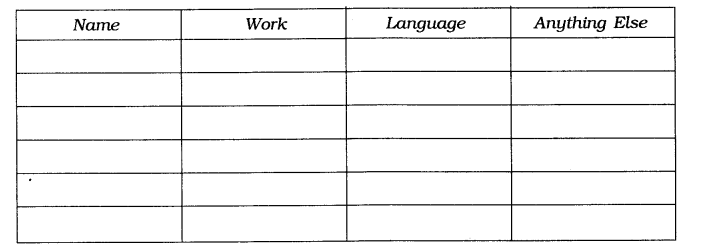 Ans: Do yourself.
Chapter 5. What Books And Burials Tell Us
Additional Questions
Additional - Queston:
Que: Name the four Vedas.
Ans: The four Vedas are:
- Rigveda
- Samaveda
- Yajurveda
- Atharvaveda ‘
Que: In what language has the Rigveda been composed?
Ans: The Rigveda is in Vedic Sanskrit.
Que: What were the various purposes of fighting battles as depicted by the Rigveda?
Ans: Battles were fought for cattle, land, water, and for capturing people.
Que:What were the groups of people in terms of their work?
Ans: There were two groups of people in terms of their work—the ‘brahmins’ and the ‘rajas’.
Que: Who were the ‘Aryas’ and the ‘Dasas’?
Ans: People who composed the hymns called themselves Aryans and they called their opponents ‘Dasas’.
Que: What were megaliths?
Ans: Stone boulders used to mark burial sites are known as megaliths.
Que: Name some areas where megaliths were prevalent.
Ans: Megaliths were prevalent in the Deccan, South India, in the North-east, and Kashmir.
Que: How is it known that burial spots were meant for families?
Ans: Sometimes megaliths contain more than one skeleton. This indicates that families were buried together.
Que: Where is Inamgaon situated?
Ans: Inamgaon is a site on the river Ghod, a tributary of the river Bhima.
Que: Write a short note on the Rigveda.
Ans: The Rigveda is the oldest of the Vedas. It indicates over a thousand hymns in Vedic (old) Sanskrit. These hymns (called ‘Sukta’ — well said) are in praise of various gods and goddesses, mainly: Agni, Indra and Soma. These hymns were composed by sages, who learned them and made their children learn. Finally, they were printed about 200 years ago.
Que: Describe in brief about how the Rigveda depicts cattle, horses, chariots, and battles.
Ans: Rigveda has prayers for cattle and horses. Horses were used in battles. Battles were fought for cattle, land, people and water. Most men took part in wars. There was not any regular army. There were assemblies where people met and discussed matters of war and peace. They chose brave warriors as their leaders.
Que: Write a short note on megaliths.
Ans: Megaliths are stone boulders used to mark burial sites. They were prevalent around 3000 years ago in the Deccan, South India, in the northeast and in Kashmir. Some megaliths are seen on the surface and some are underground. Sometimes a circle of stone boulders or a single large stone is found standing on the ground, to indicate the position of burials.
Que: How do megaliths show that there were social differences?
Ans: Sometimes, more objects are in found in one grave than in another. This indicates that people were buried according to their social status. In Brahmagiri, a skeleton was found with 33 gold beads, 2 stone beads, 4 copper bangles, and a conch shell. Whereas other skeletons have only few pots.
Que: How have people in society been depicted in the Rigveda?
Ans: According to the Rigveda, there are two groups of people in terms of their work: (i) The priests, called Brahmins, and (ii) The ‘rajas’.
The priests performed various vituals while the ‘rajas’ ruled. These rajas’ did not, however, have capital cities, palaces or armies, nor did they collect taxes. Two words were used to refer to the people of the community as a whole — those wo^ds were ‘jana’ and Vish’.
The people who composed the hymns referred to themselves using the word ‘Aryas’ and called their opponents ‘Dasas’ or ‘Dasyus’, The ‘dasas’ were later slaves and were treated as the property of their owners.

History
Class 6 (English Medium)
NCERT History Textbook
Chapter-wise NCERT Solutions for Class 6 to 12 prepared according to the latest CBSE syllabus.
English Medium
NCERT Solutions Class 6 History
Chapter Chapter 1. What, Where, How and When Solutions
Chapter 1. What, Where, How and When Open Chapters
Explore Now →
NCERT Solutions Class 6 History
Chapter Chapter 2. On The Trail Of The Earliest People Solutions
Chapter 2. On The Trail Of The Earliest People Open Chapters
Explore Now →
NCERT Solutions Class 6 History
Chapter Chapter 3. From Gathering To Growing Food Solutions
Chapter 3. From Gathering To Growing Food Open Chapters
Explore Now →
NCERT Solutions Class 6 History
Chapter Chapter 4. In The Earliest Cities Solutions
Chapter 4. In The Earliest Cities Open Chapters
Explore Now →
NCERT Solutions Class 6 History
Chapter Chapter 5. What Books And Burials Tell Us Solutions
Chapter 5. What Books And Burials Tell Us Open Chapters
Explore Now →
NCERT Solutions Class 6 History
Chapter Chapter 6. Kingdoms, Kings And An Early Republic Solutions
Chapter 6. Kingdoms, Kings And An Early Republic Open Chapters
Explore Now →
NCERT Solutions Class 6 History
Chapter Chapter 7. New Questions And Ideas Solutions
Chapter 7. New Questions And Ideas Open Chapters
Explore Now →
NCERT Solutions Class 6 History
Chapter Chapter 8. Ashoka, The Emperor Who Gave Up War Solutions
Chapter 8. Ashoka, The Emperor Who Gave Up War Open Chapters
Explore Now →
NCERT Solutions Class 6 History
Chapter Chapter 9. Vital Villages, Thriving Towns Solutions
Chapter 9. Vital Villages, Thriving Towns Open Chapters
Explore Now →
NCERT Solutions Class 6 History
Chapter Chapter 10. Traders, Kings And Pilgrims Solutions
Chapter 10. Traders, Kings And Pilgrims Open Chapters
Explore Now →
NCERT Solutions Class 6 History
Chapter Chapter 11. New Empires And Kingdoms Solutions
Chapter 11. New Empires And Kingdoms Open Chapters
Explore Now →
NCERT Solutions Class 6 History
Chapter Chapter 12. Buildings, Paintings And Books Solutions
Chapter 12. Buildings, Paintings And Books Open Chapters
Explore Now →
NCERT Solutions Class 6 History
Chapter Chapter 12 Building, painting and Books Solutions
Chapter 12 Building, painting and Books Open Chapters
Explore Now →
Class 6 NCERT Book Solutions
Chapter-wise NCERT Solutions for Class 6 to 12 prepared according to the latest CBSE syllabus.
ENGLISH MEDIUM
NCERT Solutions Class 6 Mathematics
Class 6 Mathematics Book Solutions
Mathematics Open Book
Explore Now →
NCERT Solutions Class 6 Science Curiosity
Class 6 Science Curiosity Book Solutions
Curiosity Open Book
Explore Now →Benefits of Studying NCERT Solutions
Studying from NCERT Solutions helps students build strong conceptual understanding and improve problem-solving skills. These solutions are especially useful for revision because every answer is written according to the marking scheme followed by CBSE.
- Improve conceptual understanding.
- Learn correct answer-writing techniques.
- Prepare effectively for school examinations.
- Complete syllabus revision in less time.
- Practice important textbook questions.
- Build confidence before examinations.
Prepared According to the Latest CBSE Syllabus
All NCERT Book Solutions for Class 6 available on ATP Education are updated according to the latest CBSE curriculum. Whenever NCERT introduces changes in textbooks or syllabus, our study materials are revised accordingly so that students always receive accurate and updated content.
Helpful for Competitive Examinations
NCERT textbooks form the foundation of many competitive examinations. Students preparing for Olympiads, NTSE, CUET, UPSC Foundation, SSC and several entrance examinations can strengthen their basics through these chapter-wise solutions. Understanding NCERT concepts also improves analytical thinking and logical reasoning.
Simple and Student-Friendly Explanations
Our experts prepare every answer in a simple, clear and student-friendly format. Difficult concepts are explained step by step with proper reasoning so that students of every learning level can understand them easily. This approach helps students remember concepts for a longer period and perform confidently during examinations.
Start Learning with ATP Education
Explore the complete collection of NCERT Solutions for Class 6 and begin your preparation with confidence. Every chapter is available online for free and can be accessed anytime. Whether you want to complete homework, revise important chapters or prepare for examinations, ATP Education provides reliable and high-quality study resources to help you achieve academic success.