
NCERT Solutions for Class 7 – Complete Chapter-wise Study Material
Chapter 9. Life in the Temperate Grasslands is one of the most important chapters in the Class 7 Geography English NCERT Solutions curriculum. This chapter plays a significant role in helping students build a strong conceptual foundation while preparing for school examinations, class tests, unit tests, half-yearly examinations, annual examinations, and CBSE board assessments. The chapter has been carefully designed according to the latest NCERT syllabus, making it an essential part of every student's study plan.
The Chapter 9. Life in the Temperate Grasslands - Class 7 Geography English NCERT Solutions available on ATP Education explain every question in a simple, accurate, and step-by-step manner. Each answer is prepared according to the latest CBSE guidelines so that students can understand the concepts clearly without confusion. Whether you are completing your homework, revising before examinations, or strengthening your understanding of the subject, these solutions provide reliable academic support throughout your learning journey.
One of the biggest advantages of studying Chapter 9. Life in the Temperate Grasslands is that it helps students understand important concepts, definitions, examples, and textbook exercises in an organized way. Instead of memorizing answers, students learn how to develop logical thinking, improve analytical skills, and write well-structured answers in examinations. This chapter also helps improve problem-solving ability and encourages conceptual learning, which is essential for scoring higher marks in school and competitive examinations.
Our Class 7 Geography NCERT Solutions cover all textbook questions, important exercise questions, and chapter-wise explanations in English Medium. Every solution is written in easy-to-understand language, allowing students to revise the chapter quickly before examinations. Regular practice of these solutions improves confidence, strengthens subject knowledge, and reduces examination stress.
Students preparing for school assessments should carefully study Chapter 9. Life in the Temperate Grasslands because questions from this chapter are frequently asked in objective questions, short answer questions, long answer questions, competency-based questions, and case-study questions. Understanding the concepts explained in this chapter also helps students connect related topics from other chapters, making overall learning more effective and meaningful.
At ATP Education, we continuously update our Class 7 Geography English NCERT Solutions according to the latest NCERT textbooks and CBSE curriculum. Students can confidently use these chapter-wise solutions for daily study, homework assistance, quick revision, examination preparation, and self-learning. By studying Chapter 9. Life in the Temperate Grasslands thoroughly and practising every question regularly, students can strengthen their concepts, improve writing skills, and achieve better academic performance in both school and board examinations.

Chapter 9. Life in the Temperate Grasslands - Class 7 Geography English NCERT Solutions
Chapter 9. Life in the Temperate Grasslands
NCERT Exercise
Exercise - Question:
Que: Answer the following questions.
(i) What are the Temperate Grasslands of North America called?
(ii) What are the cattle farms in the North American Grasslands known as?
(iii) Name the rivers that drain the Velds.
(iv) When is the rainy season in the Velds?
(v) What is the major occupation of the people of the South African grasslands?
Ans:
(i) Prairies.
(ii) Ranches.
(iii) (a) River Orange and (b) River Limpopo.
(iv) The velds receive rainfall mainly in summer months from November to Febraury.
(v) (a) Sheep rearing, (b) dairy farming and (iii) mining.
Que: Tick the correct answer.
(i) River Mississippi drains
(a) Canada
(b) Africa
(c) USA
(ii) Drakensberg Mountains are to the west of
(a) Prairies
(b) Velds
(c) Pampas
(iii) Merino is a species of
(a) fish
(b) elephant
(c) sheep
(iv) Kimberley is famous for
(a) diamonds
(b) silver
(c) platinum
Ans:
(i) - (c)
(ii) - (b)
(iii) - (c)
(iv) - (a)
Que: Match the following.
(i) Cowboys (a) Iron and Steel
(ii) Gold (b) Prairies
(iii) Kudu (c) Hot wind
(iv) Chinook (d) Velds
(v) Coal (e) Johannesberg
(f) Animal
Ans:
| Column I | Column II |
| (i) Cowboys | (b) Prariries |
| (ii) Gold | (e) Johannesberg |
| (iii) Kundu | (f) Animal |
| (iv) Chinook | (c) Hot wind |
| (v) Coal | (a) Iron and steal |
Que: Give reasons.
(i) The Prairies are known as the ‘Granaries of the World’.
(ii) Rise of wool industry in the Velds.
Ans:
(i) Due to the huge surprise of wheat production.
(ii) Good variety of sheeps (merino) is found here whose wool is very warm.
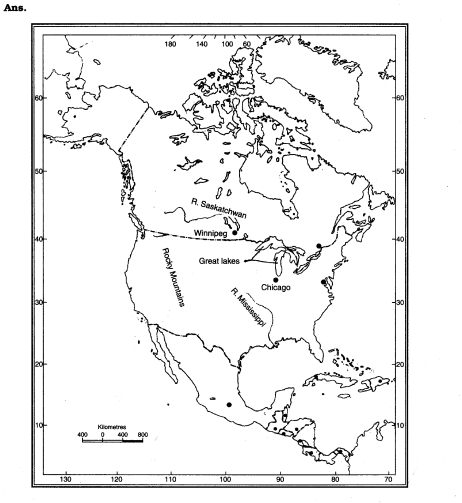
Que: Map skills:
On an outline map of North America, mark the Rocky mountains, the Great
Lakes, river Mississippi, river Saskatchewan, the cities – Chicago and Winnipeg.
Ans:
Chapter 9. Life in the Temperate Grasslands
Addtional Questions with Solutions
Additional - Question:
Que: Enumerate the major features of the prairies.
Ans: The major features of the prairies are:
- These are the temperate grasslands of North America.
- It is a region of flat, gently sloping or hilly land.
- Prairies are almost treeless for the most part, but near the low lying plains, flanking river valleys, woodlands can be found.
- The landscape is dominated by tall grass, upto two metres high. It looks like a ‘sea of grass’.
Que: Write a brief note on the climate of the prairies.
Ans: Prairies are located in the middle of the continent (North America). It is therefore, we find there a continental type of climate, characterised by extreme temperatures. The summers are warm with temperatures of around 20°C, while in winter-20°C has been recorded in Winnipeg and Canada, the important cities of the American prairies. In winters a think blanket of snow covers this region. The annual rainfall is moderate. A local wind called Chinook blows here.
Que: Write some effects of Chinook?
Ans: Chinook is a hot wind that blows in winter. Being hot it raises the temperature within a short time. This increase in temperature results in the melting of snow, making the pasturelands available for grazing of animals.
Que: Describe the climate of the velds.
Ans: The velds are under the influence of the Indian Ocean. Therefore they have a mild climate. Winters are cold and dry. Temperatures vary between 5°C and 10°C and July is the coldest month. Summers are short and warm Rainfall occurs in the summer months from November to February. Drought may occur if the rainfall is poor in the winter months from June to August.
Que: Describe the flora and fauna of the prairies.
Ans: Flora. Prairies don’t have many trees. A few trees such as willows, alders and poplars grow where water is available. Fertile soil is found in the places that receive rainfall of over 50 cm. The crops grown here are maize, potatoes, soyabean, cotton and alfa-alfa. In the areas receiving poor rainfall, short grasses can be found.
Fauna. Cattle rearing is suitable in these areas. Large cattle farms called ranches are found here. Bison or the American buffalo is the important animal of this region. Other animals are rabbits, coyotes, gophers and Prairie dog.
Que: Describe the flora and fauna of the velds.
Ans: Flora. Velds are not rich in vegetation. Grasses dominate the landscape. Red grass grows in bush velds. High velds are characterised by grasses like acacia and maroola.
Fauna. The animals found in the velds are lions, leopards, Cheetah, and Kudu.
Que: What are the major occupations of the people in the prairies? What factors contributed to the industrialisation of this region. [V. Imp.]
Ans: The people living in the praries are hardworking. Their main occupations are cultivations and dairy fanning. People use scientific methods in cultivation. They use tractors, harvesters and combines and produce surplus food. The prairies are known as the ‘Granaries of the world’ due to the huge surplus of wheat production.
Another main occupation of the people of the prairies is dairy farming. The daily belt extends from the Great Lakes to the Atlantic coast in the east. Daily farming and extensive agriculture both promote setting up of food processing industries. The factors that led to the industrialisation of this region are:
- Large mineral deposits such as coal and iron.
- A good network of roads, railways and canals.
Que: What various activities are performed by the people living in the velds?
Ans: Cattle rearing and mining are the two major activities of the people living in the velds. However, some people have engaged in agriculture also, though it is not the main occupation of this region. The soils are not very fertile in the velds. Where the land is fertile enough to grow crops, maize, wheat, barley, oats, and potato are cultivated. Cash crops like tobacco, sugercane, and cotton are also grown.
People of the velds are mostly engaged in sheep rearing. Sheep is bred mainly for wool and has given rise to the wool industry in the velds. Dairy farming is the next important occupation. Cattle are reared in warmer and wetter regions and dairy products such as butter, cheese is produced for both domestic supply and also for export.
As velds are very rich in mineral reserves, gold and diamond mining are also the chief occupations of the people of this region. Johannesburg is known for being the gold capital of the world. Kimberley is famous for its diamond mines.

Geography
Class 7 (English Medium)
NCERT Geography Textbook
Chapter-wise NCERT Solutions for Class 6 to 12 prepared according to the latest CBSE syllabus.
English Medium

NCERT Solutions Class 7 Geography
Chapter Chapter 1. Environment Solutions
Chapter 1. Environment Open Chapters
Explore Now →
NCERT Solutions Class 7 Geography
Chapter Chapter 2. Inside Our Earth Solutions
Chapter 2. Inside Our Earth Open Chapters
Explore Now →
NCERT Solutions Class 7 Geography
Chapter Chapter 3. Our Changing Earth Solutions
Chapter 3. Our Changing Earth Open Chapters
Explore Now →
NCERT Solutions Class 7 Geography
Chapter Chapter 4. Air Solutions
Chapter 4. Air Open Chapters
Explore Now →
NCERT Solutions Class 7 Geography
Chapter Chapter 5. Water Solutions
Chapter 5. Water Open Chapters
Explore Now →
NCERT Solutions Class 7 Geography
Chapter Chapter 6. Natural Vegetation and Wild Life Solutions
Chapter 6. Natural Vegetation and Wild Life Open Chapters
Explore Now →
NCERT Solutions Class 7 Geography
Chapter Chapter 7. Human environment Settlement Transport And Communication Solutions
Chapter 7. Human environment Settlement Transport And Communication Open Chapters
Explore Now →
NCERT Solutions Class 7 Geography
Chapter Chapter 8. Human Environment Interactions The Tropical and the Subtropical Region Solutions
Chapter 8. Human Environment Interactions The Tropical and the Subtropical Region Open Chapters
Explore Now →
NCERT Solutions Class 7 Geography
Chapter Chapter 9. Life in the Temperate Grasslands Solutions
Chapter 9. Life in the Temperate Grasslands Open Chapters
Explore Now →
NCERT Solutions Class 7 Geography
Chapter Chapter 10. Life in the deserts Solutions
Chapter 10. Life in the deserts Open Chapters
Explore Now →
Class 7 NCERT Book Solutions
Chapter-wise NCERT Solutions for Class 6 to 12 prepared according to the latest CBSE syllabus.
ENGLISH MEDIUM
Benefits of Studying NCERT Solutions
Studying from NCERT Solutions helps students build strong conceptual understanding and improve problem-solving skills. These solutions are especially useful for revision because every answer is written according to the marking scheme followed by CBSE.
- Improve conceptual understanding.
- Learn correct answer-writing techniques.
- Prepare effectively for school examinations.
- Complete syllabus revision in less time.
- Practice important textbook questions.
- Build confidence before examinations.
Prepared According to the Latest CBSE Syllabus
All NCERT Book Solutions for Class 7 available on ATP Education are updated according to the latest CBSE curriculum. Whenever NCERT introduces changes in textbooks or syllabus, our study materials are revised accordingly so that students always receive accurate and updated content.
Helpful for Competitive Examinations
NCERT textbooks form the foundation of many competitive examinations. Students preparing for Olympiads, NTSE, CUET, UPSC Foundation, SSC and several entrance examinations can strengthen their basics through these chapter-wise solutions. Understanding NCERT concepts also improves analytical thinking and logical reasoning.
Simple and Student-Friendly Explanations
Our experts prepare every answer in a simple, clear and student-friendly format. Difficult concepts are explained step by step with proper reasoning so that students of every learning level can understand them easily. This approach helps students remember concepts for a longer period and perform confidently during examinations.
Start Learning with ATP Education
Explore the complete collection of NCERT Solutions for Class 7 and begin your preparation with confidence. Every chapter is available online for free and can be accessed anytime. Whether you want to complete homework, revise important chapters or prepare for examinations, ATP Education provides reliable and high-quality study resources to help you achieve academic success.