
NCERT Solutions for Class 7 – Complete Chapter-wise Study Material
Chapter 10. Life in the deserts is one of the most important chapters in the Class 7 Geography English NCERT Solutions curriculum. This chapter plays a significant role in helping students build a strong conceptual foundation while preparing for school examinations, class tests, unit tests, half-yearly examinations, annual examinations, and CBSE board assessments. The chapter has been carefully designed according to the latest NCERT syllabus, making it an essential part of every student's study plan.
The Chapter 10. Life in the deserts - Class 7 Geography English NCERT Solutions available on ATP Education explain every question in a simple, accurate, and step-by-step manner. Each answer is prepared according to the latest CBSE guidelines so that students can understand the concepts clearly without confusion. Whether you are completing your homework, revising before examinations, or strengthening your understanding of the subject, these solutions provide reliable academic support throughout your learning journey.
One of the biggest advantages of studying Chapter 10. Life in the deserts is that it helps students understand important concepts, definitions, examples, and textbook exercises in an organized way. Instead of memorizing answers, students learn how to develop logical thinking, improve analytical skills, and write well-structured answers in examinations. This chapter also helps improve problem-solving ability and encourages conceptual learning, which is essential for scoring higher marks in school and competitive examinations.
Our Class 7 Geography NCERT Solutions cover all textbook questions, important exercise questions, and chapter-wise explanations in English Medium. Every solution is written in easy-to-understand language, allowing students to revise the chapter quickly before examinations. Regular practice of these solutions improves confidence, strengthens subject knowledge, and reduces examination stress.
Students preparing for school assessments should carefully study Chapter 10. Life in the deserts because questions from this chapter are frequently asked in objective questions, short answer questions, long answer questions, competency-based questions, and case-study questions. Understanding the concepts explained in this chapter also helps students connect related topics from other chapters, making overall learning more effective and meaningful.
At ATP Education, we continuously update our Class 7 Geography English NCERT Solutions according to the latest NCERT textbooks and CBSE curriculum. Students can confidently use these chapter-wise solutions for daily study, homework assistance, quick revision, examination preparation, and self-learning. By studying Chapter 10. Life in the deserts thoroughly and practising every question regularly, students can strengthen their concepts, improve writing skills, and achieve better academic performance in both school and board examinations.

Chapter 10. Life in the deserts - Class 7 Geography English NCERT Solutions
Chapter 10. Life in the deserts
NCERT Exercise
Exercise - Question:
Que: Answer the following questions.
(a) What are the two types of deserts found in the world?
(b) In which continent is the Sahara desert located?
(c) What are the climatic conditions of the Ladakh desert?
(d) What mainly attracts tourists to Ladakh?
(e) What type of clothes the people of the Sahara desert wear?
(f) Name the trees that grow in Ladakh.
Ans:
(a) The two types of deserts found in the world are hot deserts and cold deserts.
(b) The Sahara desert is located in Africa.
(c) The climate of the Ladakh desert is extremely cold and dry due to its high attitude which varies from about 3,000 m in Kargil to more than 8,000 m in the Karakoram. The air at this attitude is so then that the heat of the sun can be felt intensely. The day temperatures in summer are just above zero degree and the night temperatures are below -30°C. Winters are extremely cold with temperatures below -40°C for most of the time. There is very little rainfall in this region. It is as low as 10 cm every year. The area experiences freezing winds and burning hot sunlight. There is always a chance of sunstroke and frostbite at the same time.
(d) Ladakh is a famous tourist place. The tourists from within the country and abroad enjoy visiting Buddhist monasteries that dot the Ladakhi landscape with their traditional gompas.
The meadows and glaciers in Ladakh also attract these tourists. The ceremonies and festivities in which the local people keep themselves engaged during winter months are great attractions to the tourists.
(e) The people of the Sahara desert wear heavy clothes.
(f) Scanty patches of grasses and shrubs, groves of willows and poplars, fruit trees such as apples, apricots and walnuts.
Que: Tick the correct answer.
(i) Sahara is located in which part of Africa
(a) eastern
(b) northern '
(c) western
(ii) Sahara is what type of desert
(a) cold
(b) hot
(c) mild
(iii) The Ladakh desert is mainly inhabited by
(a) Christians and Muslims
(b) Buddhists and Muslims
(c) Christians and Buddhists
(iv) Deserts are characterised by
(a) scanty vegetation
(b) heavy precipitation
(c) low evaporation
(v) Hemis in the Ladakh is a famous
(a) temple
(b) church
(c) monastery
(vi) Egypt is famous for growing
(a) wheat
(b) maize
(c) cotton
Ans:
(i) - (b)
(ii) - (b)
(iii) - (b)
(iv) - (a)
(v) - (c)
(vi) - (c).
Que: Match the following.
(i) Oasis (a) Libya
(ii) Bedouins (b) monastery
(iii) Oil (c) glacier
(iv) Gangri (d) depressions with water
(v) Lamayuru (e) cold desert
(f) Sahara
Ans:
| Column I | Column II |
| (i) Oasis | (d) Depreesor with water |
| (ii) Bedouins | (f) Sahara |
| (iii) Oil | (a) Libya |
| (iv) Gangri | (c) Glacier |
| (v) Lamayuru | (b) Monastery. |
Que: Give reasons:
(i) There is scanty vegetation in the deserts.
(ii) People of the Sahara desert wear heavy robes.
Ans:
(i) Because of extreme harsh tempreature and little rainfall.
(ii) To protect themselves from the dust storms and hot winds.
Que: Map skills:
(i) On the outline map of Africa, mark the Sahara desert and any four countries
around it.
(ii) On the outline map of India, mark the Karakoram Range, Zanskar Range,
Ladakh and Zoji La pass.
Ans:
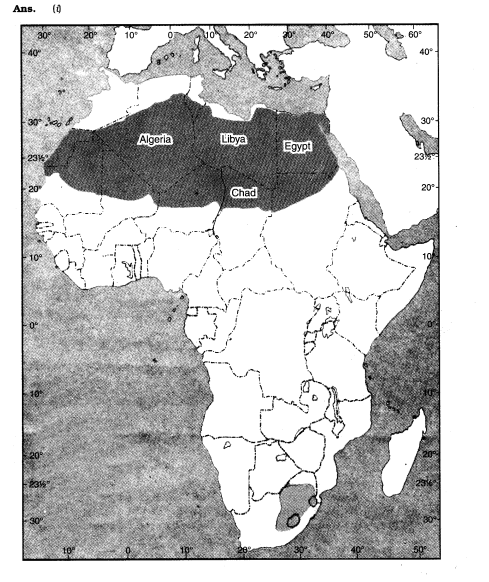
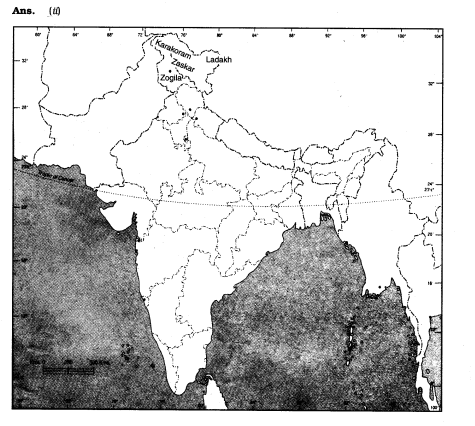
Chapter 10. Life in the deserts
Addtional Questions with Solutions
Additional - Question:
Que: How many countries are touched by the Sahara desert? Name them.
Ans: The Sahara desert touches eleven countries—Algeria, Chad, Egypt, Libya,
Mali, Mauritania, Morocco, Niger, Sudan, Tunisia, and Western Sahara.
Que: What are the two characteristic features of a desert?
Ans: The climate of a desert is either very hot and dry or very cold and dry.
The vegetation is sparse.
Que: Mention the day and night temperatures of the Sahara desert.
Ans: The day temperature—It may soar as high as 50°C.
The night temperature—Nearing zero degrees
Que: What vegetation is found in the Sahara desert?
Ans: Vegetation in the Sahara desert is comprised of cactus, date, palms, and acacia. Green islands with date palms can be seen near the oases.
Que: Name the two nomadic tribes living in the Sahara desert.
Ans: The Bedouins and Tuaregs.
Que: Name the animals reared by the Bedouins and Tuaregs.
Ans: Goats, Sheep, Camels and horses.
Que: What do these animals provide them?
Ans: These animals provide them with milk and hides.
Que: Name the countries associated with the discovery of oil
Ans: Algeria, Libya and Egypt.
Que: Ladakh is made up of two words. Mention these words with their meaning.
Ans: The two words with which Ladakh is made up of are La meaning mountain pass and Dak meaning country.
Que: Where is Ladakh located?
Ans: Ladakh is located in the Great Himalayas, on the eastern side of Jammu and Kashmir.
Que: Name an important river that flows through Ladakh.
Ans: Indus.
Que: Why is there little rainfall in the Ladakh desert?
Ans: It is because the Ladakh desert lies in the rain shadow of the Himalayas.
Que: Name the birds which are common in the Ladakh desert.
Ans: Robias, redstarts, Tibetan snowcock, raven and hoopoe.
Que: What is the use of the hair of the sheep and goat in the cold desert of Ladak?
Ans: The hair of the sheep and goat is used to make woolens.
Que: Why do people hunt Chiru or the Tibetan antelope?
Ans: People hunt the Chiru or the Tibetan antelope for its wool known as Shahtoosh
Que: Name some famous monasteries of Ladakh
Ans: Hemis, Thiksey, Shey and Lamayuru.
Que: Which National Highway connects Leh to Kashmir valley and through which pass?
Ans: The National Highway A connects Leh to Kashmir valley through the Zojila pass.
Que: Name the four passes which Manali-Leh highway crosses.
Ans: Rohtang La, Lungalacha La, Baralacha La and Tanglang La.
Que: Describe the Climate of the Sahara desert.
Ans: The Sahara desert experience scorching hot and parch dry climate. The rainy season occurs for the short time. The sky is cloudless and clear. Days are extremely hot. The temperatures during the day may rise as high as 50°C. The nights may be freezing cold with temperatures nearing zero degrees.
Que: Mention the summer and winter activities of the people of the Ladakh desert.
Ans: In the summer season the people of the Ladakh desert are busy in cultivation work. They grow crops such as barley, potatoes, peas, beans and turnip. The climate during winters is very harsh and people keep themselves engaged in festivities and ceremonies. The women manage the house and fields with great efficiency. They also manage small businesses and shops.
Que: Describe the flora and fauna found in the Sahara desert
Ans: Flora. The Sahara desert has vegetation such as cactus, date palms and acacia. In some places there are oases where one can see green islands with date palms. Fauna. The animals found in the Sahara desert are camels, hyenas, jackals, foxes, scorpions, several varieties of snakes and lizards.
Que: Describe the people of the Sahara desert Also write about their activities.
Ans: The Sahara desert experiences a harsh climate. Despite that various groups of people such as the Bedouins and Juaregs live here. These are nomadic tribes who pursue different activities. They rear animals such as goats, sheep, camels and horses. They get jnilk and hides from these animals. They prepare leather from hides. This leather is used in making belts, slippers, water bottles. They use the hair of these animals in making mats, carpets, clothes and blankets. The people of the Sahara desert wear heavy robes to protect themselves from the dust storms and hot winds.
The oasis in the Sahara desert and the Nile valley in Egypt support the settled population. Since water is available, people grow date palms. They also grow rice, wheat, barley and beans.
The Sahara is undergoing change with fast speed. Tuaregs, the nomadic tribe, are now acting as guides to foreign tourists. More and more nomadic herdsmen are migrating to cities in search of jobs in oil and gas operations.
Que: Describe the flora and fauna found in the Ladakh desert.
Ans: Flora—Vegetation is scanty in the Ladakh desert. There are scanty patches of grasses and shrubs. Groves of willows and poplars are seen in the valleys. During the summers, fruit trees such as apples, apricots and walnuts grow.
Fauna. Several species of birds are found in the Ladakh desert. Robins, redstarts, Tibetan snowcock, raven, and hoopoe are common. The animals found in this region are wild goats, wild sheep, yak, and special kinds of dogs.

Geography
Class 7 (English Medium)
NCERT Geography Textbook
Chapter-wise NCERT Solutions for Class 6 to 12 prepared according to the latest CBSE syllabus.
English Medium

NCERT Solutions Class 7 Geography
Chapter Chapter 1. Environment Solutions
Chapter 1. Environment Open Chapters
Explore Now →
NCERT Solutions Class 7 Geography
Chapter Chapter 2. Inside Our Earth Solutions
Chapter 2. Inside Our Earth Open Chapters
Explore Now →
NCERT Solutions Class 7 Geography
Chapter Chapter 3. Our Changing Earth Solutions
Chapter 3. Our Changing Earth Open Chapters
Explore Now →
NCERT Solutions Class 7 Geography
Chapter Chapter 4. Air Solutions
Chapter 4. Air Open Chapters
Explore Now →
NCERT Solutions Class 7 Geography
Chapter Chapter 5. Water Solutions
Chapter 5. Water Open Chapters
Explore Now →
NCERT Solutions Class 7 Geography
Chapter Chapter 6. Natural Vegetation and Wild Life Solutions
Chapter 6. Natural Vegetation and Wild Life Open Chapters
Explore Now →
NCERT Solutions Class 7 Geography
Chapter Chapter 7. Human environment Settlement Transport And Communication Solutions
Chapter 7. Human environment Settlement Transport And Communication Open Chapters
Explore Now →
NCERT Solutions Class 7 Geography
Chapter Chapter 8. Human Environment Interactions The Tropical and the Subtropical Region Solutions
Chapter 8. Human Environment Interactions The Tropical and the Subtropical Region Open Chapters
Explore Now →
NCERT Solutions Class 7 Geography
Chapter Chapter 9. Life in the Temperate Grasslands Solutions
Chapter 9. Life in the Temperate Grasslands Open Chapters
Explore Now →
NCERT Solutions Class 7 Geography
Chapter Chapter 10. Life in the deserts Solutions
Chapter 10. Life in the deserts Open Chapters
Explore Now →
Class 7 NCERT Book Solutions
Chapter-wise NCERT Solutions for Class 6 to 12 prepared according to the latest CBSE syllabus.
ENGLISH MEDIUM
Benefits of Studying NCERT Solutions
Studying from NCERT Solutions helps students build strong conceptual understanding and improve problem-solving skills. These solutions are especially useful for revision because every answer is written according to the marking scheme followed by CBSE.
- Improve conceptual understanding.
- Learn correct answer-writing techniques.
- Prepare effectively for school examinations.
- Complete syllabus revision in less time.
- Practice important textbook questions.
- Build confidence before examinations.
Prepared According to the Latest CBSE Syllabus
All NCERT Book Solutions for Class 7 available on ATP Education are updated according to the latest CBSE curriculum. Whenever NCERT introduces changes in textbooks or syllabus, our study materials are revised accordingly so that students always receive accurate and updated content.
Helpful for Competitive Examinations
NCERT textbooks form the foundation of many competitive examinations. Students preparing for Olympiads, NTSE, CUET, UPSC Foundation, SSC and several entrance examinations can strengthen their basics through these chapter-wise solutions. Understanding NCERT concepts also improves analytical thinking and logical reasoning.
Simple and Student-Friendly Explanations
Our experts prepare every answer in a simple, clear and student-friendly format. Difficult concepts are explained step by step with proper reasoning so that students of every learning level can understand them easily. This approach helps students remember concepts for a longer period and perform confidently during examinations.
Start Learning with ATP Education
Explore the complete collection of NCERT Solutions for Class 7 and begin your preparation with confidence. Every chapter is available online for free and can be accessed anytime. Whether you want to complete homework, revise important chapters or prepare for examinations, ATP Education provides reliable and high-quality study resources to help you achieve academic success.