NCERT Solutions for Class 7 – Complete Chapter-wise Study Material
Chapter 5. Water is one of the most important chapters in the Class 7 Geography English NCERT Solutions curriculum. This chapter plays a significant role in helping students build a strong conceptual foundation while preparing for school examinations, class tests, unit tests, half-yearly examinations, annual examinations, and CBSE board assessments. The chapter has been carefully designed according to the latest NCERT syllabus, making it an essential part of every student's study plan.
The Chapter 5. Water - Class 7 Geography English NCERT Solutions available on ATP Education explain every question in a simple, accurate, and step-by-step manner. Each answer is prepared according to the latest CBSE guidelines so that students can understand the concepts clearly without confusion. Whether you are completing your homework, revising before examinations, or strengthening your understanding of the subject, these solutions provide reliable academic support throughout your learning journey.
One of the biggest advantages of studying Chapter 5. Water is that it helps students understand important concepts, definitions, examples, and textbook exercises in an organized way. Instead of memorizing answers, students learn how to develop logical thinking, improve analytical skills, and write well-structured answers in examinations. This chapter also helps improve problem-solving ability and encourages conceptual learning, which is essential for scoring higher marks in school and competitive examinations.
Our Class 7 Geography NCERT Solutions cover all textbook questions, important exercise questions, and chapter-wise explanations in English Medium. Every solution is written in easy-to-understand language, allowing students to revise the chapter quickly before examinations. Regular practice of these solutions improves confidence, strengthens subject knowledge, and reduces examination stress.
Students preparing for school assessments should carefully study Chapter 5. Water because questions from this chapter are frequently asked in objective questions, short answer questions, long answer questions, competency-based questions, and case-study questions. Understanding the concepts explained in this chapter also helps students connect related topics from other chapters, making overall learning more effective and meaningful.
At ATP Education, we continuously update our Class 7 Geography English NCERT Solutions according to the latest NCERT textbooks and CBSE curriculum. Students can confidently use these chapter-wise solutions for daily study, homework assistance, quick revision, examination preparation, and self-learning. By studying Chapter 5. Water thoroughly and practising every question regularly, students can strengthen their concepts, improve writing skills, and achieve better academic performance in both school and board examinations.
Chapter 5. Water - Class 7 Geography English NCERT Solutions
Chapter 5. Water
NCERT Exercise
Exercise - Question:
Que: Answer the following questions.
(i) What is precipitation?
(ii) What is water cycle?
(iii) What are the factors affecting the height of the waves?
(iv) Which factors affect the movement of ocean water?
(v) What are tides and how are they caused?
(vi) What are ocean currents?
Ans:
(i) Precipitation is the deposition of moisture from the atmosphere onto the earth's surface. This may be in the form of rain, hail, frost, fog, sleet, or snow.
(ii) The process by which water continually changes its form and circulators between oceans, atmosphere and land is known as the water cycle.
(iii) (a) High speed winds, (b) earth quake, (c) volcanic eruption and (d) under water landslides.
(iv) (a) Tempreature and (b) rotation of the earth.
(v) The rhythmic rise and fall of ocean water twice a day is called a tide. Tides are caused due to the gravitational pull exerted by the sun and the moon on the earth's surface.
(vi) Ocean currents are streams of water flowing constantly on the ocean surface in definite directions.
Que: Tick the correct answer.
(i) The process by which water continually changes its form and circulatesbetween oceans, atmosphere and land.
(a) Water cycle
(b) Tides
(c) Ocean currents
(ii) Generally the warm ocean currents originate near
(a) Poles
(b) Equator
(c) None of these
(iii) The rythmic rise and fall of ocean water twice in a day is called
(a) Tide
(b) Ocean current
(c) Wave
Ans:
(i) - (a)
(ii) - (b)
(iii) - (a)
Que: Match the following.
(i) Caspian Sea (a) Largest lake
(ii) Tide (b) Periodic rise and fall of water
(iii) Tsunami (c) Strong seismic waves
(iv) Ocean currents (d) Streams of water moving along definite paths
(e) Water cycle
Ans:
| Column I | Column II |
| (i) Caspian sagar | (a) Largest lake |
| (ii) Tide | (b) Periodic rise and fall of water |
| (iii) Tsunami | (c) Strong seismic waves |
| (iv) Ocean currents | (d) Streams of water moving along definite paths |
Que: Give reason:
(i) Ocean water is salty.
(ii) The quality of water is deterioting.
Ans:
(i) Because it contains large amount of dissolved salts.
(ii) (a) Garbage we throw in river.
(b) Chemical from industries and poluted water.
(c) Remains of the harmful insecticidies and pest resistants flowing in from the fields.
(d) Unburnt or half burnt corpose of men and animal thrown in water bodies.
Chapter 5. Water
Additional Questions With Solutions
Additional - Question:
Que: What is a terrarium?
Ans: It is an artificial enclosure for keeping small house plants. .
Que: Which type of water do the ocean bodies and the seas contain?
Ans: They contain salty water.
Que: What do you mean by salinity?
Ans: Salinity is the amount of salt in grams present in 1000 grams of water.
Que: What is the average salinity of the oceans?
Ans: The average salinity of the oceans is 35 parts per thousand.
Que: What is the salinity of the Dead sea?
Ans: The salinity of the Dead sea is 45 parts per thousand.
Que: Why do swimmers float in the Dead Sea?
Ans: Swimmers float in the Dead sea because the increased salt content makes it dense.
Que: What is the significance of World Water Day?
Ans: On the occasion of World Water Day (22nd March) the need to conserve water is reinforced in different ways.
Que: What is a Tsunami?
Ans: Tsunami is a Japanese word that means ‘Harbour Waves’ as the harbors get destroyed whenever there is a Tsunami.
Que: What happens during high Ode?
Ans: During high tide, waves rise high and water covers much of the shore.
Que: What happens during low tide?
Ans: During low tide waterfalls to its lowest level and recedes from the shore.
Que: How are tides caused?
Ans: The strong gravitational pull exerted by the sun and the moon on the earth’s surface cause tides.
Que: Name one warm current and one cold current.
Ans: Warm current — The Gulf Stream
Cold current — The Labrador Ocean current.
Que: What happened to the Indira point during the tsunami of 2004?
Ans: It got submerged.
Que: How are spring and neap tides formed?
Ans: During the full moon and new moon days, the sun, the moon, and the earth are in the same line and the tides are highest. These tides are called spring tides. But when the moon is in its first and last quarter, the ocean waters get drawn in diagonally opposite directions by the gravitational pull of the sun and earth resulting in low tides. These tides are called neap tides.
Que: How are high tides important?
Ans: High tides are important for various reasons:
- They help in navigation
- They raise the water level close to the shores. This helps the ships to arrive at the harbour more easily.
- The high tides also help in fishing. Much more fish come closer to the shore during the high. This enables the fisherman to get a plentiful catch.
- The rise and fall of water due to tides is being used to generate electricity in some places.
Que: What are the waves? Write a short note on it
Ans: Waves are the rise and fall of the water on the surface of the ocean. Waves are formed when winds scrape across the ocean surface. The stronger the wind blows, the bigger the wave becomes. During the storm, the winds blow at very high speed and therefore huge waves are formed. These waves are very strong, hence very destruction. They may cause huge devastation.
Que: Write a brief note on Tsunami.
Ans: Tsunami is a Japanese word that means ‘harbour waves’ as the harbours get destroyed whenever there is a tsunami. An earthquake, a volcanic eruption or underwater landslides can shift large amounts of ocean water. As a result tsunami occurs which may be as high as 15 m. The tsunami of 2004 is still in our minds. It caused huge death and destruction in the coastal areas of India. The Indira Point in the Andaman and Nicobar Islands got submerged after the tsunami.
Que: Write a note on the importance of water.
Ans: Water is life. Without water, we can not think of life. Its scarcity may create numerous problems but its absence would definitely lead to the non-existence of all the living beings on the earth. It is a precious resource of nature. We drink water whenever we feel thirsty. We use water in numerous activities such as washing clothes, cleaning house floors, watering the garden, etc. Industries also need water for their functioning. Thus, water is very essential and therefore we must conserve it. Our careless use of water has created several problems. Whatever water is there, it is not of good quality. We should think about the ways of its conservation for our own sake.
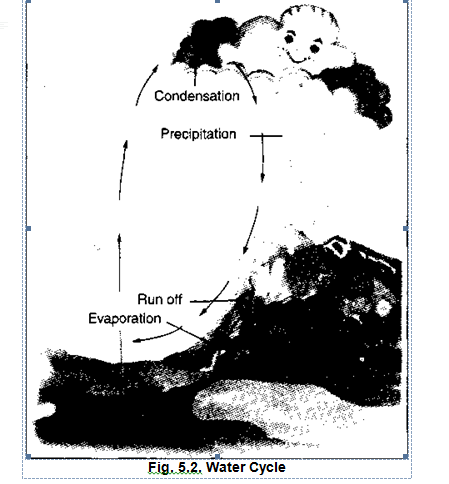
Que: Explain the water cycle with a neat and labelled diagram.
Ans: The sun’s heat causes evaporation of water, flowing down to stream or drains into water vapour. When the water vapour cools down, it condenses and forms clouds. These clouds, when become too heavy to float, start falling on the land or sea in the form of rain, snow, or sleet. Thus, the process by which water continually changes its form and circulates between oceans, atmosphere, and land is known as the water cycle.
Que: Give an account of ocean currents.
Ans: Ocean currents are streams of water flowing constantly on the ocean surface in definite directions. The ocean currents may be warm or cold. The warm ocean currents originate near the equator and move towards the poles. The cold current carries water from polar or higher latitudes to tropical or lower latitudes. For example, the Labrador Ocean current is a cold current while the Gulf Stream is a warm current.
The ocean current influences the temperature conditions of the area. Warm currents bring about warm temperatures over the land surface. The areas where the warm and cold currents meet provide the best fishing grounds of the world. For example seas around Japan and the eastern coast of North America. The areas where a warm and cold current meet also experience foggy weather and therefore navigation becomes difficult.
Que: How do we classify ocean movements? Explain.
Ans: Ocean movements can be classified into waves, tides, and currents.
When the water on the surface of the ocean rises and falls alternately, they are called waves. Waves are formed when winds scrape across the ocean surface. The stronger the wind blows, the bigger the wave becomes.
The rhythmic rise and fall of ocean water twice in a day is known as a tide. Tides may be high or low. It is high tide when water covers much of the shore by rising to its highest level. It is low tide when waterfalls to its lowest level and recedes from the shore. Tides are caused due to the strong gravitational pull exerted by the sun and moon on the earth’s surface. High tides help in navigation and fishing. The rise and fall of water due to tides is being used to generate electricity in some places.
Ocean currents. These are streams of water flowing constantly on the ocean surface in definite directions. The ocean currents may be warm such as the Gulf Stream and cold such as the Labrador Ocean current. The areas where the warm and cold currents meet provide the best fishing ground of the world. For example, seas around Japan and the Eastern Coast of North America.

Geography
Class 7 (English Medium)
NCERT Geography Textbook
Chapter-wise NCERT Solutions for Class 6 to 12 prepared according to the latest CBSE syllabus.
English Medium
NCERT Solutions Class 7 Geography
Chapter Chapter 1. Environment Solutions
Chapter 1. Environment Open Chapters
Explore Now →
NCERT Solutions Class 7 Geography
Chapter Chapter 2. Inside Our Earth Solutions
Chapter 2. Inside Our Earth Open Chapters
Explore Now →
NCERT Solutions Class 7 Geography
Chapter Chapter 3. Our Changing Earth Solutions
Chapter 3. Our Changing Earth Open Chapters
Explore Now →
NCERT Solutions Class 7 Geography
Chapter Chapter 4. Air Solutions
Chapter 4. Air Open Chapters
Explore Now →
NCERT Solutions Class 7 Geography
Chapter Chapter 5. Water Solutions
Chapter 5. Water Open Chapters
Explore Now →
NCERT Solutions Class 7 Geography
Chapter Chapter 6. Natural Vegetation and Wild Life Solutions
Chapter 6. Natural Vegetation and Wild Life Open Chapters
Explore Now →
NCERT Solutions Class 7 Geography
Chapter Chapter 7. Human environment Settlement Transport And Communication Solutions
Chapter 7. Human environment Settlement Transport And Communication Open Chapters
Explore Now →
NCERT Solutions Class 7 Geography
Chapter Chapter 8. Human Environment Interactions The Tropical and the Subtropical Region Solutions
Chapter 8. Human Environment Interactions The Tropical and the Subtropical Region Open Chapters
Explore Now →
NCERT Solutions Class 7 Geography
Chapter Chapter 9. Life in the Temperate Grasslands Solutions
Chapter 9. Life in the Temperate Grasslands Open Chapters
Explore Now →
NCERT Solutions Class 7 Geography
Chapter Chapter 10. Life in the deserts Solutions
Chapter 10. Life in the deserts Open Chapters
Explore Now →
Class 7 NCERT Book Solutions
Chapter-wise NCERT Solutions for Class 6 to 12 prepared according to the latest CBSE syllabus.
ENGLISH MEDIUM
Benefits of Studying NCERT Solutions
Studying from NCERT Solutions helps students build strong conceptual understanding and improve problem-solving skills. These solutions are especially useful for revision because every answer is written according to the marking scheme followed by CBSE.
- Improve conceptual understanding.
- Learn correct answer-writing techniques.
- Prepare effectively for school examinations.
- Complete syllabus revision in less time.
- Practice important textbook questions.
- Build confidence before examinations.
Prepared According to the Latest CBSE Syllabus
All NCERT Book Solutions for Class 7 available on ATP Education are updated according to the latest CBSE curriculum. Whenever NCERT introduces changes in textbooks or syllabus, our study materials are revised accordingly so that students always receive accurate and updated content.
Helpful for Competitive Examinations
NCERT textbooks form the foundation of many competitive examinations. Students preparing for Olympiads, NTSE, CUET, UPSC Foundation, SSC and several entrance examinations can strengthen their basics through these chapter-wise solutions. Understanding NCERT concepts also improves analytical thinking and logical reasoning.
Simple and Student-Friendly Explanations
Our experts prepare every answer in a simple, clear and student-friendly format. Difficult concepts are explained step by step with proper reasoning so that students of every learning level can understand them easily. This approach helps students remember concepts for a longer period and perform confidently during examinations.
Start Learning with ATP Education
Explore the complete collection of NCERT Solutions for Class 7 and begin your preparation with confidence. Every chapter is available online for free and can be accessed anytime. Whether you want to complete homework, revise important chapters or prepare for examinations, ATP Education provides reliable and high-quality study resources to help you achieve academic success.