NCERT Solutions for Class 7 – Complete Chapter-wise Study Material
Chapter 8. Human Environment Interactions The Tropical and the Subtropical Region is one of the most important chapters in the Class 7 Geography English NCERT Solutions curriculum. This chapter plays a significant role in helping students build a strong conceptual foundation while preparing for school examinations, class tests, unit tests, half-yearly examinations, annual examinations, and CBSE board assessments. The chapter has been carefully designed according to the latest NCERT syllabus, making it an essential part of every student's study plan.
The Chapter 8. Human Environment Interactions The Tropical and the Subtropical Region - Class 7 Geography English NCERT Solutions available on ATP Education explain every question in a simple, accurate, and step-by-step manner. Each answer is prepared according to the latest CBSE guidelines so that students can understand the concepts clearly without confusion. Whether you are completing your homework, revising before examinations, or strengthening your understanding of the subject, these solutions provide reliable academic support throughout your learning journey.
One of the biggest advantages of studying Chapter 8. Human Environment Interactions The Tropical and the Subtropical Region is that it helps students understand important concepts, definitions, examples, and textbook exercises in an organized way. Instead of memorizing answers, students learn how to develop logical thinking, improve analytical skills, and write well-structured answers in examinations. This chapter also helps improve problem-solving ability and encourages conceptual learning, which is essential for scoring higher marks in school and competitive examinations.
Our Class 7 Geography NCERT Solutions cover all textbook questions, important exercise questions, and chapter-wise explanations in English Medium. Every solution is written in easy-to-understand language, allowing students to revise the chapter quickly before examinations. Regular practice of these solutions improves confidence, strengthens subject knowledge, and reduces examination stress.
Students preparing for school assessments should carefully study Chapter 8. Human Environment Interactions The Tropical and the Subtropical Region because questions from this chapter are frequently asked in objective questions, short answer questions, long answer questions, competency-based questions, and case-study questions. Understanding the concepts explained in this chapter also helps students connect related topics from other chapters, making overall learning more effective and meaningful.
At ATP Education, we continuously update our Class 7 Geography English NCERT Solutions according to the latest NCERT textbooks and CBSE curriculum. Students can confidently use these chapter-wise solutions for daily study, homework assistance, quick revision, examination preparation, and self-learning. By studying Chapter 8. Human Environment Interactions The Tropical and the Subtropical Region thoroughly and practising every question regularly, students can strengthen their concepts, improve writing skills, and achieve better academic performance in both school and board examinations.
Chapter 8. Human Environment Interactions The Tropical and the Subtropical Region - Class 7 Geography English NCERT Solutions
Chapter 8. Human Environment Interactions The Tropical and the Subtropical Region
NCERT Exercise
Exercise - Question:
Que: Answer the following questions.
(i) Name the continent in which the Amazon Basin is located.
(ii) What are the crops grown by the people of the Amazon Basin.
(iii) Name the birds that you are likely to find in the rainforests of the Amazon.
(iv) What are the major cities located on the River Ganga.
(v) Where is the one-horned rhinoceros found?
Ans:
(i) South america.
(ii) Food crops - Tapioca, pineapple, sweet potato, manioc. cash crops - coffe,
maize, coca.
(iii) (a) Toucans, (b) Humming birds, (c) Bird of paradise.
(iv) (a) Allahbad, (b) Kanpur, (c) Varanasi, (d) Lucknow, (e) patna and, (f) Kolkata.
(v) One-horned rhinoceros is found in the Brahmaputra plain (Assam).
Que: Tick the correct answer.
(i) Toucans are a type of
(a) birds (b) animals (c) crops
(ii) Manioc is the staple food of
(a) Ganga Basin (b) Africa (c) Amazon
(iii) Kolkata is located on the river
(a) Orange (b) Hooghly (c) Bhagirathi
(iv) Deodars and firs are a type of
(a) Coniferous trees (b) Deciduous trees (c) shrubs
(v) Bengal tiger is found in.
(a) mountains (b) delta area (c) Amazon
Ans:
(i) - (a)
(ii) - (c)
(iii) - (b)
(iv) - (a)
(v) - (b)
Que: Match the following.
(i) Cotton textile (a) Assam
(ii) Maloca (b) Terrace farming
(iii) Piranha (c) Sericulture
(iv) Silk worm (d) Slanting roof
(v) Kaziranga (e) Ganga plain
(f) Varanasi
(g) Fish
Ans:
| Column I | Column II |
| (i) Cotton textile | (e) ganga plain |
| (ii) Maloca | (d) slanting roofs |
| (iii) Piranha | (g) fish |
| (iv) Silk worm | (c) sericulture |
| (v) Kaziranga | (a) assam |
Que: Give reasons.
(i) The rainforests are depleting.
(ii) Paddy is grown in the Ganga-Brahmaputra plains.
Ans:
(i) Because of indiscriminate cutting of trees for the sake of development.
(ii) Because paddy requires sufficient water. This region recevies good amount of
rainfall and there is dences network of rivers too which helps to fulfill the
requirment of water for paddy crop.
Que: Map skills.
(i) On an outline map of the Indian Sub-continent, draw the rivers Ganga
and Brahmaputra from the source to the mouth. Also show the
important tributaries of both the rivers.
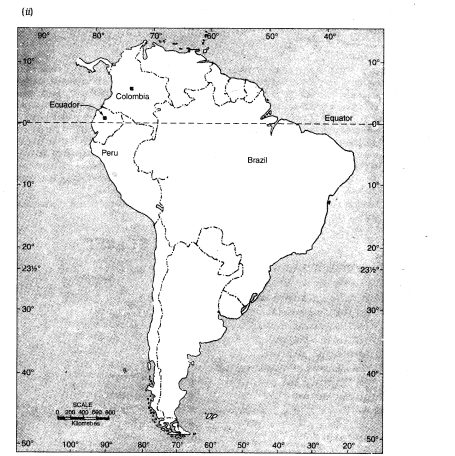
(ii) On the political map of South America, draw the equator. Mark the countries through which the equator passes.
Ans: 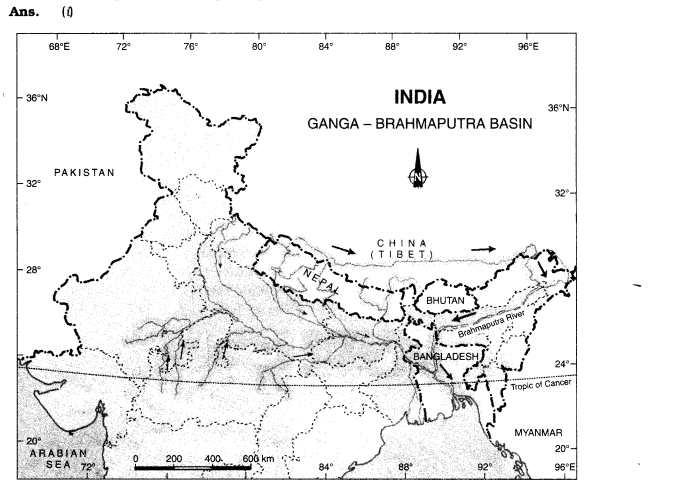
Que: For fun:
Make a collage to show places of attractions in India. You can divide the class in different groups to show attractions based on mountain landscapes, coastal beaches, wildlife sanctuaries and places of historical importance.
Ans:
Que: Activity
Collect under mentioned material and observe how the destruction of trees affects the soil cover.
Material
(i) Three small flowerpots or food cans (e.g,, cold drinks tin cans),
(ii) One big can with holes punched in the bottom (this will act as a sprinkling can),
(iii) twelve coins or bottle caps
(iv) Soil.
Steps
Take three small cans or pots. Fill them with soil till the top. Press the soil to make it level with the top of the can. Now put four coins or bottle caps on the soil of each can. Take the big can that has been punched with holes and fill it with water. You can also take the sprinkling can from your garden. Now, sprinkle water on the three cans. On the first can sprinkle water veiy slowly so that no soil splashes out. Let moderate amount of water be sprinkled on the second can. On the third can, sprinkle the water heavily. You will observe that unprotected soil splashes out. Where the ‘rain’ is heavy the amount of soil that splashes out is the maximum and least in case of the first can. The coins or caps represent the tree covers. It is clear that if the land is cleared completely of the vegetation, the soil cover will quickly disappear.
Ans: Students are suggested to do this activity themselves under the guidance of their parents/guardians.
Chapter 8. Human Environment Interactions The Tropical and the Subtropical Region
Addtional Questions with Solutions
Additional - Question:
Que: What type of vegetation grows in the Amazon forest?
Ans: Only shade tolerant vegetation grow here.
Que: Name the animals Found in the Amazon forest.
Ans: Monkeys, sloth and ant-eating tapirs.
Que: What do men and women of the rainforest do?
Ans: Men hunt and fish along the rivers and women take care of the crops.
Que: What do the people of the rainforest grow?
Ans: They grow tapioca, pineapple and sweet potato.
Que: Name the cash crops that people of the rainforest grow.
Ans: Coffee, maize and cocoa.
Que: What is the population density of West Bengal and Bihar? .
Ans: The populations density of west Bengal is 904 and that of Bihar is 880.
Que: What is susu? What does its presence indicate?
Ans: In the fresh water of River Ganga and River Brahmaputra, a variety of dolphin is found which is locally known as susu. Its presence indicates the health of the river.
Que: How and why are terraces built?
Ans: Tarraces are built on steep slopes to create flat surfaces on which crops are grown.
Que: By what names is the river Brahmaputra known in different places.
Ans: Meghna, Padma, Dehang, Debang, Yamuna, etc.
Que: What leads to the pollution of the rivers?
Ans: The wastewater from these towns and industries is discharged into the rivers. This leads to the pollution of the rivers.
Que: Name the river on which Tcy Mahal is situated?
Ans: River Yamuna.
Que: Name the cash crops grown in the Ganga-Brahmaputra Basin.
Ans: Sugarcane and jute.
Que: Write a short note on the climate of the Amazon Basin.
Ans: The climate of the Amazon Basin is characterised by hot and wet climate throughout the year. Both day and night and almost equally hot and humid. It rains almost everyday. The day temperatures are high with very high humidity. At night the temperature goes down but the humidity remains high.
Que: What do you know about the location of the Ganga-Brahmaputra Basin? Mention the climate of this Basin.
Ans: The Ganga-Brahmaputra Basin lies in the sub-tropical region that is situated between 10°N to 30°N latitudes. The tributaries of river Ganga such as the Ghaghra, the son, the Chambal, the Gandak, the Kosi and the tributaries of Brahmaputra drain it.
The area of the Ganga-Brahmaputra Basin is dominated by the monsoon climate. The monsoon brings rains from mid-June to mid-September. The summers are hot and the winters are cool.
Que: The Ganga-Brahmaputra Basin has varied topography. How does it affect the distribution of population there?
Ans: The basin area has a varied topography. As a result, the distribution of the population is not even everywhere in the area. The mountain areas with steep slopes have inhospitable terrain. Therefore less number of people live in the mountain area of the Ganga-Brahmaputra basin. The plain area provides the most suitable land for human habitation. Therefore, the density of the population of the plains is very high.
Que: What is the main activity of the people of the Ganga-Brahmaputra Basin? Give an account of it.
Ans: The main activity of the people of the Ganga-Brahmaputra Basin is agriculture. Paddy is the main crop here. Other crops grown here are wheat, maize, sorgham gram and millets. Cash crops like sugarcane and jute are also grown. Banana plantations are seen in some areas in the plain. In the West Bengal and Assam tea is grown in plantations. Silk is produced through the cultivation of silkworms in parts of Bihar and Assam. In the mountains and hills, where the slopes are gentle crops are grown on terraces.
Que: How can you say that the life of the people of the Amazon basin is changing?
Ans: Time is moving ahead very fast. This has resulted in the change of the life style of the people everywhere. The life of the people of the Amazon basin is also changing, though not at fast speed. In the old days it was difficult to reach the heart of the forest. In 1970 the Trans Amazon highway made all parts of the rain forest accessible. Aircrafts and helicopters are also used for reaching various places. The indigenous populations was pushed out from the area and forced to settle in new areas.
Que: What do you know about the wildlife of the Ganga-Brahmaputra basin?
Ans: The Ganga-Brahmaputra Basin is rich in wildlife. A variety of animals are found here. Elephants, tigers, deer and monkeys are common. The one-horned rhinoceros is found in the Brahmaputra plain. In the delta region, Bengal tiger, crocodiles and alligator are found. Acquatic life abounds in the fresh river waters, the lakes and the Bay of Bengal Sea. Popular varieties to fish such as catla, rohu and hilsa can be found here.
Que: How is tourism an important activity in the Ganga-Brahmaputra basin?
Ans: The Ganga-Brahmaputra plain has several big towns and cities, such as Allahabad, Kanpur, Varanasi, Lucknow, Patna and Kolkata. All these places are important from tourism point of view. Taj Mahal on the bank of river Yamuna in Agra is a famous tourist place. Allahabad is situated on the confluence of the river Ganga and Yamuna. Several people visit this place everyday to have a holy dip in it. Buddhist stupas in Uttar Pradesh and Bihar, Lucknow with its Imambara, Assam with Kaziranga and Manas with wildlife sanctuaries are some other places in the basin where people from different parts of the country and abroad go with great enthusiasm.
Que: How is the rainforest of the Amazon basin rich infauna?
Ans: The rainforest of the Amazon basin is very rich in fauna. A variety of birds such as toucans, hummingbirds, birds of paradise with their brilliantly coloured. Plumage and oversized bills for eating are found here.
These birds also make loud sounds in the forests. Animals like monkeys, sloth, and ant-eating tapirs are found here. Various species of reptiles and snakes also thrive in these jungles. A number of crocodiles, snakes, and pythons are also found here. Anaconda and boa constrictor are some of the species. The basin is also the home to thousands of species of insects. Several species of fishes including the flesh-eating Piranha fish is also found in the river.
Que: What do you know about the people of the rainforest?
Ans: The people of the Amazon basin practise slash and bum agriculture. They grow most of their food in small areas after clearing some trees in the forest. Men hunt and fish along the rivers and women take care of the crops. They mainly grow tapioca, pineapple and sweet potato. As hunting and fishing are uncertain it is the women who support the family. They feed them the vegetables that they grow. Their staple food is manioc, also known as cassava that grows under the ground like a potato. They also eat queen ants and egg sacs. Cash crops like coffee, maize, and cocoa are also grown.
People get wood for their houses from the rainforests. They build thatched houses shaped like beehives. There are also malocas there which are large apartmentlike houses with a steeply slanting roof.
The Amazon basin is developing day by day. In 1970 the trans-Amazon highway made all parts of the rainforest accessible. With the change of time, people’s lifestyle is also changing gradually.

Geography
Class 7 (English Medium)
NCERT Geography Textbook
Chapter-wise NCERT Solutions for Class 6 to 12 prepared according to the latest CBSE syllabus.
English Medium
NCERT Solutions Class 7 Geography
Chapter Chapter 1. Environment Solutions
Chapter 1. Environment Open Chapters
Explore Now →
NCERT Solutions Class 7 Geography
Chapter Chapter 2. Inside Our Earth Solutions
Chapter 2. Inside Our Earth Open Chapters
Explore Now →
NCERT Solutions Class 7 Geography
Chapter Chapter 3. Our Changing Earth Solutions
Chapter 3. Our Changing Earth Open Chapters
Explore Now →
NCERT Solutions Class 7 Geography
Chapter Chapter 4. Air Solutions
Chapter 4. Air Open Chapters
Explore Now →
NCERT Solutions Class 7 Geography
Chapter Chapter 5. Water Solutions
Chapter 5. Water Open Chapters
Explore Now →
NCERT Solutions Class 7 Geography
Chapter Chapter 6. Natural Vegetation and Wild Life Solutions
Chapter 6. Natural Vegetation and Wild Life Open Chapters
Explore Now →
NCERT Solutions Class 7 Geography
Chapter Chapter 7. Human environment Settlement Transport And Communication Solutions
Chapter 7. Human environment Settlement Transport And Communication Open Chapters
Explore Now →
NCERT Solutions Class 7 Geography
Chapter Chapter 8. Human Environment Interactions The Tropical and the Subtropical Region Solutions
Chapter 8. Human Environment Interactions The Tropical and the Subtropical Region Open Chapters
Explore Now →
NCERT Solutions Class 7 Geography
Chapter Chapter 9. Life in the Temperate Grasslands Solutions
Chapter 9. Life in the Temperate Grasslands Open Chapters
Explore Now →
NCERT Solutions Class 7 Geography
Chapter Chapter 10. Life in the deserts Solutions
Chapter 10. Life in the deserts Open Chapters
Explore Now →
Class 7 NCERT Book Solutions
Chapter-wise NCERT Solutions for Class 6 to 12 prepared according to the latest CBSE syllabus.
ENGLISH MEDIUM
Benefits of Studying NCERT Solutions
Studying from NCERT Solutions helps students build strong conceptual understanding and improve problem-solving skills. These solutions are especially useful for revision because every answer is written according to the marking scheme followed by CBSE.
- Improve conceptual understanding.
- Learn correct answer-writing techniques.
- Prepare effectively for school examinations.
- Complete syllabus revision in less time.
- Practice important textbook questions.
- Build confidence before examinations.
Prepared According to the Latest CBSE Syllabus
All NCERT Book Solutions for Class 7 available on ATP Education are updated according to the latest CBSE curriculum. Whenever NCERT introduces changes in textbooks or syllabus, our study materials are revised accordingly so that students always receive accurate and updated content.
Helpful for Competitive Examinations
NCERT textbooks form the foundation of many competitive examinations. Students preparing for Olympiads, NTSE, CUET, UPSC Foundation, SSC and several entrance examinations can strengthen their basics through these chapter-wise solutions. Understanding NCERT concepts also improves analytical thinking and logical reasoning.
Simple and Student-Friendly Explanations
Our experts prepare every answer in a simple, clear and student-friendly format. Difficult concepts are explained step by step with proper reasoning so that students of every learning level can understand them easily. This approach helps students remember concepts for a longer period and perform confidently during examinations.
Start Learning with ATP Education
Explore the complete collection of NCERT Solutions for Class 7 and begin your preparation with confidence. Every chapter is available online for free and can be accessed anytime. Whether you want to complete homework, revise important chapters or prepare for examinations, ATP Education provides reliable and high-quality study resources to help you achieve academic success.