
NCERT Solutions for Class 7 – Complete Chapter-wise Study Material
13. Motion and Time is one of the most important chapters in the Class 7 Science English NCERT Solutions curriculum. This chapter plays a significant role in helping students build a strong conceptual foundation while preparing for school examinations, class tests, unit tests, half-yearly examinations, annual examinations, and CBSE board assessments. The chapter has been carefully designed according to the latest NCERT syllabus, making it an essential part of every student's study plan.
The 13. Motion and Time - Class 7 Science English NCERT Solutions available on ATP Education explain every question in a simple, accurate, and step-by-step manner. Each answer is prepared according to the latest CBSE guidelines so that students can understand the concepts clearly without confusion. Whether you are completing your homework, revising before examinations, or strengthening your understanding of the subject, these solutions provide reliable academic support throughout your learning journey.
One of the biggest advantages of studying 13. Motion and Time is that it helps students understand important concepts, definitions, examples, and textbook exercises in an organized way. Instead of memorizing answers, students learn how to develop logical thinking, improve analytical skills, and write well-structured answers in examinations. This chapter also helps improve problem-solving ability and encourages conceptual learning, which is essential for scoring higher marks in school and competitive examinations.
Our Class 7 Science NCERT Solutions cover all textbook questions, important exercise questions, and chapter-wise explanations in English Medium. Every solution is written in easy-to-understand language, allowing students to revise the chapter quickly before examinations. Regular practice of these solutions improves confidence, strengthens subject knowledge, and reduces examination stress.
Students preparing for school assessments should carefully study 13. Motion and Time because questions from this chapter are frequently asked in objective questions, short answer questions, long answer questions, competency-based questions, and case-study questions. Understanding the concepts explained in this chapter also helps students connect related topics from other chapters, making overall learning more effective and meaningful.
At ATP Education, we continuously update our Class 7 Science English NCERT Solutions according to the latest NCERT textbooks and CBSE curriculum. Students can confidently use these chapter-wise solutions for daily study, homework assistance, quick revision, examination preparation, and self-learning. By studying 13. Motion and Time thoroughly and practising every question regularly, students can strengthen their concepts, improve writing skills, and achieve better academic performance in both school and board examinations.
13. Motion and Time - Class 7 Science English NCERT Solutions
13. Motion and Time
Chapter-Review
Chapter Review:
- The distance covered by an object in a unit time as the speed of the object.
- If the speed of an object moving along a straight line keeps changing, its motion is said to be non-uniform.
- An object moving along a straight line with a constant speed is said to be in uniform motion.
- The time taken by the pendulum to complete one oscillation is called its time period.
- The basic unit of time is a second.
- The speedometer of a car measure Speed.
- The odometer of a car measure Distance.
- The speed is the total distance covered divided by the total time taken is called average speed.
- The time between one sunrise and the next was called a day.
- A month was measured from one new moon to the next.
- A year was fixed as the time taken by the earth to complete one revolution of the sun.
- The metallic ball is called the bob of the pendulum.
- The to and fro motion of a simple pendulum is an example of a periodic or an oscillatory
motion. - The smallest time interval that can be measured with commonly available clocks and watches is one second.
13. Motion and Time
Exercise
Exercise :
Que1. Classify the following as motion along a straight line, circular or oscillatory motion:
(i) Motion of your hands while running.
(ii) Motion of a horse pulling a cart on a straight road.
(iii) Motion of a child in a merry-go-round.
(iv) Motion of a child on a see-saw.
(v) Motion of the hammer of an electric bell.
(vi) Motion of a train on a straight bridge.
Answer:
straight line motion : (ii), (vi)
circular motion : (iii), (iv)
oscillary motion : (i), (v)
2. Which of the following are not correct?
(i) The basic unit of time is second.
(ii) Every object moves with a constant speed.
(iii) Distances between two cities are measured in kilometres.
(iv) The time period of a given pendulum is not constant.
(v) The speed of a train is expressed in m/h.
Answer :
(i) True
(ii) False
(iii) True
(iv) False
(v) False
3. A simple pendulum takes 32 s to complete 20 oscillations. What is the time period of the pendulum?
4. The distance between two stations is 240 km. A train takes 4 hours to cover this distance. Calculate the speed of the train.
5. The odometer of a car reads 57321.0 km when the clock shows the time 08:30 AM. What is the distance moved by the car, if at 08:50 AM, the odometer reading has changed to 57336.0 km? Calculate the speed of the car in km/min during this time. Express the speed in km/h also.
6. Salma takes 15 minutes from her house to reach her school on a bicycle. If the bicycle has a speed of 2 m/s, calculate the distance between her house and the school.
7. Show the shape of the distance-time graph for the motion in the following cases:
(i) A car moving with a constant speed.
(ii) A car parked on a side road.
8. Which of the following relations is correct?
(i) Speed = Distance Time
(ii) Speed = Distance Time
(iii) Speed = Time Distance
(iv) Speed = 1 Distance
9. The basic unit of speed is:
(i) km/min
(ii) m/min
(iii) km/h
(iv) m/s
10. A car moves with a speed of 40 km/h for 15 minutes and then with a speed of 60 km/h for the next 15 minutes. The total distance covered by the car is: (i) 100 km (ii) 25 km (iii) 15 km (iv) 10 km
11. Suppose the two photographs, shown in Fig. 13.1 and Fig. 13.2, had been taken at an interval of 10 seconds. If a distance of 100 metres is shown by 1 cm in these photographs, calculate the speed of the blue car.
12. Fig. 13.15 shows the distance-ti
me graph for the motion of two vehicles A and B. Which one of them is moving faster? (i) (ii) Fig. 13.15 Fig. 13.15 Distance-time graph for the motion of two cars
13. Which of the following distance-time graphs shows a truck moving with speed which is not constant?
13. Motion and Time
Additional Questions With solutions
Additional Questions With solution:
Ques: – Define speed.
Ans: – We call the distance covered by an object in a unit time as the speed of the object.
Ques: – What is non-uniform motion?
Ans: – If the speed of an object moving along a straight line keeps changing, its motion is said to be non-uniform.
Ques: – What is uniform motion?
Ans: – An object moving along a straight line with a constant speed is said to be in uniform motion.
Ques: – Define time period?
Ans: – The time taken by the pendulum to complete one oscillation is called its time period.
Ques: – What is the bob of the pendulum?
Ans: – The metallic ball is called the bob of the pendulum.
Ques: – What is periodic or an oscillatory motion?
Ans: – The to and fro motion of a simple pendulum is an example of a periodic or an oscillatory motion.
Ques: – Name the basic unit of time.
Ans: – The basic unit of time is a second.
Ques: – What tells the speedometer of a car?
Ans: – Speed.
Ques: – What tells the odometer of a car?
Ans:– Distance.
Ques: – What is odometer?
Ans: – Another meter that measures the distance moved by the vehicle. This meter is known as an odometer.
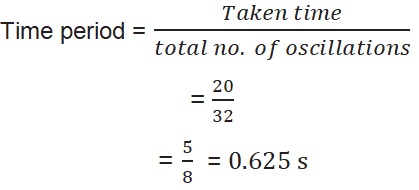
Ques: – A simple pendulum takes 32 s to complete 20 oscillations. What is the time period of the pendulum?
Ans: -
Ques :– The distance between two stations is 240 km. A train takes 4 hours to cover this distance. Calculate the speed of the train.
Ans :–
Distance = 240 km
Taken time = 4 hours

Ques :– Salma takes 15 minutes from her house to reach her school on a bicycle. If the bicycle has a speed of 2 m/s, calculate the distance between her house and the school.
Ans :-
13. Motion and Time
topic -4
Extra - Question:
Que: Give the basic unit speed.
Ans: Metre/ second in the basic unit of speed.
Que: Mention which is the most common thing in almost all the clocks.
Ans: The most common thing in almost all the clocks is that all of them shown periodic motion.
Que: Name they axis that represents dependent variable.
Ans: Y - axis represent the dependent variable.
Que: State how do we measure time interval by month.
Ans: Time intrval of a month is measures by one new moon to the next.
Que: Estimate that how many hours are there ina year.
Ans: in a year, we have 365 days and 1 day = 24h
So, for 365 days

Science
Class 7 (English Medium)
NCERT Science Textbook
Chapter-wise NCERT Solutions for Class 6 to 12 prepared according to the latest CBSE syllabus.
English Medium
NCERT Solutions Class 7 Science
Chapter 1. Nutrition in Plants Solutions
1. Nutrition in Plants Open Chapters
Explore Now →
NCERT Solutions Class 7 Science
Chapter 2. Nutrition in Animals Solutions
2. Nutrition in Animals Open Chapters
Explore Now →
NCERT Solutions Class 7 Science
Chapter 3. Fibre to Fabric Solutions
3. Fibre to Fabric Open Chapters
Explore Now →
NCERT Solutions Class 7 Science
Chapter 5. Acids, Bases and Salts Solutions
5. Acids, Bases and Salts Open Chapters
Explore Now →
NCERT Solutions Class 7 Science
Chapter 6. Physical and Chemical Changes Solutions
6. Physical and Chemical Changes Open Chapters
Explore Now →
NCERT Solutions Class 7 Science
Chapter 7. Weather, Climate and Adaptations of Animals to Climate Solutions
7. Weather, Climate and Adaptations of Animals to Climate Open Chapters
Explore Now →
NCERT Solutions Class 7 Science
Chapter 8. Winds, Storms and Cyclones Solutions
8. Winds, Storms and Cyclones Open Chapters
Explore Now →
NCERT Solutions Class 7 Science
Chapter 10. Respiration in Organisms Solutions
10. Respiration in Organisms Open Chapters
Explore Now →
NCERT Solutions Class 7 Science
Chapter 11. Transportation in Animals and Plants Solutions
11. Transportation in Animals and Plants Open Chapters
Explore Now →
NCERT Solutions Class 7 Science
Chapter 12. Reproduction in Plants Solutions
12. Reproduction in Plants Open Chapters
Explore Now →
NCERT Solutions Class 7 Science
Chapter 13. Motion and Time Solutions
13. Motion and Time Open Chapters
Explore Now →
NCERT Solutions Class 7 Science
Chapter 14. Electric Current and its Effects Solutions
14. Electric Current and its Effects Open Chapters
Explore Now →
NCERT Solutions Class 7 Science
Chapter 16. Water : A Precious Resource Solutions
16. Water : A Precious Resource Open Chapters
Explore Now →
NCERT Solutions Class 7 Science
Chapter 17. Forests: Our Lifeline Solutions
17. Forests: Our Lifeline Open Chapters
Explore Now →
NCERT Solutions Class 7 Science
Chapter 18. Wastewater Story Solutions
18. Wastewater Story Open Chapters
Explore Now →
Class 7 NCERT Book Solutions
Chapter-wise NCERT Solutions for Class 6 to 12 prepared according to the latest CBSE syllabus.
ENGLISH MEDIUM
Benefits of Studying NCERT Solutions
Studying from NCERT Solutions helps students build strong conceptual understanding and improve problem-solving skills. These solutions are especially useful for revision because every answer is written according to the marking scheme followed by CBSE.
- Improve conceptual understanding.
- Learn correct answer-writing techniques.
- Prepare effectively for school examinations.
- Complete syllabus revision in less time.
- Practice important textbook questions.
- Build confidence before examinations.
Prepared According to the Latest CBSE Syllabus
All NCERT Book Solutions for Class 7 available on ATP Education are updated according to the latest CBSE curriculum. Whenever NCERT introduces changes in textbooks or syllabus, our study materials are revised accordingly so that students always receive accurate and updated content.
Helpful for Competitive Examinations
NCERT textbooks form the foundation of many competitive examinations. Students preparing for Olympiads, NTSE, CUET, UPSC Foundation, SSC and several entrance examinations can strengthen their basics through these chapter-wise solutions. Understanding NCERT concepts also improves analytical thinking and logical reasoning.
Simple and Student-Friendly Explanations
Our experts prepare every answer in a simple, clear and student-friendly format. Difficult concepts are explained step by step with proper reasoning so that students of every learning level can understand them easily. This approach helps students remember concepts for a longer period and perform confidently during examinations.
Start Learning with ATP Education
Explore the complete collection of NCERT Solutions for Class 7 and begin your preparation with confidence. Every chapter is available online for free and can be accessed anytime. Whether you want to complete homework, revise important chapters or prepare for examinations, ATP Education provides reliable and high-quality study resources to help you achieve academic success.
Explore Subjects







Why Students Choose Us
Free Study Materials
Get completely free NCERT solutions, notes and board preparation resources.
Updated Notes
Latest CBSE and NCERT syllabus based notes for all major classes.
Practice Tests
Improve performance with chapter-wise MCQ tests and quizzes.
Trending Study Materials
2M+
Monthly Students
50K+
Study Notes
10K+
MCQ Questions
500+
Mock Tests