
NCERT Solutions for Class 6 – Complete Chapter-wise Study Material
15. AIR AROUND US is one of the most important chapters in the Class 6 Science English NCERT Solutions curriculum. This chapter plays a significant role in helping students build a strong conceptual foundation while preparing for school examinations, class tests, unit tests, half-yearly examinations, annual examinations, and CBSE board assessments. The chapter has been carefully designed according to the latest NCERT syllabus, making it an essential part of every student's study plan.
The 15. AIR AROUND US - Class 6 Science English NCERT Solutions available on ATP Education explain every question in a simple, accurate, and step-by-step manner. Each answer is prepared according to the latest CBSE guidelines so that students can understand the concepts clearly without confusion. Whether you are completing your homework, revising before examinations, or strengthening your understanding of the subject, these solutions provide reliable academic support throughout your learning journey.
One of the biggest advantages of studying 15. AIR AROUND US is that it helps students understand important concepts, definitions, examples, and textbook exercises in an organized way. Instead of memorizing answers, students learn how to develop logical thinking, improve analytical skills, and write well-structured answers in examinations. This chapter also helps improve problem-solving ability and encourages conceptual learning, which is essential for scoring higher marks in school and competitive examinations.
Our Class 6 Science NCERT Solutions cover all textbook questions, important exercise questions, and chapter-wise explanations in English Medium. Every solution is written in easy-to-understand language, allowing students to revise the chapter quickly before examinations. Regular practice of these solutions improves confidence, strengthens subject knowledge, and reduces examination stress.
Students preparing for school assessments should carefully study 15. AIR AROUND US because questions from this chapter are frequently asked in objective questions, short answer questions, long answer questions, competency-based questions, and case-study questions. Understanding the concepts explained in this chapter also helps students connect related topics from other chapters, making overall learning more effective and meaningful.
At ATP Education, we continuously update our Class 6 Science English NCERT Solutions according to the latest NCERT textbooks and CBSE curriculum. Students can confidently use these chapter-wise solutions for daily study, homework assistance, quick revision, examination preparation, and self-learning. By studying 15. AIR AROUND US thoroughly and practising every question regularly, students can strengthen their concepts, improve writing skills, and achieve better academic performance in both school and board examinations.
15. AIR AROUND US - Class 6 Science English NCERT Solutions
15. AIR AROUND US
Chapter Review
15. AIR AROUND US
Chapter-reviews:
- The air contains nitrogen 79%, oxygen 21%, carbon dioxide 1%, some other gass, water vapour. Air also contains dust particles and smoke.
- Oxygen is the gas, which is essential for respiration.
- Air support burning.
- Moving air is called wind.
- Air occupies space.
- The presence of water vapour in air is important for the water cycle in nature.
- The air contains water vapour.
- The envelope of air that surrounds the earth is known as atmosphere.
- Atmosphere is essential for life on earth.
- Aquatic animals use dissolved air in water for respiration.
- Plants and animals depend on each other for exchange of oxygen and carbon dioxide from air.
- Nitrogen gas is present in atmosphere in large amount.
- Animals and plants both use oxygen for respiration and gaseous exchanges take place among themselves.
- Animals cannot live without plants. Similarly, plants can not survive for long without animals.
- Windmills are also used to generate electricity. which run by the help of air.
- Air also helps in the dispersal of seeds and pollen of flowers of several plants.
- Air plays an important role in water cycle.
15. AIR AROUND US
Exercise (NCERT Text Book)
15. AIR AROUND US
Exercise:
Q1: What is the composition of air?
Ans: The air contains nitrogen 79%, oxygen 21%, carbon dioxide 1%, some other gass, water vapour. Air also contains dust particles and smoke.
Q2: Which gas in the atmosphere is essential for respiration?
Ans: Oxygen is the gas, which is essential for respiration.
Q3: How will you prove that air supports burning?
Ans: When we light a candle in a tub with some filled water and also cover the candle with inverted glass. We observe that the candle blows out after burning for some time, and the water level inside the inverted glass rises up to some
extent. The air component, oxygen is used in burning, so remains space is occupied by water and it rises up. This shows that air support burning.
Q4: How will you show that air is dissolved in water?
Ans: When water is boiled in a pan, we notice that some bubbles form around the inner surface of the pan. It means air is dissolving in water.
Q5: Why does a lump of cotton wool shrink in water?
Ans: A lump of cotton wool shrinks when immersed in water. This is because air present in the cotton wool escapes. Thus, the volume of the cotton wool decreases.
Q6: The layer of air around the earth is known as ___________.
Ans: The layer of air around the earth is known as atmosphere.
Q7: The component of air used by green plants to make their food, is ______.
Ans: The component of air used by green plants to make their food, is carbon dioxide.
Q8: List five activities that are possible due to the presence of air.
Ans:
(i) Respiration
(ii) Burning
(iii) Photosynthesis
(vi) Flying of kites
(v) Movement of sailing yachts, gliders, parachutes, airplanes
(vi) Generation of electricity by windmills
Q9: How do plants and animals help each other in the exchange of gases in the atmosphere?
Ans: All animals do respiration and they release carbon dioxide in the atmosphere and take oxygen during this process whereas, plants utilise carbon dioxide in the process of photosynthesis and release oxygen. Here we see that gaseous exchanges take place among animals and plants.
15. AIR AROUND US
Important Questions with solution
15. AIR AROUND US
Important Questions with solution:
Question1: What is air ?
Answer: Air is a mixture of various gases like nitrogen, oxygen, carbon dioxide and some other gases and smoke and dust particles.
Question2: What is atmosphere?
Answer: Our earth is surrounded by a thin layer of air. This layer extends up to
many kilometres above the surface of the earth and is called atmosphere.
Question3: Whch gas is carried by mountaineers while climbing up?
Answer: Mountaineers carry oxygen gas in cylinders while climbing up.
Question4: What is wind?
Answer: Moving air is called wind.
Question5: Why does Firki rotate?
Answer: When the fast-moving air exerts pressure on Firki, it rorates very fast.
Question6: What is reason that when the air comes in the contact of cold surfaces, the drops of water become visible on the surfaces?
Answer: When the air comes in the contact of cold surface, the water vapour present in air condensed and become water drops.
Question7: Which gas support burning?
Answer: Oxygen.
Question8: Which gas does not support burning?
Answer: Nitrogen.
Question9: In the presence of which gas do we feel suffocated?
Answer: Carbon dioxide.
Question10: Which gas is released on burning an object?
Answer: Carbon dioxide.
Question11: Which gas is used by plants and animals during respiration?
Answer: Oxygen.
Question12: Which gas is released by plants and animals during respiration?
Answer: Carbon dioxide.
Question13: Which gas is used by green plants during the process of photosynthesis?
Answer: Carbon dioxide.
Question14: Which gas is released by green during food making process as product?
Answer: Oxygen.
Question15: Which gas is present in atmosphere in large amount?
Answer: Nitrogen 79%.
Question16: Why are long fireplaces (Chimaneys) installed in factories?
Answer: Smokes have some gases and very tiny dust particles which are usually harmful. This is the reason to install long fireplaces (Chimaneys) in factory as they take the harmful smoke and gases away from our noses.
Question17: What are the role of fine hair and mucus present inside our nose?
Answer: When we inhale air during breathing through our nostrils. Fine hair and mucus are present inside the nose to prevent dust particles from getting into the respiratory system.
Question18: How animals and plants are interdependence on each other?
Answer: Animals and plants are interdependence on each other, because these organisms live on gaseous exchanges like oxygen and carbon dioxide. They would consume all the carbon dioxide in the atmosphere. We can see that both need each other, as the balance of oxygen and carbon dioxide in the atmosphere is thus maintained. This shows the interdependence of plants and animals.
Question19: Write the some properties of air?
Answer:
Properties of air:
(i) Air occupies space.
(ii) Air has no colour and one can see through it.
(iii) It is transparent.
(iv) It fills the space.
(v) Air apply force and has power to do work.
Question20. What is windmill?
Answer: The windmill is used to draw water from tubewells and to run flour
mills. Windmills are also used to generate electricity.
15. AIR AROUND US
Exempler Problems As Assignment
15. AIR AROUND US
Exempler Problems:
Multiple Choice Question:
1. Which of the following statements is incorrect?
(a) All living things require air to breathe.
(b) We can feel air but we cannot see it.
(c) Moving air makes it possible to fly a kite.
(d) Air is present everywhere but not in soil.
2. Wind does not help in the movement of which of the following?
(a) Firki
(b) Weather cock
(c) Ceiling fan
(d) Sailing yacht
3. What is not true about air?
(a) It makes the windmill rotate.
(b) It helps in the movements of aeroplanes.
(c) Birds can fly due to presence of air.
(d) It has no role in water cycle.
4. Mountaineers carry oxygen cylinders with them because
(a) there is no oxygen on high mountains.
(b) there is deficiency of oxygen on mountains at high altitude.
(c) oxygen is used for cooking.
(d) oxygen keeps them warm at low temperature.
5. Boojho took an empty plastic bottle, turned it upside down and dipped its open mouth into a bucket filled with water. He then tilted the bottle slightly and made the following observations.
(i) Bubbles of air came out from the bottle.
(ii) Some water entered the bottle.
(iii) Nitrogen gas came out in the form of bubbles and oxygen got dissolved in water.
(iv) No bubbles formed, only water entered the bottle.
Which observations is/are correct?
(a) (i) and (ii) (b) (iv) only
(c) (iii) and (iv) (d) (i) only
6. Which of the following components of air is present in the largest amount in the atmosphere?
(a) Nitrogen (b) Oxygen
(c) Water vapour (d) Carbon dioxide
7. The components of air which are harmful to living beings are:
(a) nitrogen and carbon dioxide.
(b) dust and water vapour.
(c) dust and smoke.
(d) smoke and water vapour.
8. Usha took a lump of dry soil in a glass and added water to it till it was completely immersed. She observed bubbles coming out. The bubbles contain
(a) water vapour (b) only oxygen gas
(c) air (d) none of these
9. State whether the following statements are true or false. If false, correct them.
(a) Plants consume oxygen for respiration.
(b) Plants produce oxygen during the process of making their own food.
(c) Air helps in the movements of sailing yachts and glider but plays no role in the flight of birds and aeroplanes.
(d) Air does not occupy any space.
10. In a number of musical instruments, air plays an important role. Can you name some such instruments?
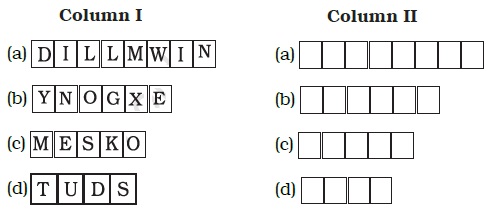
11. In the boxes of Column I the letters of some words got jumbled. Arrange them in proper form in the boxes given in Column II
12. Make sentences using the given set of words.
(a) 99%, oxygen, nitrogen, air, together
(b) Respiration, dissolved, animals, air, aquatic
(c) Air, wind, motion, called
13. A list of words is given in a box. Use appropriate words to fill up the blanks in the following statements:
Air, oxygen, wind, water vapour, mixture, combination, direction, road, bottles, cylinders.
(a) The ______ makes the windmill rotate.
(b) Air is a ______ of some gases.
(c) A weather cock shows the ______ in which the air is moving at that place.
(d) Mountaineers carry oxygen ______ with them, while climbing high mountains.
17. Explain the following observations very briefly
(a) A firki does not rotate in a closed area.
(b) The arrow of weather cock points towards a particular direction at a particular moment.
(c) An empty glass in fact is not empty.
(d) Breathing through mouth may harm you.
18. Write just a few sentences for an imaginary situation if any of the following gases disappear from the atmosphere:
(a) oxygen
(b) nitrogen
(c) carbon dioxide

Science
Class 6 (English Medium)
NCERT Science Textbook
Chapter-wise NCERT Solutions for Class 6 to 12 prepared according to the latest CBSE syllabus.
English Medium
NCERT Solutions Class 6 Science
Chapter 1. FOOD: WHERE DOES IT COME FROM Solutions
1. FOOD: WHERE DOES IT COME FROM Open Chapters
Explore Now →
NCERT Solutions Class 6 Science
Chapter 2. COMPONENTS OF FOOD Solutions
2. COMPONENTS OF FOOD Open Chapters
Explore Now →
NCERT Solutions Class 6 Science
Chapter 3. FIBRE TO FABRIC Solutions
3. FIBRE TO FABRIC Open Chapters
Explore Now →
NCERT Solutions Class 6 Science
Chapter 4. SORTING MATERIAL INTO GROUPS Solutions
4. SORTING MATERIAL INTO GROUPS Open Chapters
Explore Now →
NCERT Solutions Class 6 Science
Chapter 5. SEPARATION OF SUBSTANCES Solutions
5. SEPARATION OF SUBSTANCES Open Chapters
Explore Now →
NCERT Solutions Class 6 Science
Chapter 6. CHANGES AROUND US Solutions
6. CHANGES AROUND US Open Chapters
Explore Now →
NCERT Solutions Class 6 Science
Chapter 7. GETTING TO KNOW PLANTS Solutions
7. GETTING TO KNOW PLANTS Open Chapters
Explore Now →
NCERT Solutions Class 6 Science
Chapter 8. BODY MOVEMENTS Solutions
8. BODY MOVEMENTS Open Chapters
Explore Now →
NCERT Solutions Class 6 Science
Chapter 9. THE LIVING ORGANISMS AND THEIR SURROUNDINGS Solutions
9. THE LIVING ORGANISMS AND THEIR SURROUNDINGS Open Chapters
Explore Now →
NCERT Solutions Class 6 Science
Chapter 10. MOTION AND MEASUREMENT OF DISTANCES Solutions
10. MOTION AND MEASUREMENT OF DISTANCES Open Chapters
Explore Now →
NCERT Solutions Class 6 Science
Chapter 11. LIGHT, SHADOWS AND REFLECTIONS Solutions
11. LIGHT, SHADOWS AND REFLECTIONS Open Chapters
Explore Now →
NCERT Solutions Class 6 Science
Chapter 12. ELECTRICITY AND CIRCUITS Solutions
12. ELECTRICITY AND CIRCUITS Open Chapters
Explore Now →
NCERT Solutions Class 6 Science
Chapter 13. FUN WITH MAGNETS Solutions
13. FUN WITH MAGNETS Open Chapters
Explore Now →
NCERT Solutions Class 6 Science
Chapter 15. AIR AROUND US Solutions
15. AIR AROUND US Open Chapters
Explore Now →
NCERT Solutions Class 6 Science
Chapter 16. GARBAGE IN, GARBAGE OUT Solutions
16. GARBAGE IN, GARBAGE OUT Open Chapters
Explore Now →
Class 6 NCERT Book Solutions
Chapter-wise NCERT Solutions for Class 6 to 12 prepared according to the latest CBSE syllabus.
ENGLISH MEDIUM
NCERT Solutions Class 6 Mathematics
Class 6 Mathematics Book Solutions
Mathematics Open Book
Explore Now →
NCERT Solutions Class 6 Science Curiosity
Class 6 Science Curiosity Book Solutions
Curiosity Open Book
Explore Now →Benefits of Studying NCERT Solutions
Studying from NCERT Solutions helps students build strong conceptual understanding and improve problem-solving skills. These solutions are especially useful for revision because every answer is written according to the marking scheme followed by CBSE.
- Improve conceptual understanding.
- Learn correct answer-writing techniques.
- Prepare effectively for school examinations.
- Complete syllabus revision in less time.
- Practice important textbook questions.
- Build confidence before examinations.
Prepared According to the Latest CBSE Syllabus
All NCERT Book Solutions for Class 6 available on ATP Education are updated according to the latest CBSE curriculum. Whenever NCERT introduces changes in textbooks or syllabus, our study materials are revised accordingly so that students always receive accurate and updated content.
Helpful for Competitive Examinations
NCERT textbooks form the foundation of many competitive examinations. Students preparing for Olympiads, NTSE, CUET, UPSC Foundation, SSC and several entrance examinations can strengthen their basics through these chapter-wise solutions. Understanding NCERT concepts also improves analytical thinking and logical reasoning.
Simple and Student-Friendly Explanations
Our experts prepare every answer in a simple, clear and student-friendly format. Difficult concepts are explained step by step with proper reasoning so that students of every learning level can understand them easily. This approach helps students remember concepts for a longer period and perform confidently during examinations.
Start Learning with ATP Education
Explore the complete collection of NCERT Solutions for Class 6 and begin your preparation with confidence. Every chapter is available online for free and can be accessed anytime. Whether you want to complete homework, revise important chapters or prepare for examinations, ATP Education provides reliable and high-quality study resources to help you achieve academic success.
Explore Subjects









Why Students Choose Us
Free Study Materials
Get completely free NCERT solutions, notes and board preparation resources.
Updated Notes
Latest CBSE and NCERT syllabus based notes for all major classes.
Practice Tests
Improve performance with chapter-wise MCQ tests and quizzes.
Trending Study Materials
2M+
Monthly Students
50K+
Study Notes
10K+
MCQ Questions
500+
Mock Tests