9. Force and Laws of Motion - Class 9 Science English CBSE Notes
CBSE Notes for Class 9 are one of the most useful study resources for students who want to understand every chapter clearly and perform well in school examinations. At ATP Education, we provide carefully prepared chapter-wise CBSE Notes for Class 9 based on the latest CBSE syllabus and NCERT curriculum. These notes are designed to simplify learning, improve conceptual understanding, and help students revise important topics quickly before examinations.
CBSE Notes for Class 9 – Chapter-wise Revision Notes
Every chapter is explained in a simple and student-friendly manner so that learners can understand difficult concepts without confusion. Whether you are preparing for class tests, periodic assessments, half-yearly examinations, annual examinations, or board-oriented assessments, our Class 9 CBSE Notes help you revise the complete syllabus in less time while covering all the important concepts.

9. Force and Laws of Motion - Class 9 Science English CBSE Notes
9. Force and Laws of Motion
Chapter 9. Force And Law Of Motion
Force : Force is push or pull which change or it has tendency to change the position of body.
In other words;
Applied pushing, hitting and pulling on an object is known as force.
The S.I unit of force is neuton (N) or kgm-2.
It is a vector quantity. It has both magnitude and direction.
Force is caused motion in an object.
Type of forces:
1. Friction force: This is a force which acts opposite to the direction of motion. It acting between to surfaces. Example:
(i) When we walk the force acting between our slipper and the earth.
(ii) When a car runs on the road force acting between tires and the road.
Reducing the friction force:
For reducing or minimising the frictional force we use
(i) Smooth marble
(ii) Smooth plane
(iii) Providing a lubricant on top of the planes
2. Centripital force:
3. Magnetic force:
4. Gravitational force:
Acording to its severity there are two kinds of force is known;
(i) Balanced force : If the resultant of several force acting on a body is zero then force are said to be balanced force.
(ii) Unbalanaced force : If the resultant of several force acting on a body is not zero then force are said to be balanced force.
- If an unbalanced force is applied on the object, there will be a change either in its speed or in the direction of its motion.
- An unbalanced force is required to accelerate the motion of an object.
- The change in the speed (or in the direction of motion) of object would continue as long as this unbalanced force is applied.
Newton further studied Galileo’s ideas on force and motion and presented three fundamental laws that govern the motion of objects. These three laws are known as Newton’s laws of motion.
(1) The First Law of Motion
(2) The Second Law of Motion
(3) The Third Law of Motion
9. Force and Laws of Motion
Chapter 9. Force and Laws of Motion
(1) The First Law of Motion:
The first law of motion states;
"An object remains in a state of rest or of uniform motion in a straight line unless
compelled to change that state by an applied force."
In other words: all objects resist a change in their state of motion.
- The first law of motion tells us that the motion of an object due to applying unbalanced force. When an unbalanced force is applied to any object it moves due to force.
- The first law of motion indicates that when an unbalanced external force acts on an object, its velocity changes, that is, the object
gets an acceleration.
Inertia:
Defintion: There is a resistance offered by an object to change its state of motion. If it is at rest it tends to remain at rest; if it is moving it tends to keep moving. This property of an object is called its inertia.
- Inertia is a property or tendency of every object.
- Inertia is measured by mass of an object.
- The heavier object has the greater inertia than the light object.
Law of inertia:
The tendency of undisturbed objects to stay at rest or to keep moving with the same velocity is called inertia.
Types of inertia :
(i) Inertia of Rest
(ii) Inertia of motion
(iii) Inertia of direction
Examples of inertia:
(I) Travelling in a car: While travelling in a motorcar can be explained on the basis of the law of inertia. We tend to remain at rest with respect to the seat until the drives applies a braking force to stop the motorcar. With the application of brakes, the car slows down but our body tends to continue in the same state of motion because of its inertia. A sudden application of brakes may thus cause injury to us by impact or collision with the panels in front. Safety belts are worn to prevent such accidents. Safety belts exert a force on our body to make the forward motion slower.
(ii) Standing in bus: When we are standing in a bus and the bus begins to move suddenly. Now we tend to fall backwards. This is because the sudden start of the bus brings motion to the bus as well as to our feet in contact with the floor of the bus. But the rest of our body opposes this motion because of its inertia.
(iii) Sharp turning at high speed of a car: When a motorcar makes a sharp turn at a high speed, we tend to get thrown to one side. This can again be explained on the basis of the law of inertia. We tend to continue in our straight-line motion. When an unbalanced force is applied by the engine to change the direction of motion of the motorcar, we slip to one side of the seat due to the inertia of our body.
- A body will remain at rest unless acted upon by an unbalanced force.
(iv) Hitting aarom coins by a stricker: When we attempt a sharp horizontal hit at the botton of the pile using another carom coins or stricker. If the hits is strong enough. the bottom coin moves out quickly and removed and due to inertia of the other coins makes them fall vertically on the table.
This is why, the first law of motion is also known as the law of inertia.
Mass: The quantity of material present in a object is called its mass.
The mass of an object is a measure of its inertia.
Differences between Inertia and Mass:
| Inertia | Mass |
|
1. Inertia is a property of an object. 2. Intertia of a object is measured by its mass. |
1. Mass is a amount of material of an object. 2. Mass is a measurable quantity itself. |
9. Force and Laws of Motion
Chapter 9. Force and Laws of Motion
(2) The Second Law of Motion:
- The acceleration of an object depends on the force applied to it and how we measure a force.
- The second law of motion give the formulla to measure the applied force on an object.
- If an object is to be accelerated, we know that a greater force is required to give a greater velocity.
- The effects produced by an object is depended on the mass and the velocity of the object.
Momentum: The momentum is an another type of quantity which is represented by Neuton.
Momentum is defined by the product of mass and velocity of an object.
Defintion:
"Momentum is the product of mass and velocity of an object."
It is denoted by the letter "p". It is a vector quantity. As it has both magnitude and direction. It has same direction as velocity of an object.
S.I unit of momentum is kilogram-meter/second (kgms-1)
As we know that the change in velocity is made using applying the unbalanced force on the object, so force can change the momentum of an object.
Two factors which can change the momentum of an object:
(i) Change in mass of an object
(ii) Change in velocity of an object
- the force necessary to change the momentum of an object depends on the time rate at which the momentum is changed.
The Second Law of Motion:
The second law of motion states, "the rate of change of momentum of an object is proportional to the applied unbalanced force in the direction of force."
- The Second law of motion gives a method to measure the force applied on an object.
Mathematically find the force from the second law of motion:
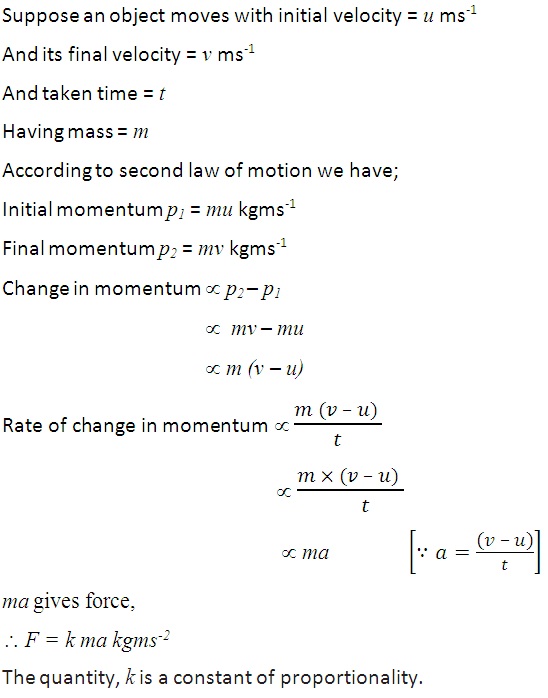
- The rate of change in momentum is actualy force.
- In decreasing in the rate of change in momentum is also decrease in amount of force.
What to do to decrease the force or the rate in change of momentum in our daily life?
Uses of the second law of motion in daily life:
(i) A cricket player pulls his hand backward while catching ball:
While catching a fast moving cricket ball, a fielder in the ground gradually pulls his hands backwards with the moving ball. This is why, The fast moving ball has a large amount of momemtum, due to its high velocity. This ball carries greater force, that may cause hand injury. Therefore the fielder pulls his hand backward to increase the time, Due to incerase in time the rate of change in momentum decreases to zero.
(ii) Using a cushioned bed or on a sand bed in high jump:
In a high jump athletic event, the athletes are made to fall either on a cushioned bed or on a sand bed. This is to increase the time of the athlete’s fall to stop after making the jump. This decreases the rate of change of momentum and hence the force.
9. Force and Laws of Motion
Chapter 9. Force and Laws of Motion
(3) The Third law of motion:
The third law of motion states that when one object exerts a force on another object, the second object instantaneously exerts a force back on the first.
Some important facts about this law-
- These two forces are always equal in magnitude but opposite in direction.
- These forces act on different objects and never on the same object.
- The two opposing forces are also known as action and reaction forces.
How to show the action and reaction forces are equal and opposite:
Let us consider two spring balances connected together as shown in Figure. The fixed end of balance B is attached with a rigid support, like a wall. When a force is applied through the free end of spring balance A, it is observed that both the spring balances show the same readings on their scales. It means that the force exerted by spring balance A on balance B is equal but opposite in direction to the force exerted by the balance B on balance A.
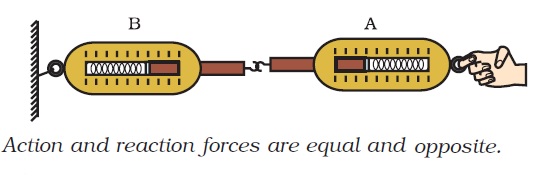
Action force : The force which is applied on an object A and object A exerts that force on object B is called action force.
Reaction force : When object B exerts a force on object A as resulting force applied by A is called reaction force.
Remember:-
- The action and reaction always act on two different objects.
- Every action there is an equal and opposite reaction.
Why action and reaction force always equal in magnitude but may not produce acceleration of equal magnitudes:
The action and reaction forces are always equal in magnitude, these forces may not produce accelerations of equal magnitudes. This is because each force acts on a different object that may have a different mass.
An Example of gun and bullet:
When a gun is fired, it exerts a forward force on the bullet. The bullet exerts an equal
and opposite reaction force on the gun. This results in the recoil of the gun. Since the gun has a much greater mass than the bullet, the acceleration of the gun is much less than the acceleration of the bullet.
The Law of Conservation of Momentum:
The sum of momenta of the two objects before collision is equal to the sum of momenta after the collision provided there is no external unbalanced force acting on them. This is known as the law of conservation of momentum.
This law gives the following mathematical formula,
mAuA + mBuB = mAvA + mBvB
9. Force and Laws of Motion
Assignment:
Q1. When a carpet is beaten with stick, dust particles come out of it. Expain the reason?
Q2. What is law of conservation of momentum?
Q3. Which of the following has more inertia:
(A) a bicycle or a train
(B) a five rupee coin or a one rupee coin
Q4. Write S.I. unit of momentum.
Q5. State whether momentum is scalar or vector?
Q6. What is called the product of mass and velocity of a body?
Q7. Name the scientist who gave the laws of motion.
Q8. if a body have mass 'm' and velocity 'v' then what will be the momentum?
Q9. On the basis of which law of motion rocket works?
Q10. Which law of motion is called the law of inertia.
Q11. Which law of motion gives a method to measure the force?
Q12. Name the physical quantity which is multiply by velocity of an object to obtain momentum.
Q13. Explain, why, it is easier to stop a tennis ball than a cricket ball moving with the same speed.
Q14. Calculate the momentum of a toy car of mass 300 g moving with a speed of 5 m/s.
Q15. Write the S.I unit of force.
9. Force and Laws of Motion
Page is under construction.
9. Force and Laws of Motion
Page is under construction.
Why Choose CBSE Notes for Class 9?
Reading the complete textbook is essential for building knowledge, but revision notes help students organize that knowledge effectively. Our CBSE Revision Notes for Class 9 summarize every chapter by highlighting important concepts, definitions, keywords, formulas, examples, and important points that students should remember during examinations. This approach saves valuable study time and makes revision much easier.
Students often find it difficult to revise lengthy chapters before examinations. Our notes solve this problem by presenting important information in a structured format that is easy to understand and remember. Regular revision using these notes helps improve confidence and strengthens conceptual clarity.
Chapter-wise Study Material
Each chapter included in the CBSE Notes for Class 9 section is prepared according to the latest academic session. Every topic is explained in simple language while maintaining accuracy and completeness. Students can easily revise important concepts, learn key points, and strengthen their understanding of each chapter.
The notes are suitable for daily classroom learning, homework preparation, revision before examinations, and self-study. They also serve as an excellent companion to NCERT textbooks by presenting the most important information in an organized manner.

Explore CBSE Notes Class 9 Science
Chapter-wise NCERT Solutions for Class 6 to 12 prepared according to the latest CBSE syllabus.
English Medium

CBSE Notes Class 9 Science
Chapter 1. Matter in Our Surroundings (CBSE NOTES)
1. Matter in Our Surroundings ()
Explore Now →
CBSE Notes Class 9 Science
Chapter 2. Is Matter around us Pure (CBSE NOTES)
2. Is Matter around us Pure ()
Explore Now →
CBSE Notes Class 9 Science
Chapter 3. Atoms and Molecules (CBSE NOTES)
3. Atoms and Molecules ()
Explore Now →
CBSE Notes Class 9 Science
Chapter 4. Structure of The Atom (CBSE NOTES)
4. Structure of The Atom ()
Explore Now →
CBSE Notes Class 9 Science
Chapter 5. The Fundamental Unit of Life (CBSE NOTES)
5. The Fundamental Unit of Life ()
Explore Now →
CBSE Notes Class 9 Science
Chapter 7. Diversity in Living Organisms (CBSE NOTES)
7. Diversity in Living Organisms ()
Explore Now →
CBSE Notes Class 9 Science
Chapter 9. Force and Laws of Motion (CBSE NOTES)
9. Force and Laws of Motion ()
Explore Now →
CBSE Notes Class 9 Science
Chapter 11. Work and Energy (CBSE NOTES)
11. Work and Energy ()
Explore Now →
CBSE Notes Class 9 Science
Chapter 13. Why Do We Fall ill (CBSE NOTES)
13. Why Do We Fall ill ()
Explore Now →
CBSE Notes Class 9 Science
Chapter 14. Natural Resources (CBSE NOTES)
14. Natural Resources ()
Explore Now →
CBSE Notes Class 9 Science
Chapter 15. Improvement in Food Resources (CBSE NOTES)
15. Improvement in Food Resources ()
Explore Now →Benefits of Using ATP Education Notes
- Latest CBSE syllabus based notes.
- Chapter-wise revision material.
- Easy-to-understand explanations.
- Important concepts and key points.
- Quick revision before examinations.
- Useful for school tests and annual exams.
- Available in Hindi and English Medium.
- Free educational resources for every student.
Your CBSE Notes Library Class 9:
Chapter-wise CBSE Notes for Class 6 to 12 prepared according to the latest CBSE syllabus.
HINDI MEDIUM
CBSE Class 9 Science Exploration
Class 9 Science Exploration CBSE Notes
अन्वेषण Open Notes
Explore Now →
Your CBSE Notes Library For Class 9
Chapter-wise CBSE Notes for Class 6 to 12 prepared according to the latest CBSE syllabus.
ENGLISH MEDIUM
NCERT Solutions Class 9 Science Exploration
Class 9 Science Exploration CBSE Notes
Exploration Open Book
Explore Now →Prepare with Confidence
Success in examinations depends on regular practice, conceptual understanding, and effective revision. Our Class 9 CBSE Notes are designed to help students study smarter instead of studying longer. By revising chapter-wise notes regularly, learners can improve their understanding, remember important concepts for a longer period, and write better answers during examinations.
Along with these notes, students can also explore NCERT Solutions, MCQ Questions, Online Tests, Important Questions, Study Materials, and other learning resources available on ATP Education. Together, these resources provide complete academic support for effective learning and better examination preparation.
Start exploring the CBSE Notes for Class 9 today and make your learning journey easier with well-organized chapter-wise notes, quick revision material, and reliable study resources prepared especially for CBSE students.
Benefits of Studying with Our CBSE Notes
- Chapter-wise Coverage: Every chapter is explained in a structured and easy-to-follow format.
- Latest CBSE Syllabus: Notes are prepared according to the latest CBSE curriculum and NCERT guidelines.
- Quick Revision: Revise important concepts, formulas, definitions, and key points in less time.
- Simple Language: Difficult topics are explained in clear and student-friendly language for better understanding.
- Concept-Based Learning: Focus on understanding concepts instead of memorizing answers.
- Exam-Oriented Preparation: Helps students prepare effectively for class tests, unit tests, half-yearly, annual, and board examinations.
- Subject-wise Organization: Easily access notes for Mathematics, Science, English, Hindi, Social Science, Physics, Chemistry, Biology, Economics, and more.
- Time-Saving Study Material: Well-organized notes reduce study time and improve learning efficiency.
- Improves Answer Writing: Learn important points and present answers in a better and more organized manner.
- Boosts Confidence: Regular revision strengthens concepts and increases confidence before examinations.
- Free Learning Resource: Access high-quality CBSE Notes without any subscription or hidden charges.
- Available in Hindi & English Medium: Study comfortably in your preferred medium with chapter-wise notes.