12. Sound - Class 9 Science English CBSE Notes
CBSE Notes for Class 9 are one of the most useful study resources for students who want to understand every chapter clearly and perform well in school examinations. At ATP Education, we provide carefully prepared chapter-wise CBSE Notes for Class 9 based on the latest CBSE syllabus and NCERT curriculum. These notes are designed to simplify learning, improve conceptual understanding, and help students revise important topics quickly before examinations.
CBSE Notes for Class 9 – Chapter-wise Revision Notes
Every chapter is explained in a simple and student-friendly manner so that learners can understand difficult concepts without confusion. Whether you are preparing for class tests, periodic assessments, half-yearly examinations, annual examinations, or board-oriented assessments, our Class 9 CBSE Notes help you revise the complete syllabus in less time while covering all the important concepts.

12. Sound - Class 9 Science English CBSE Notes
12. Sound
12. Sound
Sound: When an object vibrates it produces sound.
Vibration: When an object moves fast in to and fro motion, this motion is called vibration.

Ways to produce sound:
(i) Hitting on an object.
(ii) By friction
(iii) By scratching
(iv) By rubbing
(v) By blowing or moving any object sound can be produced.
Sound in Human:
In Human being sound is produced by vibrating the vocal chords.
- Sound moves in form of waves.
- Honeybee is produced sound by vibration of its feathers, this is called humming.
Propagation of Sound: The sound travels from one place to another place, this is called propagation of sound.
Medium: Sound does not propagate without any medium. It need medium to travel from one to another place. "substances like solid, liquid or gas provides medium to sound for propagation, such substances are called mediums."
Definition of medium: The matter or substance through which sound is transmitted is called a medium.
Medium of Sound for Propagation:
There are three medium by which sound propagates.
(i) Solid like metalic rod, glass, wood etc.
(ii) Liquid like water, oil and drinks etc.
(iii) Gas like air, and other gases.
- Sound does not propagte in vaccum because it has not any particles of medium.
- The medium which has high density, the sound moves very fast or the speed of sound is greater in that medium.
- So that the speed of sound is the greatest in solid inspite of all mediums.
How does the sound propagates?
When an object vibrates, it sets the particles of the medium around it vibrating. A particle of the medium in contact with the vibrating
object is first displaced from its equilibrium position. It then exerts a force on the adjacent particle. As a result of which the adjacent particle gets displaced from its position of rest. After displacing the adjacent particle the first particle comes back to its original position. This process continues in the medium till the sound reaches our ear.
Compression: When a vibrating object moves forward, it pushes and compresses the air in front of it creating a region of high pressure. This region is called a compression(C).
Rarefaction: When the vibrating object moves backwards, it creates a region of low pressure called rarefaction (R).
Differences between compression and rarefaction:
Compression:
(i) It creates when object moves forward.
(ii) Compression is the region of high pressure.
Rarefaction:
(i) It creates when objects moves backward.
(ii) Rarefaction is the region of low pressure.
Propagation of density variations or pressure variations:
Pressure is related to the number of particles of a medium in a given volume. More density of the particles in the medium gives more pressure and vice versa. Thus, propagation of sound can be visualised as propagation of density variations or pressure variations in the medium.
12. Sound
Sound Wave : Sound is known as the wave and wave is disturbance which is produced by a vibrating object. These wave are longitudinal wave which create by compression and rarefaction.
Sound wave is mechanical wave: Sound waves need medium to propagate from one place to another, in otherhand it need body for transmission, this is the reason that sound waves are called mechanical waves.
Common medium for the propagation of sound : Air is common medium.
Sound waves are longitudinal waves:
Sound wavves are longitudinal waves because the displacement of particles of medium occure parallel to the direction of propagation in these waves. The particles do not move from one place to another but they oscillate in to and fro motion ramain about mean position as the waves travel. Just like this sound waves propagate, therefore sound waves are longitudinal waves.
Features of sound waves:
There are following features of sound waves:
(i) Frequency
(ii) Amplitude
(iii) Velocity
Wavelength : The distance between two consecutive compressions (C) or two consecutive rarefactions (R) is called the wavelength.
Or the distance covered by a wave to complete an oscillation is called wavelength.
Hence wavelength is kind of length, therefore the S.I unit of wavelength is metre (m).
Wavelength is represented by Greek letter λ (lambda).
Frequency: The number of oscillation completed in one second is called frequency.
S.I unit of frequncy is Hertz(Hz).
Time Period : The time taken to complete one oscillation is called it's time period.
- SI unit of time period is second (s). Time period is denoted by T.
- The frequency of a wave is the reciprocal of the time period.

Amplitude : The maximum displacement of the particles of medium from their original undisturbed position (equilibrium position) during the propagation of wave is called amplitude.
Amplitude is denoted by A and its SI unit is metre (m).
Representing graphically the density and pressure variations.
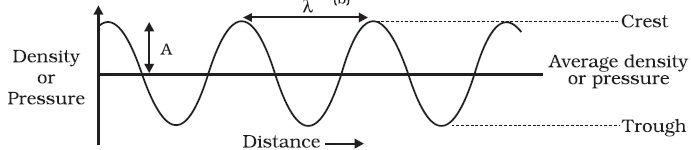
Sound have characteristics like pitch, loudness and timbre.
Crest: A pick of sound wave is called crest.
Trough: A valley of the sound wave is called trough.
Timbre : The quality or timber of sound is that characteristic which enables us to distinguish one sound from another having the same pitch and loudness.
Tone : A sound of single frequency is called a tone.
Note : The sound which is produced due to a mixture of several frequencies is called a note and is pleasant to listen.
Noise: The sound which is unpleasant to ear is called noise.
The speed of sound : The speed of sound is defined as the distance which a point on a wave, such as a compression or a rarefaction, travels per unit time.
Speed (v) = distance/time
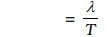
λ is wavelength
T is time period
or v = λ ν
That is, speed = wavelength × frequency.
- The speed of sound remains almost the same for all frequencies in a given medium under the same physical conditions.
Example 1. A sound wave has a frequency of 2 kHz and wave length
35 cm. Find the speed of sound.
Solution:
Given,
Frequency, ν = 2 kHz = 2000 Hz
Wavelength, λ = 35 cm = 0.35 m
Speed (v) = wavelength × frequency
= λ ν
= 0.35 × 2000
= 700 m/s
Therefore speed is 700 m/s
Example 2. Calculate the wavelength of a sound wave whose frequency is 220 Hz and speed is 440 m/s in a given medium.
Solution:
Frequency = 220 Hz
Speed = 440 m/s
Wavelength = speed/frequency
= 440/220
= 2 m
Therefore, wavelength is 2 m
Intensity of sound : The amount of sound energy passing each second through unit area is called the intensity of sound.
Loudness of sound : Loudness is a measure of the response of the
ear to the sound.
Factors on which the loudness of sound depends:
(i) Loudness of sound depends on apletudes of vibration.
Transverse wave:
1. Particles of the medium moves in a direction parallel to the direction of propagation of the disturbance.
2. It forms compression and rarefaction.
3. Example – light wave.
Longitudinal wave:
1. Particles do not oscillate along the line of wave propagation but oscillate up and down about their mean position as the wave travels
2. It forms crest and trough.
3. Example – sound wave.
12. Sound
Reflection of sound:
Factors which influences the speed of sound:
(i) Temperature: The speed of sound changes with temperature.
For example, the speed of sound in air is 331 m s–1 at 0 ०C and 344 m s–1 at 22 ०C. The speeds of sound at a particular temperature.
(ii) Particles of Medium : The speed of sound decreases when we go from solid to gaseous state. So in different medium the speed of sound is different.
Speed of sound and speed of light: The speed of sound is less than the speed of light. For example, The sound of a thunder is heard
a little later than the flash of light is seen. Because the speed of light is very faster than speed of sound. So light comes to us soon while sound travels very late to us.
Sound Boom : When the speed of any object exceeds the speed of sound it is said to be travelling at supersonic speed. Bullets, jet
aircrafts etc. When a sound, producing source moves with a speed higher than that of sound, it produces shock waves in air. These shock waves carry a large amount of energy. The air pressure variation
associated with this type of shock waves produces a very sharp and loud sound called the “sonic boom”.
Reflection of Sound:

The reflection of sound is same phenominom like reflection of sound. It also follows the same law of reflection.
Law of reflection of sound:
(i) The directions in which the sound is incident and is reflected make equal angles.
(iii) The angle of incident, angle of reflection and the normal to the reflecting surface are in the same plane.
Essential factor for reflection of sound:
(i) It need a large size of barrier/obstacle of polished or rough surafce.
Echo Sound : When any sound refelects by any obstacle, we hear the same sound again a little later. This sound which we hear is called an echo sound.
Condition to hear the echo sound:
1. Sensation of sound : The sensation of sound persists in our brain for about 0.1 s.
2. Condition to hear echo sound: To hear a distinct echo the time interval between the original sound and the reflected one must be at least 0.1s.
3. Distance of obstacle : For hearing distinct echoes, the minimum distance of the obstacle from the source of sound must be half of this distance, that is, 17.2 m.
Common Use of the reflection of sound :
(i) By using the multiple reflection of sound megaphones or loudspeaker, horns and some musical instruments are made.
(ii) Stethoscope: Stethoscope is a medical instrument which is used to hear various internal sounds of human heart and lungs. It also helps to identify the varietes of different organs sound.
Method of stethoscope:
In stethoscopes the sound of the patient’s heartbeat reaches the doctor’s ears by multiple reflection of sound.
(iii) The ceiling of concert halls are design in such way that sound after reflection reaches to all corners of the hall.
Reverberation : The repeated reflection of sound that results in the persistance of sound is called reverberation.
Methods to reduce reverberation:
(i) The curtains are suspended in the buildings to reduce it so that the sound can be absorbed.
(ii) By increasing the presence of listeners in the rooms or auditoriums, the sound is absorbed by it as well.
(iii) To reduce it, compressed fiber board, rough plaster etc. are applied.
(iv) The right choice of seat's materials in the seats also act as sound absorbers.
12. Sound
The Types of Sound :
We can't hear all kinds of sound. On the basis of hearing there are three types of sound:
(1) Infrasound : The sound of frequency less than 20 Hz is called infrasound or infrasonic sound. Such type of sound can't be heared by human being. There are some animals that produce infrasound.
(i) Rhinoceroses : Rhinoceroses communicate using infrasound of frequency as low as 5 Hz.
(ii) Whales and Elephant : Whales and elephants produce sound in the
infrasound range.
(iii) Rats and snake : It is observed that some animals get disturbed before earthquakes. Earthquakes produce low-frequency infrasound before the main shock waves begin which possibly alert the animals.
(2) Audible sound : The sound of frequency between 20 Hz to 20000 Hz is called audible sound.
(3) Ultrasound : Frequencies higher than 20 kHz are called ultrasonic sound or ultrasound. Ultrasound is produced by dolphins, bats and porpoises. Rats also play games by producing ultrasound.
Hearing Aid: People with hearing loss may need a hearing aid. A hearing aid is an electronic, battery operated device. The hearing aid receives sound through a microphone. The microphone converts the sound waves to electrical signals. These electrical signals are amplified by an amplifier. The amplified electrical signals are given to a speaker of the hearing aid. The speaker converts the amplified electrical signal to sound and sends to the ear for clear hearing.
Applications of Ultrasound :
Ultrasounds are high frequency waves. Ultrasounds are able to travel along welldefined paths even in the presence of obstacles.
Ultrasounds are used extensively in industries and for medical purposes.
Applications of Ultrasound:
(i) Ultrasound is generally used to clean parts located in hard-to-reach places, for example, spiral tube, odd shaped parts, electronic components etc.
(ii) Ultrasounds can be used to detect cracks and flaws in metal blocks.
(iii) Ultrasound is used in the medical field to detect illnesses/diseases.
(iv) Ultrasound is used in a device named SONAR, which is used to measure the depth of ocean in the ships.
12. Sound
Page is under construction.
12. Sound
Page is under construction.
12. Sound
Page is under construction.
Why Choose CBSE Notes for Class 9?
Reading the complete textbook is essential for building knowledge, but revision notes help students organize that knowledge effectively. Our CBSE Revision Notes for Class 9 summarize every chapter by highlighting important concepts, definitions, keywords, formulas, examples, and important points that students should remember during examinations. This approach saves valuable study time and makes revision much easier.
Students often find it difficult to revise lengthy chapters before examinations. Our notes solve this problem by presenting important information in a structured format that is easy to understand and remember. Regular revision using these notes helps improve confidence and strengthens conceptual clarity.
Chapter-wise Study Material
Each chapter included in the CBSE Notes for Class 9 section is prepared according to the latest academic session. Every topic is explained in simple language while maintaining accuracy and completeness. Students can easily revise important concepts, learn key points, and strengthen their understanding of each chapter.
The notes are suitable for daily classroom learning, homework preparation, revision before examinations, and self-study. They also serve as an excellent companion to NCERT textbooks by presenting the most important information in an organized manner.

Explore CBSE Notes Class 9 Science
Chapter-wise NCERT Solutions for Class 6 to 12 prepared according to the latest CBSE syllabus.
English Medium

CBSE Notes Class 9 Science
Chapter 1. Matter in Our Surroundings (CBSE NOTES)
1. Matter in Our Surroundings ()
Explore Now →
CBSE Notes Class 9 Science
Chapter 2. Is Matter around us Pure (CBSE NOTES)
2. Is Matter around us Pure ()
Explore Now →
CBSE Notes Class 9 Science
Chapter 3. Atoms and Molecules (CBSE NOTES)
3. Atoms and Molecules ()
Explore Now →
CBSE Notes Class 9 Science
Chapter 4. Structure of The Atom (CBSE NOTES)
4. Structure of The Atom ()
Explore Now →
CBSE Notes Class 9 Science
Chapter 5. The Fundamental Unit of Life (CBSE NOTES)
5. The Fundamental Unit of Life ()
Explore Now →
CBSE Notes Class 9 Science
Chapter 7. Diversity in Living Organisms (CBSE NOTES)
7. Diversity in Living Organisms ()
Explore Now →
CBSE Notes Class 9 Science
Chapter 9. Force and Laws of Motion (CBSE NOTES)
9. Force and Laws of Motion ()
Explore Now →
CBSE Notes Class 9 Science
Chapter 11. Work and Energy (CBSE NOTES)
11. Work and Energy ()
Explore Now →
CBSE Notes Class 9 Science
Chapter 13. Why Do We Fall ill (CBSE NOTES)
13. Why Do We Fall ill ()
Explore Now →
CBSE Notes Class 9 Science
Chapter 14. Natural Resources (CBSE NOTES)
14. Natural Resources ()
Explore Now →
CBSE Notes Class 9 Science
Chapter 15. Improvement in Food Resources (CBSE NOTES)
15. Improvement in Food Resources ()
Explore Now →Benefits of Using ATP Education Notes
- Latest CBSE syllabus based notes.
- Chapter-wise revision material.
- Easy-to-understand explanations.
- Important concepts and key points.
- Quick revision before examinations.
- Useful for school tests and annual exams.
- Available in Hindi and English Medium.
- Free educational resources for every student.
Your CBSE Notes Library Class 9:
Chapter-wise CBSE Notes for Class 6 to 12 prepared according to the latest CBSE syllabus.
HINDI MEDIUM
CBSE Class 9 Science Exploration
Class 9 Science Exploration CBSE Notes
अन्वेषण Open Notes
Explore Now →
Your CBSE Notes Library For Class 9
Chapter-wise CBSE Notes for Class 6 to 12 prepared according to the latest CBSE syllabus.
ENGLISH MEDIUM
NCERT Solutions Class 9 Science Exploration
Class 9 Science Exploration CBSE Notes
Exploration Open Book
Explore Now →Prepare with Confidence
Success in examinations depends on regular practice, conceptual understanding, and effective revision. Our Class 9 CBSE Notes are designed to help students study smarter instead of studying longer. By revising chapter-wise notes regularly, learners can improve their understanding, remember important concepts for a longer period, and write better answers during examinations.
Along with these notes, students can also explore NCERT Solutions, MCQ Questions, Online Tests, Important Questions, Study Materials, and other learning resources available on ATP Education. Together, these resources provide complete academic support for effective learning and better examination preparation.
Start exploring the CBSE Notes for Class 9 today and make your learning journey easier with well-organized chapter-wise notes, quick revision material, and reliable study resources prepared especially for CBSE students.
Benefits of Studying with Our CBSE Notes
- Chapter-wise Coverage: Every chapter is explained in a structured and easy-to-follow format.
- Latest CBSE Syllabus: Notes are prepared according to the latest CBSE curriculum and NCERT guidelines.
- Quick Revision: Revise important concepts, formulas, definitions, and key points in less time.
- Simple Language: Difficult topics are explained in clear and student-friendly language for better understanding.
- Concept-Based Learning: Focus on understanding concepts instead of memorizing answers.
- Exam-Oriented Preparation: Helps students prepare effectively for class tests, unit tests, half-yearly, annual, and board examinations.
- Subject-wise Organization: Easily access notes for Mathematics, Science, English, Hindi, Social Science, Physics, Chemistry, Biology, Economics, and more.
- Time-Saving Study Material: Well-organized notes reduce study time and improve learning efficiency.
- Improves Answer Writing: Learn important points and present answers in a better and more organized manner.
- Boosts Confidence: Regular revision strengthens concepts and increases confidence before examinations.
- Free Learning Resource: Access high-quality CBSE Notes without any subscription or hidden charges.
- Available in Hindi & English Medium: Study comfortably in your preferred medium with chapter-wise notes.