10. Gravitation - Class 9 Science English CBSE Notes
CBSE Notes for Class 9 are one of the most useful study resources for students who want to understand every chapter clearly and perform well in school examinations. At ATP Education, we provide carefully prepared chapter-wise CBSE Notes for Class 9 based on the latest CBSE syllabus and NCERT curriculum. These notes are designed to simplify learning, improve conceptual understanding, and help students revise important topics quickly before examinations.
CBSE Notes for Class 9 – Chapter-wise Revision Notes
Every chapter is explained in a simple and student-friendly manner so that learners can understand difficult concepts without confusion. Whether you are preparing for class tests, periodic assessments, half-yearly examinations, annual examinations, or board-oriented assessments, our Class 9 CBSE Notes help you revise the complete syllabus in less time while covering all the important concepts.

10. Gravitation - Class 9 Science English CBSE Notes
10. Gravitation
The Universal Law of gravitation:
Gravitational force:
All the heavenly bodies attract each other. There is a force which acts on. This force is called gravitational force.
In other words:
Gravitational force: The force attracting two objects is known as gravitational force.
Universal Law of Gravitaion:
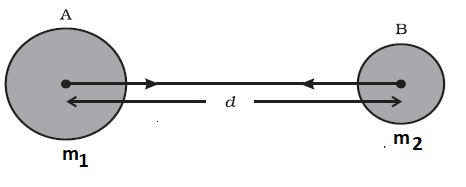
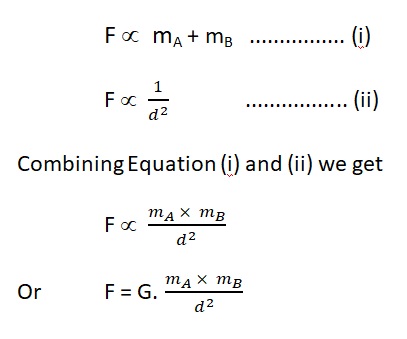
The law of gravitation states that the force of attraction between any two objects is proportional to the product of their masses and inversely proportional to the square of the distance between them. The law applies to objects anywhere in the universe. Such a law is said to be universal.
This law gives a formula to find this force.
The value of G was found out by Henry Cavendish (1731 – 1810) by using a
sensitive balance.
The accepted value of G : 6.673 X 10⁻¹¹ N m2 Kg-2
- The law is universal in the sense that it is applicable to all bodies, whether the bodies are big or small, whether they are celestial or terrestrial.
- The universal law of gravitation is given by Sir Isaac Newton.
IMPORTANCE OF THE UNIVERSAL LAW OF GRAVITATION
(i) The force that binds us to the earth;
(ii) The motion of the moon around the earth;
(iii) The motion of planets around the Sun;
(iv) The tides due to the moon and the Sun.
Centripetal force : When we moves a stone released with thread in a circular path with a certain speed, then it changes direction at every point. The change in direction involves change in velocity and acceleration. The force that causes this acceleration and keeps the body moving along the circular path is acting toward the centre. This force is called the centripetal force.
10. Gravitation
Free Fall : Whenever objects fall towards the earth under this force alone, we
say that the objects are in free fall.
Falling objects have the following properties:
(i) There is no change in the direction of motion of the objects.
(ii) due to the earth’s attraction, there will be a change in the magnitude of the velocity.
(iii) Any change in velocity involves acceleration.
(iv) Whenever an object falls towards the earth, an acceleration is involved.
(v) This acceleration is due to the earth’s gravitational force.
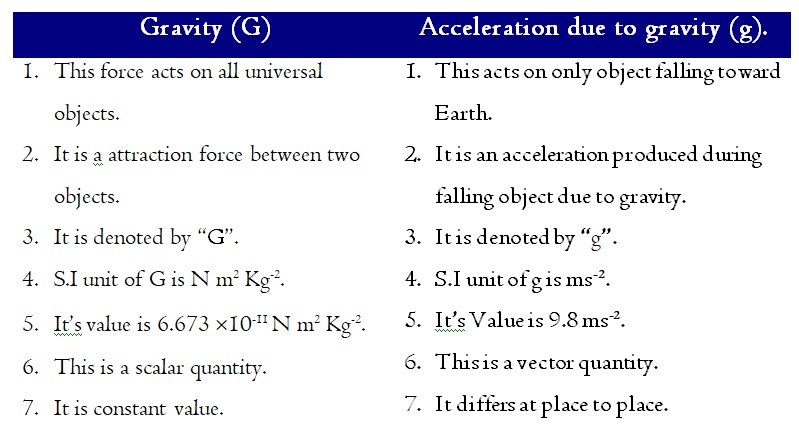
Acceleration due to gravity:
Whenever an object falls towards the earth, an acceleration is involved. This acceleration is due to the earth’s gravitational force. This acceleration is called acceleration due to gravity.
It is denoted by g. The unit of g is the same as that of acceleration, that is, ms-2.
We know from the second law of motion that force is the product of mass and
acceleration.
F = ma
We already know that there is acceleration involved in falling objects due
to the gravitational force and is denoted by g.
Here we use g as accelaration of falling object.
Now, We have
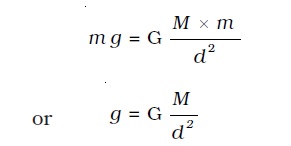
F = mg
Now we can derive two other formula
The value of "g" is differ at different place of Earth:
The earth is not a perfect sphere. As the radius of the earth increases from the poles to the equator, the value of g becomes greater at the poles than at the equator.
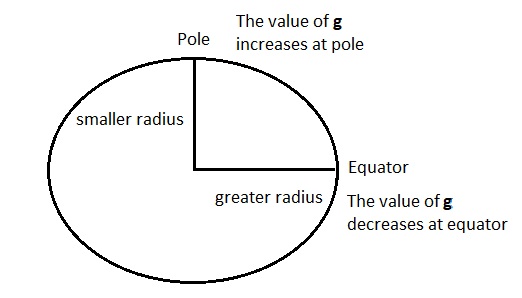
Where on the value of g is greater the weight of any object also increases due to the gravity force. While where is the greater radius like equator the weight of an object also decreases.
10. Gravitation
10. Gravitation
10. Gravitation
Thrust And Pressure:
Weight: Weight is the force acting vertically downwards.
Thrust: The force acting on an object perpendicular to the surface is called thrust.
Pressure: The force (thrust) exerted by an object per unit area is called pressure. SI unit of pressure N/m2 or N m-2 This unit is known as Pascal, which is denoted by Pa.
Pressure = Thrust/area
Understanding this by a simple example:
lets force (thrust) = 10 N
And Area = 2 m2,
then,
Pressure = 10 / 2 N/m2
= 5 N/m2
if area increases by 5 m2 on same force.
Pressure = 10 / 5 N/m2
= 2 N/m2
We get conclusion that if increases the area on same force
Important points:
- The effect of thrust depends on the area on which it acts.
- Area is inverse proportionally to the pressure, It means the same force acting on a smaller area exerts a larger pressure, and a larger area exerts a smaller pressure.
- if larger thrust (force) acting on same area pressure will be larger and smaller thrust acting on same area pressure will be smaller, so relation between thrust and pressure is direct proportionally.
Up thrust or buoyant force depends on:
(i) The size or volume of the body immersed in a liquid.
(ii) The density of the liquid in which the body is immersed.
10. Gravitation
Page is under construction.
10. Gravitation
Page is under construction.
10. Gravitation
Page is under construction.
Why Choose CBSE Notes for Class 9?
Reading the complete textbook is essential for building knowledge, but revision notes help students organize that knowledge effectively. Our CBSE Revision Notes for Class 9 summarize every chapter by highlighting important concepts, definitions, keywords, formulas, examples, and important points that students should remember during examinations. This approach saves valuable study time and makes revision much easier.
Students often find it difficult to revise lengthy chapters before examinations. Our notes solve this problem by presenting important information in a structured format that is easy to understand and remember. Regular revision using these notes helps improve confidence and strengthens conceptual clarity.
Chapter-wise Study Material
Each chapter included in the CBSE Notes for Class 9 section is prepared according to the latest academic session. Every topic is explained in simple language while maintaining accuracy and completeness. Students can easily revise important concepts, learn key points, and strengthen their understanding of each chapter.
The notes are suitable for daily classroom learning, homework preparation, revision before examinations, and self-study. They also serve as an excellent companion to NCERT textbooks by presenting the most important information in an organized manner.

Explore CBSE Notes Class 9 Science
Chapter-wise NCERT Solutions for Class 6 to 12 prepared according to the latest CBSE syllabus.
English Medium

CBSE Notes Class 9 Science
Chapter 1. Matter in Our Surroundings (CBSE NOTES)
1. Matter in Our Surroundings ()
Explore Now →
CBSE Notes Class 9 Science
Chapter 2. Is Matter around us Pure (CBSE NOTES)
2. Is Matter around us Pure ()
Explore Now →
CBSE Notes Class 9 Science
Chapter 3. Atoms and Molecules (CBSE NOTES)
3. Atoms and Molecules ()
Explore Now →
CBSE Notes Class 9 Science
Chapter 4. Structure of The Atom (CBSE NOTES)
4. Structure of The Atom ()
Explore Now →
CBSE Notes Class 9 Science
Chapter 5. The Fundamental Unit of Life (CBSE NOTES)
5. The Fundamental Unit of Life ()
Explore Now →
CBSE Notes Class 9 Science
Chapter 7. Diversity in Living Organisms (CBSE NOTES)
7. Diversity in Living Organisms ()
Explore Now →
CBSE Notes Class 9 Science
Chapter 9. Force and Laws of Motion (CBSE NOTES)
9. Force and Laws of Motion ()
Explore Now →
CBSE Notes Class 9 Science
Chapter 11. Work and Energy (CBSE NOTES)
11. Work and Energy ()
Explore Now →
CBSE Notes Class 9 Science
Chapter 13. Why Do We Fall ill (CBSE NOTES)
13. Why Do We Fall ill ()
Explore Now →
CBSE Notes Class 9 Science
Chapter 14. Natural Resources (CBSE NOTES)
14. Natural Resources ()
Explore Now →
CBSE Notes Class 9 Science
Chapter 15. Improvement in Food Resources (CBSE NOTES)
15. Improvement in Food Resources ()
Explore Now →Benefits of Using ATP Education Notes
- Latest CBSE syllabus based notes.
- Chapter-wise revision material.
- Easy-to-understand explanations.
- Important concepts and key points.
- Quick revision before examinations.
- Useful for school tests and annual exams.
- Available in Hindi and English Medium.
- Free educational resources for every student.
Your CBSE Notes Library Class 9:
Chapter-wise CBSE Notes for Class 6 to 12 prepared according to the latest CBSE syllabus.
HINDI MEDIUM
CBSE Class 9 Science Exploration
Class 9 Science Exploration CBSE Notes
अन्वेषण Open Notes
Explore Now →
Your CBSE Notes Library For Class 9
Chapter-wise CBSE Notes for Class 6 to 12 prepared according to the latest CBSE syllabus.
ENGLISH MEDIUM
NCERT Solutions Class 9 Science Exploration
Class 9 Science Exploration CBSE Notes
Exploration Open Book
Explore Now →Prepare with Confidence
Success in examinations depends on regular practice, conceptual understanding, and effective revision. Our Class 9 CBSE Notes are designed to help students study smarter instead of studying longer. By revising chapter-wise notes regularly, learners can improve their understanding, remember important concepts for a longer period, and write better answers during examinations.
Along with these notes, students can also explore NCERT Solutions, MCQ Questions, Online Tests, Important Questions, Study Materials, and other learning resources available on ATP Education. Together, these resources provide complete academic support for effective learning and better examination preparation.
Start exploring the CBSE Notes for Class 9 today and make your learning journey easier with well-organized chapter-wise notes, quick revision material, and reliable study resources prepared especially for CBSE students.
Benefits of Studying with Our CBSE Notes
- Chapter-wise Coverage: Every chapter is explained in a structured and easy-to-follow format.
- Latest CBSE Syllabus: Notes are prepared according to the latest CBSE curriculum and NCERT guidelines.
- Quick Revision: Revise important concepts, formulas, definitions, and key points in less time.
- Simple Language: Difficult topics are explained in clear and student-friendly language for better understanding.
- Concept-Based Learning: Focus on understanding concepts instead of memorizing answers.
- Exam-Oriented Preparation: Helps students prepare effectively for class tests, unit tests, half-yearly, annual, and board examinations.
- Subject-wise Organization: Easily access notes for Mathematics, Science, English, Hindi, Social Science, Physics, Chemistry, Biology, Economics, and more.
- Time-Saving Study Material: Well-organized notes reduce study time and improve learning efficiency.
- Improves Answer Writing: Learn important points and present answers in a better and more organized manner.
- Boosts Confidence: Regular revision strengthens concepts and increases confidence before examinations.
- Free Learning Resource: Access high-quality CBSE Notes without any subscription or hidden charges.
- Available in Hindi & English Medium: Study comfortably in your preferred medium with chapter-wise notes.