
NCERT Solutions for Class 8 – Complete Chapter-wise Study Material
13. Direct and Inverse Proportions is one of the most important chapters in the Class 8 Mathematics English NCERT Solutions curriculum. This chapter plays a significant role in helping students build a strong conceptual foundation while preparing for school examinations, class tests, unit tests, half-yearly examinations, annual examinations, and CBSE board assessments. The chapter has been carefully designed according to the latest NCERT syllabus, making it an essential part of every student's study plan.
The 13. Direct and Inverse Proportions - Class 8 Mathematics English NCERT Solutions available on ATP Education explain every question in a simple, accurate, and step-by-step manner. Each answer is prepared according to the latest CBSE guidelines so that students can understand the concepts clearly without confusion. Whether you are completing your homework, revising before examinations, or strengthening your understanding of the subject, these solutions provide reliable academic support throughout your learning journey.
One of the biggest advantages of studying 13. Direct and Inverse Proportions is that it helps students understand important concepts, definitions, examples, and textbook exercises in an organized way. Instead of memorizing answers, students learn how to develop logical thinking, improve analytical skills, and write well-structured answers in examinations. This chapter also helps improve problem-solving ability and encourages conceptual learning, which is essential for scoring higher marks in school and competitive examinations.
Our Class 8 Mathematics NCERT Solutions cover all textbook questions, important exercise questions, and chapter-wise explanations in English Medium. Every solution is written in easy-to-understand language, allowing students to revise the chapter quickly before examinations. Regular practice of these solutions improves confidence, strengthens subject knowledge, and reduces examination stress.
Students preparing for school assessments should carefully study 13. Direct and Inverse Proportions because questions from this chapter are frequently asked in objective questions, short answer questions, long answer questions, competency-based questions, and case-study questions. Understanding the concepts explained in this chapter also helps students connect related topics from other chapters, making overall learning more effective and meaningful.
At ATP Education, we continuously update our Class 8 Mathematics English NCERT Solutions according to the latest NCERT textbooks and CBSE curriculum. Students can confidently use these chapter-wise solutions for daily study, homework assistance, quick revision, examination preparation, and self-learning. By studying 13. Direct and Inverse Proportions thoroughly and practising every question regularly, students can strengthen their concepts, improve writing skills, and achieve better academic performance in both school and board examinations.
13. Direct and Inverse Proportions - Class 8 Mathematics English NCERT Solutions
13. Direct and Inverse Proportions
Exercise 13.1
Exercise 13.1
Q1. Following are the car parking charges near a railway station upto
4 hours Rs 60
8 hours Rs 100
12 hours Rs 140
24 hours Rs 180
Check if the parking charges are in direct proportion to the parking time.
Solution :


Q2. A mixture of paint is prepared by mixing 1 part of red pigments with 8 parts of base. In the following table, find the parts of base that need to be added.


Q3. In Question 2 above, if 1 part of a red pigment requires 75 mL of base, how much red pigment should we mix with 1800 mL of base?
Solution:

Q4. A machine in a soft drink factory fills 840 bottles in six hours. How many bottles will it fill in five hours?
Solution:

Q5. A photograph of a bacteria enlarged 50,000 times attains a length of 5 cm as shown in the diagram. What is the actual length of the bacteria? If the photograph is enlarged 20,000 times only, what would be its enlarged length?

Q6. In a model of a ship, the mast is 9 cm high, while the mast of the actual ship is 12 m high. If the length of the ship is 28 m, how long is the model ship?

Therefore the length of model ship is 21 cm.
Q7. Suppose 2 kg of sugar contains 9 × 10⁶ crystals.
How many sugar crystals are there in
(i) 5 kg of sugar?
(ii) 1.2 kg of sugar?
Solution:


Q8. Rashmi has a road map with a scale of 1 cm representing 18 km. She drives on a road for 72 km. What would be her distance covered in the map?

Q9. A 5 m 60 cm high vertical pole casts a shadow 3 m 20 cm long. Find at the same time
(i) The length of the shadow cast by another pole 10 m 50 cm high
(ii) The height of a pole which casts a shadow 5m long.
Solution:


Q10. A loaded truck travels 14 km in 25 minutes. If the speed remains the same, how far can it travel in 5 hours?
Solution:

13. Direct and Inverse Proportions
Exercise 13.2
Exercise 13.2
Q1. Which of the following are in inverse proportion?
(i) The number of workers on a job and the time to complete the job.
(ii) The time taken for a journey and the distance travelled in a uniform speed.
(iii) Area of cultivated land and the crop harvested.
(iv) The time taken for a fixed journey and the speed of the vehicle.
(v) The population of a country and the area of land per person.
Solution:
(i) Numbers of workers on a job and time always be in inverse proportion because when we increase in workers time reduces and when we reduce in workers time it take more time.
(ii) The time taken and distance are in direct proportion because if we increase in time it covers more distance. Hence both quantities increase together.
(iii) As area will be cultivated as more crops will be harvested. So these are direct proportion.
(iv) Time and speed always be in inverse proportion. As we increase the time we have to reduce the speed to cover a fixed distance. Similarly we see that if we increase the speed time reduces automatically.
(v) If population is increased area land will be short to live. Therefore these both quantity are in inverse proportion.
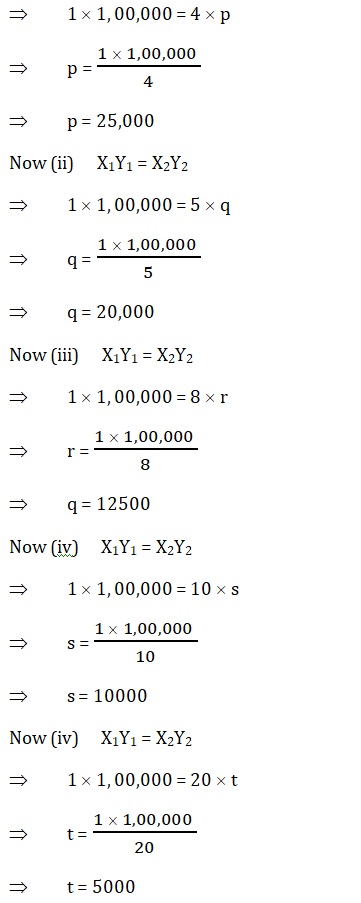
Q2. In a Television game show, the prize money of Rs 1,00,000 is to be divided equally amongst the winners. Complete the following table and find whether the prize money given to an individual winner is directly or inversely proportional to the number of winners?

Solution: Prize will be distributed to winner in inverse proportion.
As both quantities are in inverse proportion.
Suppose the table has …


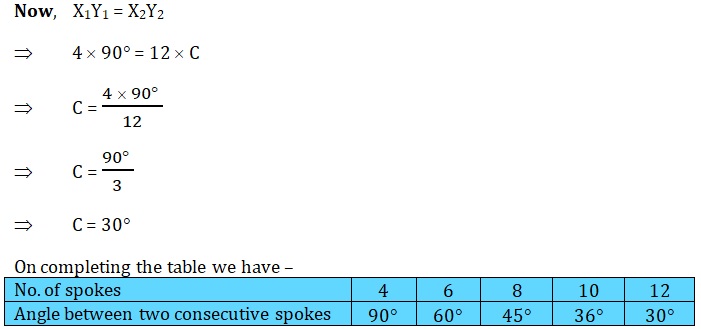
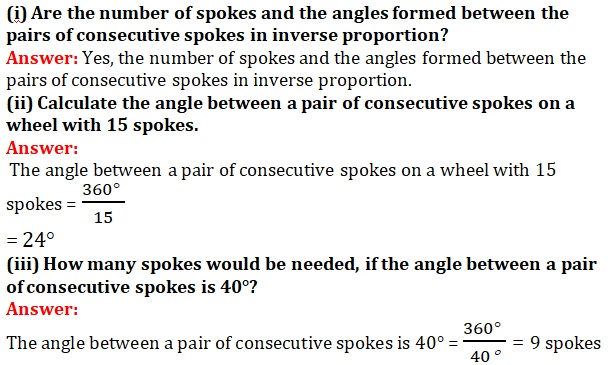
Q3. Rehman is making a wheel using spokes. He wants to fix equal spokes in such a way that the angles between any pair of consecutive spokes are equal. Help him by completing the following table.
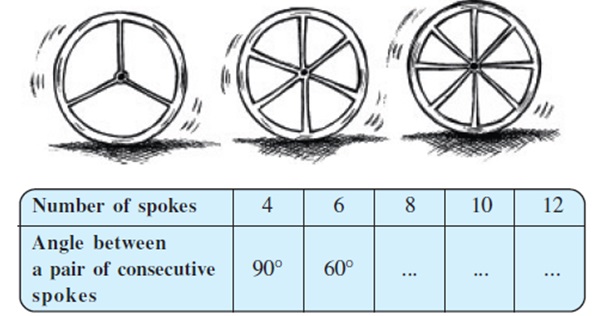
Solution:
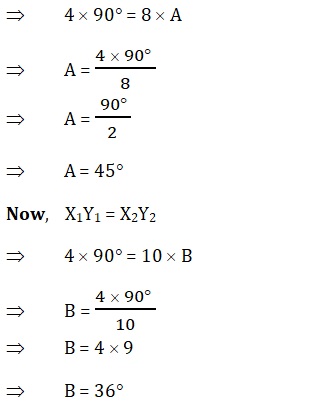
The relation between spokes and angle between consecutive spokes are in inverse proportion.
Therefore, X1Y1 = X2Y2
Q4. If a box of sweets is divided among 24 children, they will get 5 sweets each. How many would each get, if the number of the children is reduced by 4?
Solution:
According to question we have the table like this
13. Direct and Inverse Proportions
Exercise 13.3
raराम एक अच्चा लड़का है |
वह इसी गाँव में रहता है |
मैं एक डॉक्टर हूँ |

Mathematics
Class 8 (English Medium)
NCERT Mathematics Textbook
Chapter-wise NCERT Solutions for Class 6 to 12 prepared according to the latest CBSE syllabus.
English Medium
NCERT Solutions Class 8 Mathematics
Chapter 1. Rational Numbers Solutions
1. Rational Numbers Open Chapters
Explore Now →
NCERT Solutions Class 8 Mathematics
Chapter 2. Linear Equations in One Variable Solutions
2. Linear Equations in One Variable Open Chapters
Explore Now →
NCERT Solutions Class 8 Mathematics
Chapter 3. Understanding Quadrilaterals Solutions
3. Understanding Quadrilaterals Open Chapters
Explore Now →
NCERT Solutions Class 8 Mathematics
Chapter 4. Practical Geometry Solutions
4. Practical Geometry Open Chapters
Explore Now →
NCERT Solutions Class 8 Mathematics
Chapter 5. Data Handling Solutions
5. Data Handling Open Chapters
Explore Now →
NCERT Solutions Class 8 Mathematics
Chapter 6. Squares and Square Roots Solutions
6. Squares and Square Roots Open Chapters
Explore Now →
NCERT Solutions Class 8 Mathematics
Chapter 7. Cubes and Cube Roots Solutions
7. Cubes and Cube Roots Open Chapters
Explore Now →
NCERT Solutions Class 8 Mathematics
Chapter 8. Comparing Quantities Solutions
8. Comparing Quantities Open Chapters
Explore Now →
NCERT Solutions Class 8 Mathematics
Chapter 9. Algebraic Expressions and Identities Solutions
9. Algebraic Expressions and Identities Open Chapters
Explore Now →
NCERT Solutions Class 8 Mathematics
Chapter 10. Visualising Solid Shapes Solutions
10. Visualising Solid Shapes Open Chapters
Explore Now →
NCERT Solutions Class 8 Mathematics
Chapter 11. Mensuration Solutions
11. Mensuration Open Chapters
Explore Now →
NCERT Solutions Class 8 Mathematics
Chapter 12. Exponents and Powers Solutions
12. Exponents and Powers Open Chapters
Explore Now →
NCERT Solutions Class 8 Mathematics
Chapter 13. Direct and Inverse Proportions Solutions
13. Direct and Inverse Proportions Open Chapters
Explore Now →
NCERT Solutions Class 8 Mathematics
Chapter 14. Factorisation Solutions
14. Factorisation Open Chapters
Explore Now →
NCERT Solutions Class 8 Mathematics
Chapter 15. Introduction to Graphs Solutions
15. Introduction to Graphs Open Chapters
Explore Now →
NCERT Solutions Class 8 Mathematics
Chapter 16. Playing with Numbers Solutions
16. Playing with Numbers Open Chapters
Explore Now →
Class 8 NCERT Book Solutions
Chapter-wise NCERT Solutions for Class 6 to 12 prepared according to the latest CBSE syllabus.
ENGLISH MEDIUM
NCERT Solutions Class 8 Its So Happened (English)
Class 8 Its So Happened (English) Book Solutions
Open Book
Explore Now →
NCERT Solutions Class 8 Honey Dew (English)
Class 8 Honey Dew (English) Book Solutions
Open Book
Explore Now →
NCERT Solutions Class 8 HoneyDew (English Poem)
Class 8 HoneyDew (English Poem) Book Solutions
Open Book
Explore Now →Benefits of Studying NCERT Solutions
Studying from NCERT Solutions helps students build strong conceptual understanding and improve problem-solving skills. These solutions are especially useful for revision because every answer is written according to the marking scheme followed by CBSE.
- Improve conceptual understanding.
- Learn correct answer-writing techniques.
- Prepare effectively for school examinations.
- Complete syllabus revision in less time.
- Practice important textbook questions.
- Build confidence before examinations.
Prepared According to the Latest CBSE Syllabus
All NCERT Book Solutions for Class 8 available on ATP Education are updated according to the latest CBSE curriculum. Whenever NCERT introduces changes in textbooks or syllabus, our study materials are revised accordingly so that students always receive accurate and updated content.
Helpful for Competitive Examinations
NCERT textbooks form the foundation of many competitive examinations. Students preparing for Olympiads, NTSE, CUET, UPSC Foundation, SSC and several entrance examinations can strengthen their basics through these chapter-wise solutions. Understanding NCERT concepts also improves analytical thinking and logical reasoning.
Simple and Student-Friendly Explanations
Our experts prepare every answer in a simple, clear and student-friendly format. Difficult concepts are explained step by step with proper reasoning so that students of every learning level can understand them easily. This approach helps students remember concepts for a longer period and perform confidently during examinations.
Start Learning with ATP Education
Explore the complete collection of NCERT Solutions for Class 8 and begin your preparation with confidence. Every chapter is available online for free and can be accessed anytime. Whether you want to complete homework, revise important chapters or prepare for examinations, ATP Education provides reliable and high-quality study resources to help you achieve academic success.
Explore Subjects



Why Students Choose Us
Free Study Materials
Get completely free NCERT solutions, notes and board preparation resources.
Updated Notes
Latest CBSE and NCERT syllabus based notes for all major classes.
Practice Tests
Improve performance with chapter-wise MCQ tests and quizzes.
Trending Study Materials
2M+
Monthly Students
50K+
Study Notes
10K+
MCQ Questions
500+
Mock Tests