
NCERT Solutions for Class 8 – Complete Chapter-wise Study Material
5. Data Handling is one of the most important chapters in the Class 8 Mathematics English NCERT Solutions curriculum. This chapter plays a significant role in helping students build a strong conceptual foundation while preparing for school examinations, class tests, unit tests, half-yearly examinations, annual examinations, and CBSE board assessments. The chapter has been carefully designed according to the latest NCERT syllabus, making it an essential part of every student's study plan.
The 5. Data Handling - Class 8 Mathematics English NCERT Solutions available on ATP Education explain every question in a simple, accurate, and step-by-step manner. Each answer is prepared according to the latest CBSE guidelines so that students can understand the concepts clearly without confusion. Whether you are completing your homework, revising before examinations, or strengthening your understanding of the subject, these solutions provide reliable academic support throughout your learning journey.
One of the biggest advantages of studying 5. Data Handling is that it helps students understand important concepts, definitions, examples, and textbook exercises in an organized way. Instead of memorizing answers, students learn how to develop logical thinking, improve analytical skills, and write well-structured answers in examinations. This chapter also helps improve problem-solving ability and encourages conceptual learning, which is essential for scoring higher marks in school and competitive examinations.
Our Class 8 Mathematics NCERT Solutions cover all textbook questions, important exercise questions, and chapter-wise explanations in English Medium. Every solution is written in easy-to-understand language, allowing students to revise the chapter quickly before examinations. Regular practice of these solutions improves confidence, strengthens subject knowledge, and reduces examination stress.
Students preparing for school assessments should carefully study 5. Data Handling because questions from this chapter are frequently asked in objective questions, short answer questions, long answer questions, competency-based questions, and case-study questions. Understanding the concepts explained in this chapter also helps students connect related topics from other chapters, making overall learning more effective and meaningful.
At ATP Education, we continuously update our Class 8 Mathematics English NCERT Solutions according to the latest NCERT textbooks and CBSE curriculum. Students can confidently use these chapter-wise solutions for daily study, homework assistance, quick revision, examination preparation, and self-learning. By studying 5. Data Handling thoroughly and practising every question regularly, students can strengthen their concepts, improve writing skills, and achieve better academic performance in both school and board examinations.
5. Data Handling - Class 8 Mathematics English NCERT Solutions
5. Data Handling
Exercise 5.1
1. For which of these would you use a histogram to show the data? (a) The number of letters for different areas in a postman’s bag.
(b) The height of competitors in an athletics meet.
(c) The number of cassettes produced by 5 companies.
(d) The number of passengers boarding trains from 7:00 a.m. to 7:00 p.m. at a station.
Give reasons for each.
Ans.
In the case of the data given in alternative (b) and (d), we will use histogram as we can divide
The given data in class intervals. In case of alternative (a) and (c), we do not know about the numbers of letter of different areas and the number of cassettes produces by given companies. We don’t have any approximate idea about it. Therefore, we cannot define class intervals for this data and thus we will note use a histogram.
2. The shoppers who come to a departmental store are marked as: man (M), woman (W), boy (B) or girl (G). The following list gives the shoppers who came during the first hour in the morning:
W W W G B W W M G G M M W
W W W G B M W B G G M W W M M W W W M W B W G M W W W G W M M W W M W G W M G W M M B G G W
Ans:
By observing the data above, we can make a frequency distribution table as follows.

3. The weekly wages (in `) of 30 workers in a factory are.
830, 835, 890, 810, 835, 836, 869, 845, 898, 890, 820, 860, 832, 833, 855, 845,
804, 808, 812, 840, 885, 835, 835, 836, 878, 840, 868, 890, 806, 840
Using tally marks make a frequency table with intervals as 800–810, 810–820 and so on.
Ans:

- 830-840 is the group which has maximum number of workers.
- The worker who earn more than Rs 850 are the number of workers who fall in the group of 800-810 or 810-820 or 820-830 or 830-840 or 840-850 Hence the total number of workers earning less than 850 will be the sum of the numbers of all these workers i.e. 3 + 2 + 1 + 9 + 5 = 20
5. The number of hours for which students of a particular class watched television during holidays is shown through the given graph.
Answer the following.
- for how many hours did the maximum number of students watch TV?
- How many students watched TV for less than 4 hours?
- How many students spend more than 5 hours in watching TV?
Answer:
- From the graph, it can be observe that the maximum number of students watched TV for 4 – 5 hours.
- The students who watched TV for less than 4 hours are students who watched TV for 1-2 hours or 2-3 hours or 3-4 hours.
Hence the total number of students = 4 + 8 + 22 = 34
- The students who watched TV for more than 5 hours are students who watched TV for 5-6 hours or 6-7 hours.
Hence, total number of students = 8 + 6 = 14

5. Data Handling
Exercise 5.2
Exercise 5.2
- A survey was made to find the type of music that a certain group of young people liked in a city. Adjoining pie chart shows the finding of this survey.
- If 20 people liked classical music, how many young people were surveyed?
- Which type of music is liked by the maximum number of people?
- If a cassette company were to make 1000 CD’s, how many of each type would they make?
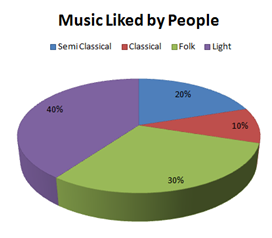
- Number of people who like classical music = 10 %
This 10% present 20 people.
So, 10% represent = = 200 people.
Therefore, 200 young people were surveyed.
- From the pie chart, it can be easily observed that the light music is represented by the maximum part of the pie chart 40%. Hence, most of the people like light music.
- Number of CD’s of classical music = 10% of 1000
= 100
So, the number of CD’s of semi classical music = 20% of 100
= = 200
So, the number of CD’s of folk music = 30%
= = 300
And the number of cassettes of light music = 40% of 1000
= = 400
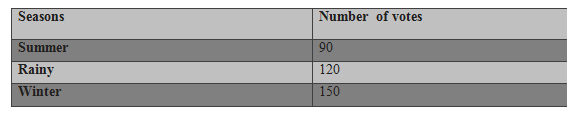
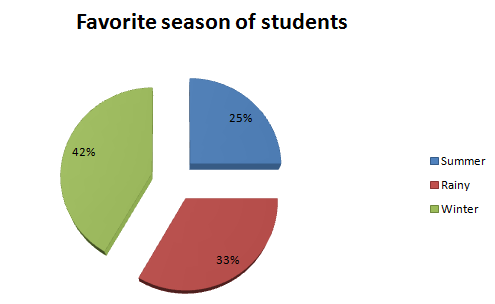
2. A group of 360 people were asked to vote for their favorite’s season from the three seasons rainy, winter and summer.
(i) Which season got the most votes?
(ii) Find the central angle of each sector.
(iii) Draw a pie chart to show this information.
Answer:
- Winter.
- Total number of votes = 90 + 120+ 150 = 360
Question 3:
Draw a pie chart showing the following information.
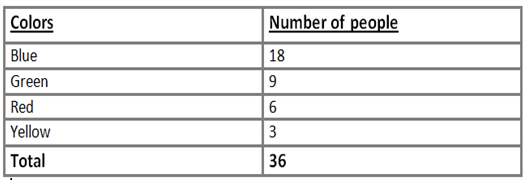
Ans:
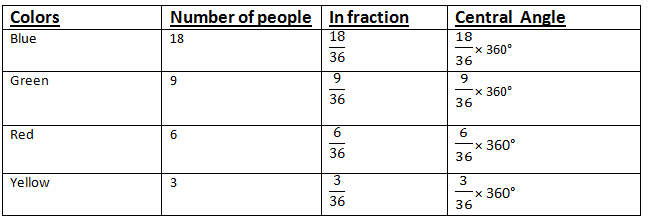
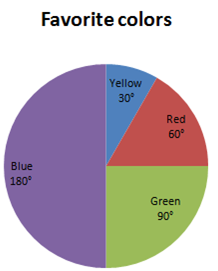
The central angle for each color can be calculated as follows.
Question:
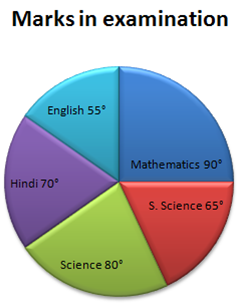
The adjoining pie chart gives the mark scored in a examination by a student in Hindi, English, Mathematics, Social science and science. If the total marks obtained by a student were 540, answer the following question.
In which subject did the students score 105 marks?
How many more marks were obtained by the students in mathematics than Hindi?
Examine whether the sum of the marks obtained in social science and mathematics is more than that in science and Hindi.
(HINT: Just study the angle.)
Answer:
The central angle of each subject can be calculated as follows
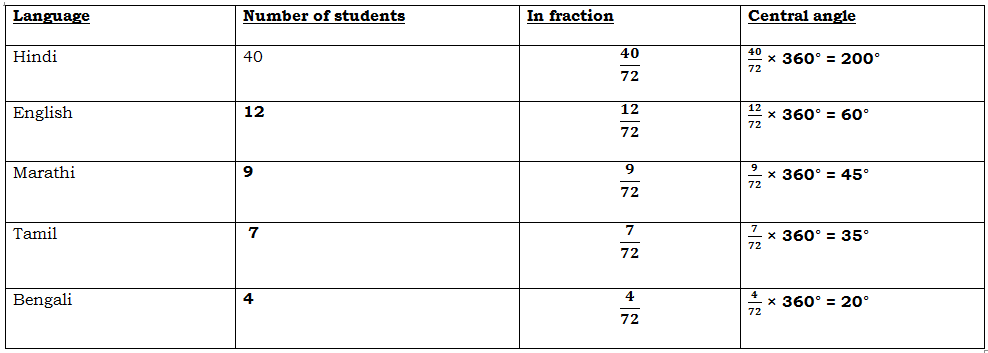
A pie chart of the above data is as follows.
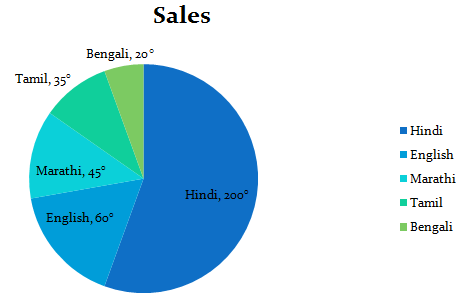
5. Data Handling
Exercise 5.3
Exercise 5.3
1. List the outcomes you can see in these experiments.
Spinning a wheel
Tossing two coins together

Answer:
On spinning the given wheel, the possible outcomes are A, B, C, and D.
By tossing two coins together , the possible outcomes ate HT, TH, HH, TT, where H and T presents head and tail of coins respectively.
2. When a die is thrown
- list the possible outcomes of an event of getting
- (a) a prime number (b) not a prime number
- (a) a number greater than 5 (b) a number not greater than 5
- (a) When a dice is thrown, the possible outcomes, 2, 3, 5, are prime numbers. Hence, these are the possible outcomes of an event of not getting a prime number on the face of a dice
(b) Out of these outcomes 1, 4, 6 are not prime numbers. Hence these are the outcomes of an event of not getting a prime number on the face of a dice.
(ii) (A) out of these outcomes, a number greater than 5 is possible 6 when the number of face of
The dice.
(b) Out of these outcomes, a number is not greater than 5 is possible when the number the second
Number on the face of the dice is anyone of the outcomes 1, 2, 3, 4, 5.

Mathematics
Class 8 (English Medium)
NCERT Mathematics Textbook
Chapter-wise NCERT Solutions for Class 6 to 12 prepared according to the latest CBSE syllabus.
English Medium
NCERT Solutions Class 8 Mathematics
Chapter 1. Rational Numbers Solutions
1. Rational Numbers Open Chapters
Explore Now →
NCERT Solutions Class 8 Mathematics
Chapter 2. Linear Equations in One Variable Solutions
2. Linear Equations in One Variable Open Chapters
Explore Now →
NCERT Solutions Class 8 Mathematics
Chapter 3. Understanding Quadrilaterals Solutions
3. Understanding Quadrilaterals Open Chapters
Explore Now →
NCERT Solutions Class 8 Mathematics
Chapter 4. Practical Geometry Solutions
4. Practical Geometry Open Chapters
Explore Now →
NCERT Solutions Class 8 Mathematics
Chapter 5. Data Handling Solutions
5. Data Handling Open Chapters
Explore Now →
NCERT Solutions Class 8 Mathematics
Chapter 6. Squares and Square Roots Solutions
6. Squares and Square Roots Open Chapters
Explore Now →
NCERT Solutions Class 8 Mathematics
Chapter 7. Cubes and Cube Roots Solutions
7. Cubes and Cube Roots Open Chapters
Explore Now →
NCERT Solutions Class 8 Mathematics
Chapter 8. Comparing Quantities Solutions
8. Comparing Quantities Open Chapters
Explore Now →
NCERT Solutions Class 8 Mathematics
Chapter 9. Algebraic Expressions and Identities Solutions
9. Algebraic Expressions and Identities Open Chapters
Explore Now →
NCERT Solutions Class 8 Mathematics
Chapter 10. Visualising Solid Shapes Solutions
10. Visualising Solid Shapes Open Chapters
Explore Now →
NCERT Solutions Class 8 Mathematics
Chapter 11. Mensuration Solutions
11. Mensuration Open Chapters
Explore Now →
NCERT Solutions Class 8 Mathematics
Chapter 12. Exponents and Powers Solutions
12. Exponents and Powers Open Chapters
Explore Now →
NCERT Solutions Class 8 Mathematics
Chapter 13. Direct and Inverse Proportions Solutions
13. Direct and Inverse Proportions Open Chapters
Explore Now →
NCERT Solutions Class 8 Mathematics
Chapter 14. Factorisation Solutions
14. Factorisation Open Chapters
Explore Now →
NCERT Solutions Class 8 Mathematics
Chapter 15. Introduction to Graphs Solutions
15. Introduction to Graphs Open Chapters
Explore Now →
NCERT Solutions Class 8 Mathematics
Chapter 16. Playing with Numbers Solutions
16. Playing with Numbers Open Chapters
Explore Now →
Class 8 NCERT Book Solutions
Chapter-wise NCERT Solutions for Class 6 to 12 prepared according to the latest CBSE syllabus.
ENGLISH MEDIUM
NCERT Solutions Class 8 Its So Happened (English)
Class 8 Its So Happened (English) Book Solutions
Open Book
Explore Now →
NCERT Solutions Class 8 Honey Dew (English)
Class 8 Honey Dew (English) Book Solutions
Open Book
Explore Now →
NCERT Solutions Class 8 HoneyDew (English Poem)
Class 8 HoneyDew (English Poem) Book Solutions
Open Book
Explore Now →Benefits of Studying NCERT Solutions
Studying from NCERT Solutions helps students build strong conceptual understanding and improve problem-solving skills. These solutions are especially useful for revision because every answer is written according to the marking scheme followed by CBSE.
- Improve conceptual understanding.
- Learn correct answer-writing techniques.
- Prepare effectively for school examinations.
- Complete syllabus revision in less time.
- Practice important textbook questions.
- Build confidence before examinations.
Prepared According to the Latest CBSE Syllabus
All NCERT Book Solutions for Class 8 available on ATP Education are updated according to the latest CBSE curriculum. Whenever NCERT introduces changes in textbooks or syllabus, our study materials are revised accordingly so that students always receive accurate and updated content.
Helpful for Competitive Examinations
NCERT textbooks form the foundation of many competitive examinations. Students preparing for Olympiads, NTSE, CUET, UPSC Foundation, SSC and several entrance examinations can strengthen their basics through these chapter-wise solutions. Understanding NCERT concepts also improves analytical thinking and logical reasoning.
Simple and Student-Friendly Explanations
Our experts prepare every answer in a simple, clear and student-friendly format. Difficult concepts are explained step by step with proper reasoning so that students of every learning level can understand them easily. This approach helps students remember concepts for a longer period and perform confidently during examinations.
Start Learning with ATP Education
Explore the complete collection of NCERT Solutions for Class 8 and begin your preparation with confidence. Every chapter is available online for free and can be accessed anytime. Whether you want to complete homework, revise important chapters or prepare for examinations, ATP Education provides reliable and high-quality study resources to help you achieve academic success.
Explore Subjects




Why Students Choose Us
Free Study Materials
Get completely free NCERT solutions, notes and board preparation resources.
Updated Notes
Latest CBSE and NCERT syllabus based notes for all major classes.
Practice Tests
Improve performance with chapter-wise MCQ tests and quizzes.
Trending Study Materials
2M+
Monthly Students
50K+
Study Notes
10K+
MCQ Questions
500+
Mock Tests