
NCERT Solutions for Class 6 – Complete Chapter-wise Study Material
Chapter 3. Motions of the Earth is one of the most important chapters in the Class 6 Geography English NCERT Solutions curriculum. This chapter plays a significant role in helping students build a strong conceptual foundation while preparing for school examinations, class tests, unit tests, half-yearly examinations, annual examinations, and CBSE board assessments. The chapter has been carefully designed according to the latest NCERT syllabus, making it an essential part of every student's study plan.
The Chapter 3. Motions of the Earth - Class 6 Geography English NCERT Solutions available on ATP Education explain every question in a simple, accurate, and step-by-step manner. Each answer is prepared according to the latest CBSE guidelines so that students can understand the concepts clearly without confusion. Whether you are completing your homework, revising before examinations, or strengthening your understanding of the subject, these solutions provide reliable academic support throughout your learning journey.
One of the biggest advantages of studying Chapter 3. Motions of the Earth is that it helps students understand important concepts, definitions, examples, and textbook exercises in an organized way. Instead of memorizing answers, students learn how to develop logical thinking, improve analytical skills, and write well-structured answers in examinations. This chapter also helps improve problem-solving ability and encourages conceptual learning, which is essential for scoring higher marks in school and competitive examinations.
Our Class 6 Geography NCERT Solutions cover all textbook questions, important exercise questions, and chapter-wise explanations in English Medium. Every solution is written in easy-to-understand language, allowing students to revise the chapter quickly before examinations. Regular practice of these solutions improves confidence, strengthens subject knowledge, and reduces examination stress.
Students preparing for school assessments should carefully study Chapter 3. Motions of the Earth because questions from this chapter are frequently asked in objective questions, short answer questions, long answer questions, competency-based questions, and case-study questions. Understanding the concepts explained in this chapter also helps students connect related topics from other chapters, making overall learning more effective and meaningful.
At ATP Education, we continuously update our Class 6 Geography English NCERT Solutions according to the latest NCERT textbooks and CBSE curriculum. Students can confidently use these chapter-wise solutions for daily study, homework assistance, quick revision, examination preparation, and self-learning. By studying Chapter 3. Motions of the Earth thoroughly and practising every question regularly, students can strengthen their concepts, improve writing skills, and achieve better academic performance in both school and board examinations.
Chapter 3. Motions of the Earth - Class 6 Geography English NCERT Solutions
Chapter 3. Motions of the Earth
Chapter-Review
Chapter - Review:
- The phenomenon of day and night is because of the rotation of the earth. Had there been no rotation, one side of the earth would perpetually have night, and temperatures would have dropped in this half. The other half would forever have a day, and in this half, temperatures would have risen. In such cases, It wpould nort be possible to sustain life on earth.
- Earth takes 24 hours to complete one rotation and this is known as earth day.
- 23 hr 56 min 4 sec is the actual time taken to complete on rotation, but for convenience purposes, it is taken to be 24 hours.
- The movement of the earth on its own axis around the sun is termed a revolution.
- The earth moves around the sun in an elliptical - shaped orbit.
- It takes 365.25 days to complete one revolution. This is the time taken by the earth to go round an elliptical orbit with the sun at a focus.
- We consider 365 days as one year, and the rest one - fourth of a day is added up for every four years to give us one extra day. This day is added up to the fourth year, and the year has 366 days. This year is called a leap year. This day is added up to the month of february.
- In a leap year, february has 29 days instead of 28 days.
- Seasons change due to change in the position of the Earth around the sun.
- Because of the change in the position of earth, a year is divided into summer, winter, spring and autumn.
- Summer solstice begins on 21st June in the Northern Hemisphere.
- On this day, the Northern Hemisphere is tilted towards he sun.
- Sun rays fall on the Tropic of cancer.
- The North pole is inclined towards the sun and areas beyound the Arctic Circle experience continuous daylight for about six months.
- The longest day and shortest night occur on 21st June, the summer Solstice.
- The conditions in the Southern Hemisphere are reversed, and it is winter season there.
- Winter solstice occurs on the 22nd of December in the Northern Hemisphere.
- The Southern Hemisphere at this time is tilted towards the sun.
- The Sunrays fall on the Tropic of Capricorn in the Southern Hemisphere.
- The Southern Hemisphere has loger days during this period and shorter night.
- The conditions are reversed in the northern hemisphere.
- The direct rays of the sun fall on the equator on 21st March and 23rd September.
- The whole Earth experiences equal days and equal night because neither of the poles is tilted towards the sun.
- On 23rd September, it is autumn season in the Northern hemisphere and spring season in the Southern hemisphere.
- The opposite is the caes on 21st march when it is spring in the Northern hemisphere and autumn in the Southern hemisphere.
Chapter 3. Motions of the Earth
NCERT Exercise
Exercise - Question:
Q1. Answer the following questions briefly.
Ans. The Earth remains tilted to one side while it revolves around the Earth at an angle of 66
(b) Define rotation and revolution.
Ans. Rotation : The movement of the Earth on its own axis is called rotation. The earth takes 24 hours to Complete one rotation. It causes day and night.
Revolution : The movement of the earth around the sun in a fixed orbit is called revolution. The earth takes 365 days and 6 hours to complete one revolution. It causes seasons.
(c) what is a leap year ?
Ans. It is a year when the month of February has 29 days instead of 28 days. Every fourth year is a leap year.
(d) Differentiate between summer and Winter Solstice.
Ans. summer solstice : It is the position of the earth when the Northern Hemisphere has the longest day and the shortest night. It occurs on 21st June. In the Southern Hemisphere, it is winter season at this time. The days are short and the nights are long.
Winter solstice : It is the position of the earth when southern Hemisphere has long days and shorter nights, In the northern Hemisphere, the days are short and the nights are long. It occurs on 22nd December.
(e) What is an equinox ?
Ans. Equinoxes are days when direct rays of the sun fall on equator. At this position neither of the poles are tilted towards the sun, so the whole earth experiences equal nights. It occurs on 21st March and 23rd September.
(f) Why does the southern Hemisphere experiences Winter and summer Solstice in different times than of Northern Hemisphere.
Ans. The seasons in Southern Hemisphere and Northern Hemisphere are exactly the opposite.
(g) Why do the poles experience six months day and six months nights ?
Ans. When the rays of the sun fall directly on the Tropic of Cancer (21st June), the areas near the south pole receive less heat. The North Pole is inclined towards the sun and places beyond the Arctic circle experience continuous daylight. At this time, the southern Hemisphere has the opposite season. The nights are long and areas beyond Antarctic circle remain in continuous night.
Q2. Tick the correct answers.
(a) The movement of the earth around the sun is Known as
(i) Rotation
(ii) Revolution
(iii) Inclination
(b) Direct rays of the sun fall on the equator on
(i) 21st March
(ii) 21st June
(iii) 22nd December
(c) Christmas is celebrated in summer in
(i) Japan
(ii) India
(iii) Australia
(d) Cycle of the seasons is caused due to
(i) Rotation
(ii) Revolution
(iii) Gravitation
Ans. (a) (ii), (b) (i), (c) (iii), (d) (ii)
Q3. Fill in the blanks :
(a) A leap year has......... number of days.
(b) The daily motion of the earth is......... .
(c) The earth travels around the sun in........ orbit.
(d) The sun's rays fall vertically on the Tropic of........ on 21st June.
(e) Days are shorter during........ season.
Ans. (a) 366, (b) rotation, (c) elliptical, (d) cancer, (e) winter.
Chapter 3. Motions of the Earth
Additional Questions
Additional Question:
Que: Define the circle of illumination.
Ans: The circle that divides the day from night on the globe is known as the circle of illumination.
Que: Which motion of the earth is associated with the changes in season?
Ans: Revolution.
Que: Why do season change?
Ans: Season change due to the change in the position of the earth around the sun.
Que: Why do the aresa near the ples recevies less heat?
Ans: I t is because the rays of sun are slanting on the poles.
Que: When do the longest day and the shortest night occur in the Northern hemisphere?
Ans: On 21st June.
Que: In which Hemisphere does Australia lie?
Ans: Australia lies in the Southern Hemisphere.
Que: What would happen if the earth did not rotate?
Ans: In such a condition the portion of the earth facing the sun would always experience day, and thus there would be continuous warmth in the region. At the same time, the other half would always remain dark and be freezing cold all the time. These are extreme conditions which are not suitable for life. Thus, we can say that if the earth did not rotate life would not have been poosible.
Que: How does leap year occur?
Ans: The earth taken 36514 days Le. one year to complete one revolution areound the sun. We consider a year as consisting of 365 days only and ignore six hours for our convenience. Six houres saved every year are added to the month of february. Thus every fourth year, February of 29 days instead of 28 days. Such a year with 366 days is called a leap year.
Que: Explain:
(a) summer solstice
(b) Winter solstice
(c) Equinox
Ans:
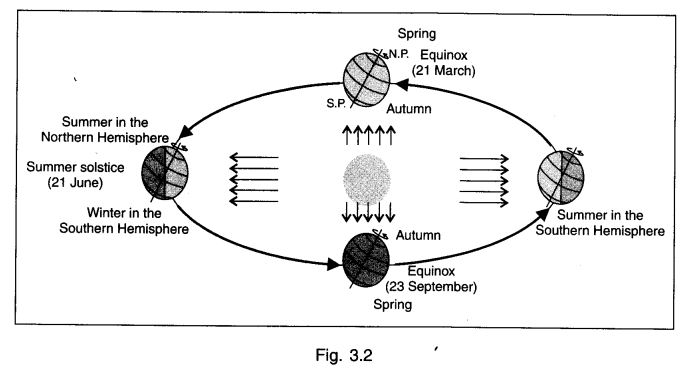
(a) Summer solstice, The Northern Hemisphere is titled towards the sun on 21st June. As the rays of thes sun fall directly on the Tropic of cancer, these areas receive more heat. But the size of the area to the poles receives less heat due to the slanting rays of the sun. The North pole is inclined toward the sun the place beyound the Arctic Circle experience continuous daylight for about six months.
Since a large area of the Northern Hemisphere is getting light from the sun, it is summer in the regions north of the equator. The longest day and the shortest night at these places occur on 21st June. These conditiond are reversed in the Southern Hemisphere at this time. it is winter season there having longer nights and shorter days. This position of the earth is konwn as the summer solstice.
(b) Winter solstice. On 22nd December, the tropic of Capricorn receives direct rays of the as the South pole tilts towards it, As the sun's rays fall vertically at the Tropic of Capricorn, a larger portion of the Southern Hemisphere gets light. hence, the Southern hemisphere enjoys sumer having longer days and shorter nights. This position of the earth is called the winter solstice.
(c) On 21st March and 3rd September direct rays of the sun fall on the equator. At this position, neither of the poles is tilted toward the sun. As a result, the entire earth experiences equal days and equal nights. This phenomenon known as an equinox.

Geography
Class 6 (English Medium)
NCERT Geography Textbook
Chapter-wise NCERT Solutions for Class 6 to 12 prepared according to the latest CBSE syllabus.
English Medium
NCERT Solutions Class 6 Geography
Chapter Chapter 2. Globe Latitudes and Longitudes Solutions
Chapter 2. Globe Latitudes and Longitudes Open Chapters
Explore Now →
NCERT Solutions Class 6 Geography
Chapter Chapter 3. Motions of the Earth Solutions
Chapter 3. Motions of the Earth Open Chapters
Explore Now →
NCERT Solutions Class 6 Geography
Chapter Chapter 4. Maps Solutions
Chapter 4. Maps Open Chapters
Explore Now →
NCERT Solutions Class 6 Geography
Chapter Chapter 5. Major Domains of the Earth Solutions
Chapter 5. Major Domains of the Earth Open Chapters
Explore Now →
NCERT Solutions Class 6 Geography
Chapter Chapter 6. Major Landforms of the Earth Solutions
Chapter 6. Major Landforms of the Earth Open Chapters
Explore Now →
NCERT Solutions Class 6 Geography
Chapter Chapter 7. Our Country-India Solutions
Chapter 7. Our Country-India Open Chapters
Explore Now →
NCERT Solutions Class 6 Geography
Chapter Chapter 1. The Earth in the Solar System Solutions
Chapter 1. The Earth in the Solar System Open Chapters
Explore Now →
NCERT Solutions Class 6 Geography
Chapter Chapter 8. India Climate, Vegetation and Wildlife Solutions
Chapter 8. India Climate, Vegetation and Wildlife Open Chapters
Explore Now →
NCERT Solutions Class 6 Geography
Chapter 1. The earth in the solar system Solutions
1. The earth in the solar system Open Chapters
Explore Now →
Class 6 NCERT Book Solutions
Chapter-wise NCERT Solutions for Class 6 to 12 prepared according to the latest CBSE syllabus.
ENGLISH MEDIUM
NCERT Solutions Class 6 Mathematics
Class 6 Mathematics Book Solutions
Mathematics Open Book
Explore Now →
NCERT Solutions Class 6 Science Curiosity
Class 6 Science Curiosity Book Solutions
Curiosity Open Book
Explore Now →Benefits of Studying NCERT Solutions
Studying from NCERT Solutions helps students build strong conceptual understanding and improve problem-solving skills. These solutions are especially useful for revision because every answer is written according to the marking scheme followed by CBSE.
- Improve conceptual understanding.
- Learn correct answer-writing techniques.
- Prepare effectively for school examinations.
- Complete syllabus revision in less time.
- Practice important textbook questions.
- Build confidence before examinations.
Prepared According to the Latest CBSE Syllabus
All NCERT Book Solutions for Class 6 available on ATP Education are updated according to the latest CBSE curriculum. Whenever NCERT introduces changes in textbooks or syllabus, our study materials are revised accordingly so that students always receive accurate and updated content.
Helpful for Competitive Examinations
NCERT textbooks form the foundation of many competitive examinations. Students preparing for Olympiads, NTSE, CUET, UPSC Foundation, SSC and several entrance examinations can strengthen their basics through these chapter-wise solutions. Understanding NCERT concepts also improves analytical thinking and logical reasoning.
Simple and Student-Friendly Explanations
Our experts prepare every answer in a simple, clear and student-friendly format. Difficult concepts are explained step by step with proper reasoning so that students of every learning level can understand them easily. This approach helps students remember concepts for a longer period and perform confidently during examinations.
Start Learning with ATP Education
Explore the complete collection of NCERT Solutions for Class 6 and begin your preparation with confidence. Every chapter is available online for free and can be accessed anytime. Whether you want to complete homework, revise important chapters or prepare for examinations, ATP Education provides reliable and high-quality study resources to help you achieve academic success.
Explore Subjects



Why Students Choose Us
Free Study Materials
Get completely free NCERT solutions, notes and board preparation resources.
Updated Notes
Latest CBSE and NCERT syllabus based notes for all major classes.
Practice Tests
Improve performance with chapter-wise MCQ tests and quizzes.
Trending Study Materials
2M+
Monthly Students
50K+
Study Notes
10K+
MCQ Questions
500+
Mock Tests