
NCERT Solutions for Class 11 – Complete Chapter-wise Study Material
9. Sequences and Series is one of the most important chapters in the Class 11 Mathematics English NCERT Solutions curriculum. This chapter plays a significant role in helping students build a strong conceptual foundation while preparing for school examinations, class tests, unit tests, half-yearly examinations, annual examinations, and CBSE board assessments. The chapter has been carefully designed according to the latest NCERT syllabus, making it an essential part of every student's study plan.
The 9. Sequences and Series - Class 11 Mathematics English NCERT Solutions available on ATP Education explain every question in a simple, accurate, and step-by-step manner. Each answer is prepared according to the latest CBSE guidelines so that students can understand the concepts clearly without confusion. Whether you are completing your homework, revising before examinations, or strengthening your understanding of the subject, these solutions provide reliable academic support throughout your learning journey.
One of the biggest advantages of studying 9. Sequences and Series is that it helps students understand important concepts, definitions, examples, and textbook exercises in an organized way. Instead of memorizing answers, students learn how to develop logical thinking, improve analytical skills, and write well-structured answers in examinations. This chapter also helps improve problem-solving ability and encourages conceptual learning, which is essential for scoring higher marks in school and competitive examinations.
Our Class 11 Mathematics NCERT Solutions cover all textbook questions, important exercise questions, and chapter-wise explanations in English Medium. Every solution is written in easy-to-understand language, allowing students to revise the chapter quickly before examinations. Regular practice of these solutions improves confidence, strengthens subject knowledge, and reduces examination stress.
Students preparing for school assessments should carefully study 9. Sequences and Series because questions from this chapter are frequently asked in objective questions, short answer questions, long answer questions, competency-based questions, and case-study questions. Understanding the concepts explained in this chapter also helps students connect related topics from other chapters, making overall learning more effective and meaningful.
At ATP Education, we continuously update our Class 11 Mathematics English NCERT Solutions according to the latest NCERT textbooks and CBSE curriculum. Students can confidently use these chapter-wise solutions for daily study, homework assistance, quick revision, examination preparation, and self-learning. By studying 9. Sequences and Series thoroughly and practising every question regularly, students can strengthen their concepts, improve writing skills, and achieve better academic performance in both school and board examinations.
9. Sequences and Series - Class 11 Mathematics English NCERT Solutions
9. Sequences and Series
Exercise 9.1 (Available)
Exercise 9.1
Write the first five terms of each of the sequences in Exercises 1 to 6 whose nth terms are:

Q1. Write the first five terms of the sequences whose nth term is an = n(n+2).
Solution: Q1.
is an = n(n+2)
Putting n = 1, 2, 3, 4 and 5 we obtain
a1 = 1(1 + 2) = 1× 3 = 3
a2 = 2(2 + 2) = 2× 4 = 8
a3 = 3(3 + 2) = 3× 5 = 15
a4 = 4(4 + 2) = 4× 6 = 24
a5 = 5(5 + 2) = 5× 7 = 35
Therefore, the five terms are 3, 8, 15, 24 and 35


Q5. Write the first five terms of the sequences whose nth term is an = (-1)n-15n+1
Solution: Q5.
an = (-1)n-15n+1
Putting n = 1, 2, 3, 4 and 5 we obtain
a1 = (-1)1-151+1 = (1)(5)2 = 25
a2 = (-1)2-152+1 = (-1) (5)3 = - 125
a3 = (-1)3-153+1 = (1) (5)4 = 625
a4 = (-1)4-154+1 = (-1) (5)5 = - 3125
a5 = (-1)5-155+1 = (1) (5)6 =156 25
Thus the five terms are 25, -125, 625, - 3125 and 15625


9. Sequences and Series
Exercise 9.2
This Page is under construction.
This will be published soon.
Jaust wait ...................
9. Sequences and Series
Exercise 9.3 (Available)


Q13. How many terms of G.P. 3, 32, 33, …. are needed to give the sum 120?

Q14. The sum of first three terms of a G.P. is 16 and the sum of the next three terms is 128. Determine the first term, the common ratio and the sum to n terms of the G.P.
Solution:

Q15. Given a G.P. with a = 729 and 7th term 64, determine S7.
Solution:

Q16. Find a G.P. for which sum of the first two terms is – 4 and the fifth term is 4 times the third term.
Solution:
S2 = - 4,
T5 = 4(T3)

Q17. If the 4th, 10th and 16th terms of a G.P. are x, y and z, respectively. Prove that x, y, z are in G.P.
Solution:
T4 = ar3 = x ------------------ (I)
T10 = ar9 = y ---------------(II)
T16 = ar15 = z ---------------(III)
If T4, T10 and T16 are in G.P then x, y and z also will be in G.P

Q18. Find the sum to n terms of the sequence, 8, 88, 888, 8888… .
Solution:
Let S is the sum of n terms of series;
∴ Sn = 8 + 88 + 888 + 8888 + ………….. to the n term
= 8(1 + 11 + 111 + 1111 + ……….. )


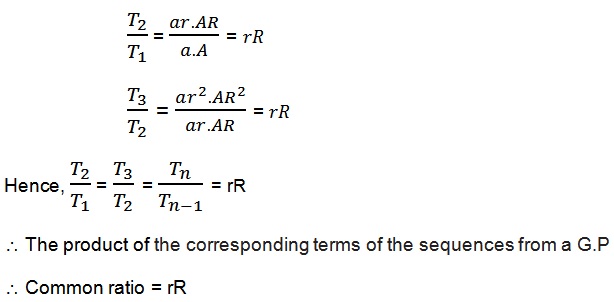
Q20. Show that the products of the corresponding terms of the sequences a, ar, ar2, …arn – 1 and A, AR, AR2, … ARn – 1 form a G.P, and find the common ratio.
Solution:
Product of sequence = a.A, ar.AR, ar2.AR2 ………….. arn -1.ARn -1
Common ratio :
Q21. Find four numbers forming a geometric progression in which the third term is greater than the first term by 9, and the second term is greater than the 4th by 18.
Solution:

Q22. If the pth, qth and rth terms of a G.P. are a, b and c, respectively. Prove that
aq – r br – p cp – q = 1.
Solution:
Let first term be A and common ratio be R.
Tp = ARp – 1 = a -------------- (I)
Tq = ARq – 1 = b -------------- (II)
Tr = ARr – 1 = c --------------- (III)
aq – r . br – p . cp – q = (ARp – 1 )q – r . (ARq – 1)r – p . (ARr – 1)p – q
= AR(p – 1)(q – r ).AR(q – 1)(r – p) . AR(r – 1)(p – q)
= AR(p – 1)(q – r ) + (q – 1)(r – p) + (r – 1)(p – q)
= AR(pq – pr – q + r + qr – pq – r + p + pr – qr – p + q)
= (AR)0
= 1
Q23. If the first and the nth term of a G.P. are a and b, respectively, and if P is the product of n terms, prove that P2 = (ab)n.
Solution:

Q24. Show that the ratio of the sum of first n terms of a G.P. to the sum of terms from (n + 1)th to (2n)th term is 1/rn.
Solution:

Q25. If a, b, c and d are in G.P. show that
(a2 + b2 + c2) (b2 + c2 + d2) = (ab + bc + cd)2.
Solution:
a, b, c, d are in G.P. Therefore,
bc = ad ……………………... (1)
b2 = ac …………………….... (2)
c2 = bd …………………...... (3)
It has to be proved that,
(a2 + b2 + c2) (b2 + c2 + d2) = (ab + bc – cd)2
R.H.S.
= (ab + bc + cd)2
= (ab + ad + cd)2 [Using (1)]
= [ab + d (a + c)]2
= (ab)2 + 2(ab)d(a + c) + [d(a + c)]2
= a2b2 + 2abd (a + c) + d2 (a + c)2
= a2b2 +2a2bd + 2acbd + d2(a2 + 2ac + c2)
[Using (1) and (2)]
= a2b2 + 2a2c2 + 2b2c2 + d2a2 + 2d2b2 + d2c2 [using bc = ad and b2 = ac]
= a2b2 + a2c2 + a2c2 + b2c2 + b2c2 + d2a2 + d2b2 + d2b2 + d2c2
= a2b2 + a2c2 + (ac)2 + b2c2 + b2c2 + a2d2 + (bd)2 × (bd)2 + c2d2
= a2b2 + a2c2 + (b2)2 + b2c2 + b2c2 + a2d2 + (bd)2 × (c2)2 + c2d2
= a2b2 + a2c2 + b2 × b2 + b2c2 + c2b2 + a2d2 + b2d2 + c2 × c2 + c2d2
= a2b2 + a2c2 + a2d2 + b2 × b2 + b2c2 + b2d2 + c2b2 + c2 × c2 + c2d2
[Using (2) and (3) and rearranging terms]
= a2(b2 + c2 + d2) + b2 (b2 + c2 + d2) + c2 (b2+ c2 + d2)
= (a2 + b2 + c2) (b2 + c2 + d2) = L.H.S.
∴ L.H.S. = R.H.S.
∴ (a2 + b2 + c2) (b2 + c2 + d2) = (ab + bc – cd)2
Q26. Insert two numbers between 3 and 81 so that the resulting sequence is G.P.
Solution:
Let G1, G2 be three numbers between 3 and 81 such that 3, G1, G2, 81 is a G.P
T1 = 3
T2 = ar
T3 = ar2
T4 = ar3 = 81
3.r3 = 81
r3 =
r3 = 27

For r = 3, we have
T2 = ar = 3.3 = 9
T3 = ar2 = 3.32 = 27


Q28. The sum of two numbers is 6 times their geometric mean, show that numbers are in the ratio (3 + 2√2) : (3 − 2√2).
Solution:
Let the numbers be a and b.


9. Sequences and Series
Exercise 9.4
This Page is under construction.
This will be published soon.
Jaust wait ...................
9. Sequences and Series
Miscellaneous Exercise on Chapter - 9 (Available)
Miscellaneous Exercise on Chapter - 9
Q1. Show that the sum of (m + n)th and (m – n)th terms of an A.P. is equal to twice the mth term.
Solution:
Let a and d be the first term and the common difference of the A.P. respectively. It is known that the kth term of an A. P. is given by
ak = a + (k –1) d
∴ am + n = a + (m + n –1) d
am – n = a + (m – n –1) d
am = a + (m –1) d
∴ am + n + am – n = a + (m + n –1) d + a + (m – n –1) d
= 2a + (m + n –1 + m – n –1) d
= 2a + (2m – 2) d
= 2a + 2 (m – 1) d
=2 [a + (m – 1) d]
= 2am
Thus, the sum of (m + n)th and (m – n)th terms of an A.P. is equal to twice the mth term.
Q2. If the sum of three numbers in A.P., is 24 and their product is 440, find the numbers.
Solution:
Let the three numbers in A.P. be a – d, a, and a + d.
According to the given information,
(a – d) + (a) + (a + d) = 24 … (1)
⇒ 3a = 24
∴ a = 8
(a – d) a (a + d) = 440 … (2)
⇒ (8 – d) (8) (8 + d) = 440
⇒ (8 – d) (8 + d) = 55
⇒ 64 – d2 = 55
⇒ d2 = 64 – 55 = 9
⇒ d = ± 3
Therefore, when d = 3, the numbers are 5, 8, and 11 and when d = –3, the numbers are 11, 8, and 5.
Thus, the three numbers are 5, 8, and 11.
Q3. Let the sum of n, 2n, 3n terms of an A.P. be S1, S2 and S3, respectively, show that S3 =3 (S2– S1).
Solution:
Let a and b be the first term and the common difference of the A.P. respectively. Therefore,

Q4. Find the sum of all numbers between 200 and 400 which are divisible by 7.
Solution:
The numbers lying between 200 and 400, which are divisible by 7, are
203, 210, 217 … 399
∴ First term, a = 203
Last term, l = 399
Common difference, d = 7
Let the number of terms of the A.P. be n.
∴ an = 399 = a + (n –1) d
⇒ 399 = 203 + (n –1) 7
⇒ 7 (n –1) = 196
⇒ n –1 = 28
⇒ n = 29

Sum of 29 terms is 8729.
Q5. Find the sum of integers from 1 to 100 that are divisible by 2 or 5.
Solution:
Integers from 1 to 100 which are divisible by 2 are 2, 4, 6, 8 ................. 100.
which form A.P : 2, 4, 6, 8 ................. 100.
Case-I
a = 2, d = d2 - d1 ⇒ 4 - 2 = 2 , an = 100,
an = a + (n - 1)d
100 = 2 + (n - 1)2
100 - 2 = (n - 1)2
98 = (n - 1)2
n - 1 = 98/2
n - 1 = 49
n = 49 + 1
n = 50

Case-II
The integers between 1 to 100 divisible by 5.
5, 10, 15 ..................... 100.
a = 5, d = 10 - 5 = 5,
an = 100
an = a + (n - 1)d
⇒100 = 5 + (n - 1)5
⇒100 - 5 = (n - 1)5
⇒95/5 = n - 1
⇒19 = n - 1
⇒n = 19 + 1
⇒n = 20

Q6. Find the sum of all two digit numbers which when divided by 4, yields 1 as remainder.
Solution:
The two-digit numbers, which when divided by 4, yield 1 as remainder, are as
A.P: 13, 17, … 97.
This series forms an A.P.
a = 13, d = 17-13 = 4 an = 97
an = a + (n –1) d
∴ 97 = 13 + (n –1) (4)
⇒ 4 (n –1) = 84
⇒ n – 1 = 21
⇒ n = 22
Sum of n terms of an A.P. is given by,


Q8. The sum of some terms of G.P. is 315 whose first term and the common ratio are 5 and 2, respectively. Find the last term and the number of terms.
Solution:
It is given that a = 5, r = 2, Sn = 315
n = ? and an = ?

Q9. The first term of a G.P. is 1. The sum of the third term and fifth term is 90. Find the common ratio of G.P.
Solution:
Let a and r be the first term and the common ratio of the G.P, respectively.
T1 = a = 1
T2 = ar = 1×r = r
T3 = ar2 = 1× r2 = r2
T4 = ar3 = 1× r3 = r3
T5 = ar4 = 1× r4 = r4
Given: T3 + T5 = 90
⇒r2 + r4 = 90
⇒ r4 + r2 - 90 =0
Let r2 = y then gives;
y2 + y - 90 = 0
y2 + 10y - 9y - 90 = 0
y(y + 10) -9(y + 10) = 0
(y + 10)(y - 9) = 0
y + 10 = 0, y - 9 = 0
y = -10 (Not to be taken) , y = 9
y = 9 ⇒ r2 = 9 ⇒ r = √9 ⇒ r = ± 3
Therefore, common ratios are 3, - 3.
Q10. The sum of three numbers in G.P. is 56. If we subtract 1, 7, 21 from these numbers in that order, we obtain an arithmetic progression. Find the numbers.
Solution:
Let the three numbers in G.P. be a, ar, and ar2.
According to condition,
a + ar + ar2 = 56 ……………….… (1)
Now, a – 1, ar – 7, ar2 – 21 are in A.P
therefore,
a1 = a – 1,
a2 = ar – 7,
a3 = ar2 – 21
a2 - a1 = a3 - a2
∴ (ar – 7) – (a – 1) = (ar2 – 21) – (ar – 7)
⇒ ar – a – 6 = ar2 – ar – 14
⇒ar2 – 2ar + a = 8
⇒a – 2ar + ar2 = 8 ........................ (2)


Q11. A G.P. consists of an even number of terms. If the sum of all the terms is 5 times the sum of terms occupying odd places, then find its common ratio.
Solution:
Let the G.P be T1, T2, T3, T4 ................. T2n
It is given that there are even numbers of terms.
numbers of terms = 2n
S = T1 + T2 + T3 + T4 + .................+ T2n
S = a + ar + ar2 + ……………….
First term = a, common ratio = r

Let be sum of terms occupying odd places
S1 = T1 + T3 + T5 + .................+ T2n-1
S1 = a + ar2 + ar4 + ……………….
First term = a, common ratio = r2
Total terms in this series = n (half of 2n)


Q12. The sum of the first four terms of an A.P. is 56. The sum of the last four terms is 112. If its first term is 11, then find the number of terms.
Solution:
S4 = 56, a = 11, Let total terms in A.P be n


Mathematics
Class 11 (English Medium)
NCERT Mathematics Textbook
Chapter-wise NCERT Solutions for Class 6 to 12 prepared according to the latest CBSE syllabus.
English Medium

NCERT Solutions Class 11 Mathematics
Chapter 2. Relations and Functions Solutions
2. Relations and Functions Open Chapters
Explore Now →
NCERT Solutions Class 11 Mathematics
Chapter 3. Trigonometric Functions Solutions
3. Trigonometric Functions Open Chapters
Explore Now →
NCERT Solutions Class 11 Mathematics
Chapter 4. Principle Of Mathematical Induction Solutions
4. Principle Of Mathematical Induction Open Chapters
Explore Now →
NCERT Solutions Class 11 Mathematics
Chapter 5. Complex Numbers and Quadratic Equations Solutions
5. Complex Numbers and Quadratic Equations Open Chapters
Explore Now →
NCERT Solutions Class 11 Mathematics
Chapter 6. Linear Inequalities Solutions
6. Linear Inequalities Open Chapters
Explore Now →
NCERT Solutions Class 11 Mathematics
Chapter 7. Permutations and Combinations Solutions
7. Permutations and Combinations Open Chapters
Explore Now →
NCERT Solutions Class 11 Mathematics
Chapter 8. Binomial Theorem Solutions
8. Binomial Theorem Open Chapters
Explore Now →
NCERT Solutions Class 11 Mathematics
Chapter 9. Sequences and Series Solutions
9. Sequences and Series Open Chapters
Explore Now →
NCERT Solutions Class 11 Mathematics
Chapter 10. Straight Lines Solutions
10. Straight Lines Open Chapters
Explore Now →
NCERT Solutions Class 11 Mathematics
Chapter 11. Conic Sections Solutions
11. Conic Sections Open Chapters
Explore Now →
NCERT Solutions Class 11 Mathematics
Chapter 12. Introduction to Three Dimensional Geometry Solutions
12. Introduction to Three Dimensional Geometry Open Chapters
Explore Now →
NCERT Solutions Class 11 Mathematics
Chapter 13. Limits and Derivatives Solutions
13. Limits and Derivatives Open Chapters
Explore Now →
NCERT Solutions Class 11 Mathematics
Chapter 14. Mathematical Reasoning Solutions
14. Mathematical Reasoning Open Chapters
Explore Now →
NCERT Solutions Class 11 Mathematics
Chapter 15. Statistics Solutions
15. Statistics Open Chapters
Explore Now →
NCERT Solutions Class 11 Mathematics
Chapter 16. Probability Solutions
16. Probability Open Chapters
Explore Now →
Class 11 NCERT Book Solutions
Chapter-wise NCERT Solutions for Class 6 to 12 prepared according to the latest CBSE syllabus.
ENGLISH MEDIUM
NCERT Solutions Class 11 Mathematics
Class 11 Mathematics Book Solutions
Mathematics Open Book
Explore Now →
NCERT Solutions Class 11 Political Science-I
Class 11 Political Science-I Book Solutions
Open Book
Explore Now →
NCERT Solutions Class 11 History
Class 11 History Book Solutions
Themes In World History Open Book
Explore Now →Benefits of Studying NCERT Solutions
Studying from NCERT Solutions helps students build strong conceptual understanding and improve problem-solving skills. These solutions are especially useful for revision because every answer is written according to the marking scheme followed by CBSE.
- Improve conceptual understanding.
- Learn correct answer-writing techniques.
- Prepare effectively for school examinations.
- Complete syllabus revision in less time.
- Practice important textbook questions.
- Build confidence before examinations.
Prepared According to the Latest CBSE Syllabus
All NCERT Book Solutions for Class 11 available on ATP Education are updated according to the latest CBSE curriculum. Whenever NCERT introduces changes in textbooks or syllabus, our study materials are revised accordingly so that students always receive accurate and updated content.
Helpful for Competitive Examinations
NCERT textbooks form the foundation of many competitive examinations. Students preparing for Olympiads, NTSE, CUET, UPSC Foundation, SSC and several entrance examinations can strengthen their basics through these chapter-wise solutions. Understanding NCERT concepts also improves analytical thinking and logical reasoning.
Simple and Student-Friendly Explanations
Our experts prepare every answer in a simple, clear and student-friendly format. Difficult concepts are explained step by step with proper reasoning so that students of every learning level can understand them easily. This approach helps students remember concepts for a longer period and perform confidently during examinations.
Start Learning with ATP Education
Explore the complete collection of NCERT Solutions for Class 11 and begin your preparation with confidence. Every chapter is available online for free and can be accessed anytime. Whether you want to complete homework, revise important chapters or prepare for examinations, ATP Education provides reliable and high-quality study resources to help you achieve academic success.
Explore Subjects









Why Students Choose Us
Free Study Materials
Get completely free NCERT solutions, notes and board preparation resources.
Updated Notes
Latest CBSE and NCERT syllabus based notes for all major classes.
Practice Tests
Improve performance with chapter-wise MCQ tests and quizzes.
Trending Study Materials
2M+
Monthly Students
50K+
Study Notes
10K+
MCQ Questions
500+
Mock Tests