
NCERT Solutions for Class 11 – Complete Chapter-wise Study Material
10. Straight Lines is one of the most important chapters in the Class 11 Mathematics English NCERT Solutions curriculum. This chapter plays a significant role in helping students build a strong conceptual foundation while preparing for school examinations, class tests, unit tests, half-yearly examinations, annual examinations, and CBSE board assessments. The chapter has been carefully designed according to the latest NCERT syllabus, making it an essential part of every student's study plan.
The 10. Straight Lines - Class 11 Mathematics English NCERT Solutions available on ATP Education explain every question in a simple, accurate, and step-by-step manner. Each answer is prepared according to the latest CBSE guidelines so that students can understand the concepts clearly without confusion. Whether you are completing your homework, revising before examinations, or strengthening your understanding of the subject, these solutions provide reliable academic support throughout your learning journey.
One of the biggest advantages of studying 10. Straight Lines is that it helps students understand important concepts, definitions, examples, and textbook exercises in an organized way. Instead of memorizing answers, students learn how to develop logical thinking, improve analytical skills, and write well-structured answers in examinations. This chapter also helps improve problem-solving ability and encourages conceptual learning, which is essential for scoring higher marks in school and competitive examinations.
Our Class 11 Mathematics NCERT Solutions cover all textbook questions, important exercise questions, and chapter-wise explanations in English Medium. Every solution is written in easy-to-understand language, allowing students to revise the chapter quickly before examinations. Regular practice of these solutions improves confidence, strengthens subject knowledge, and reduces examination stress.
Students preparing for school assessments should carefully study 10. Straight Lines because questions from this chapter are frequently asked in objective questions, short answer questions, long answer questions, competency-based questions, and case-study questions. Understanding the concepts explained in this chapter also helps students connect related topics from other chapters, making overall learning more effective and meaningful.
At ATP Education, we continuously update our Class 11 Mathematics English NCERT Solutions according to the latest NCERT textbooks and CBSE curriculum. Students can confidently use these chapter-wise solutions for daily study, homework assistance, quick revision, examination preparation, and self-learning. By studying 10. Straight Lines thoroughly and practising every question regularly, students can strengthen their concepts, improve writing skills, and achieve better academic performance in both school and board examinations.
10. Straight Lines - Class 11 Mathematics English NCERT Solutions
10. Straight Lines
Exercise 10.1
Exercise 10.1
Q1. Draw a quadrilateral in the Cartesian plane, whose vertices are (– 4, 5), (0, 7), (5, – 5) and (– 4, –2). Also, find its area.
 Solution:
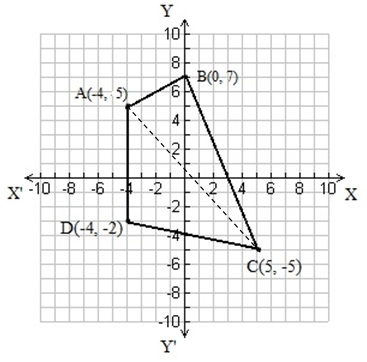
Let ABCD be the given quadrilateral with vertices A (–4, 5), B (0, 7), C (5, –5), and D (– 4, –2).
Now, by plotting A, B, C, and D on the Cartesian plane and joining AB, BC, CD, and DA, the given quadrilateral can be drawn as joining Point A to C forms a diagonal AC.
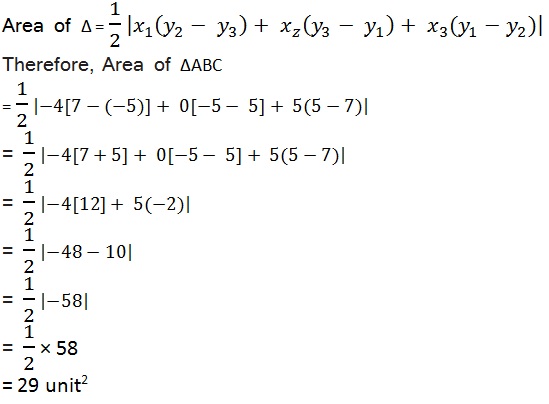
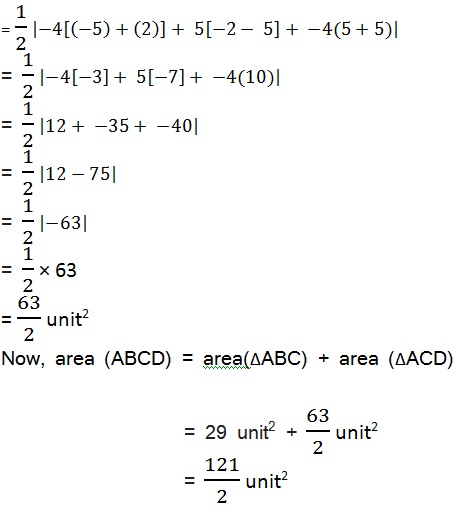
Accordingly, area (ABCD) = area(∆ABC) + area (∆ACD)
Using area of triangle formula.
Therefore, Area of ∆ACD where A (-4, 5), C (5, -5), D (-4, -2)
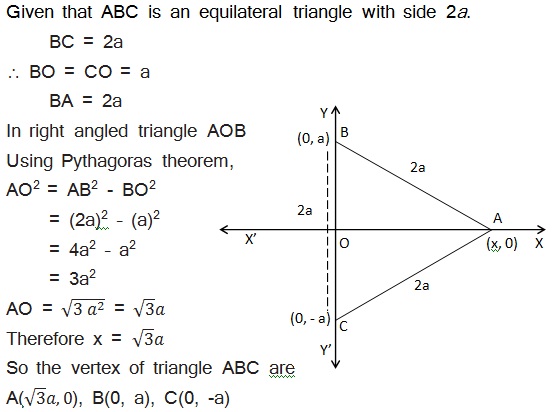
Q2. The base of an equilateral triangle with side 2a lies along the y-axis such that the mid-point of the base is at the origin. Find vertices of the triangle.
Solution:
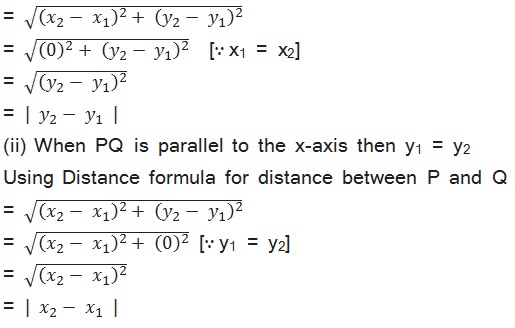
Q3. Find the dis tance between P (x1, y1) and Q (x2, y2) when: (i) PQ is parallel to the y-axis, (ii) PQ is parallel to the x-axis.
Solution:
Given points are : P(x1, y1) and Q(x2, y2)
(i) When PQ is parallel to the y-axis then x1 = x2
Using Distance formula for distance between P and Q
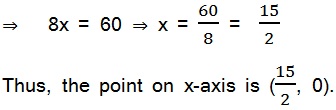
Q4. Find a point on the x-axis, which is equidistant from the points (7, 6) and (3, 4).
Solution:
Let the point on x-axis be P (x, 0) which is equidistance from points A (7, 6) and B (3, 4).
Accordingly,
AP = BP
Or AP2 = BP2 [Squaring both sides]
⇒ (x – 7)2 + (0 – 6)2 = (x – 3)2 + (0 – 4)2
⇒ x2 – 14x + 49 + 36 = x2 – 6x + 9 + 16
⇒ x2 – 14x + 85 = x2 – 6x + 25
⇒ 85 – 25 = 14x – 6x
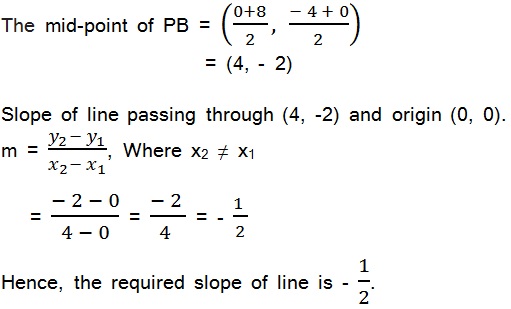
Q5. Find the slope of a line, which passes through the origin and the mid-point of the line segment joining the points P (0, – 4) and B (8, 0).
Solution:
The coordinates of the mid-point of the line segment joining the points P (0, – 4) and B (8, 0).
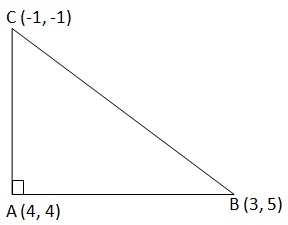
Q6. Without using the Pythagoras theorem, show that the points (4, 4), (3, 5) and (–1, –1) are the vertices of a right angled triangle.
Solution:
The vertices of the given triangle are
A (4, 4), B (3, 5), and C (–1, –1).
If given vertices are of a right angle triangle.
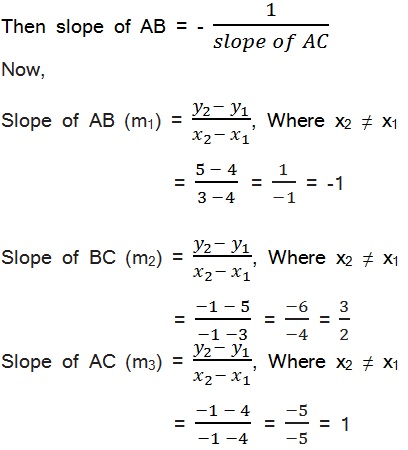
m1m3 = -1
Slope of AB (m1) × Slope of AC (m3) = -1
It means side AB and AC are perpendicular to each other.
Here, given triangle is right-angled at point A (4, 4).
Thus, the points (4, 4), (3, 5), and (–1, –1) are the vertices of a right-angled triangle.
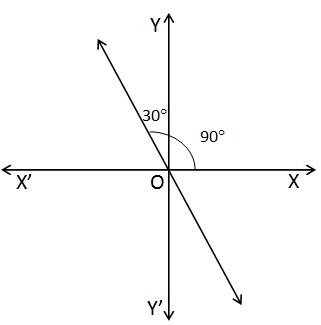
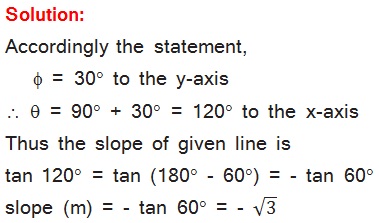
Q7. Find the slope of the line, which makes an angle of 30° with the positive direction of y-axis measured anticlockwise.
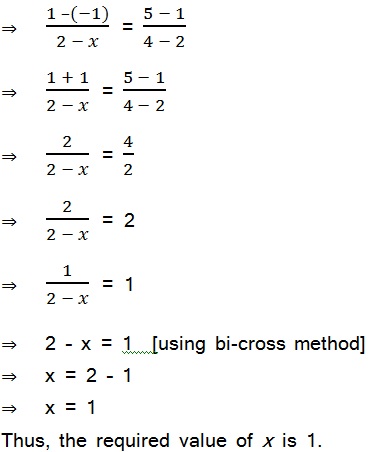
Q8. Find the value of x for which the points (x, – 1), (2,1) and (4, 5) are collinear.
Solution:
Let point be A (x, –1), B (2, 1), and C (4, 5).
If points A (x, –1), B (2, 1), and C (4, 5) are collinear, then
Slope of AB = Slope of BC
Q9. Without using distance formula, show that points (– 2, – 1), (4, 0), (3, 3) and (–3, 2) are the vertices of a parallelogram.
Solution:
To be the points A(– 2, – 1), B(4, 0), C(3, 3) and D(–3, 2) of the vertices of a parallelogram.
There must be AB || CD or BC || AD
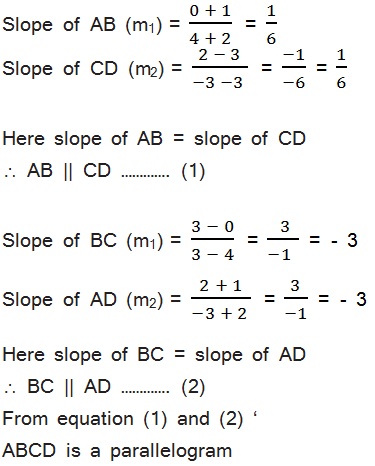
Thus, points (–2, –1), (4, 0), (3, 3), and (–3, 2) are the vertices of a parallelogram.
Q10. Find the angle between the x-axis and the line joining the points (3,–1) and (4,–2).
Solution:
Let be points A(3,–1) and B(4,–2) are given for a line.
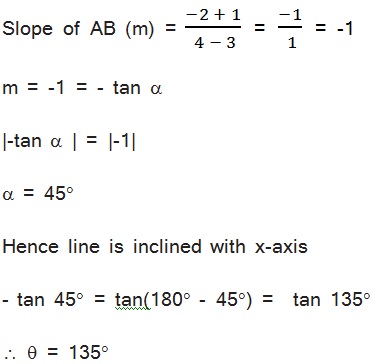
Thus, the angle between the x-axis and the line joining the points (3, –1) and (4, –2) is 135°.

Solution:
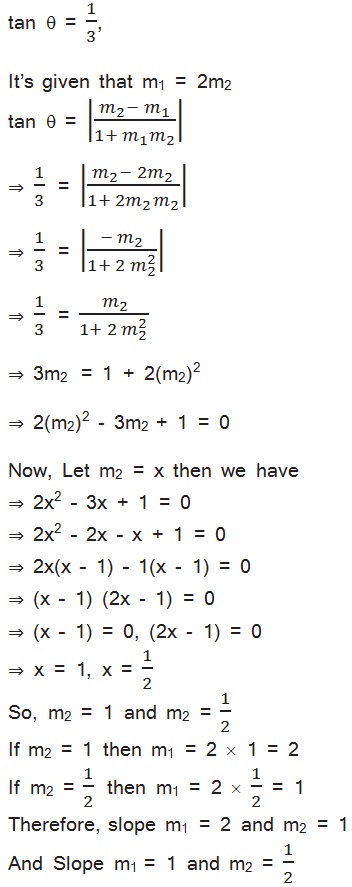
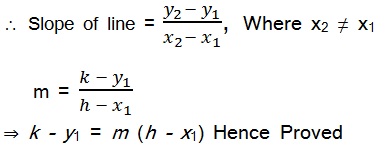
Q12. A line passes through (x1, y1) and (h, k). If slope of the line is m, show that k – y1 = m (h – x1).
Solution:
Line passes through points (x1, y1) and (h, k).
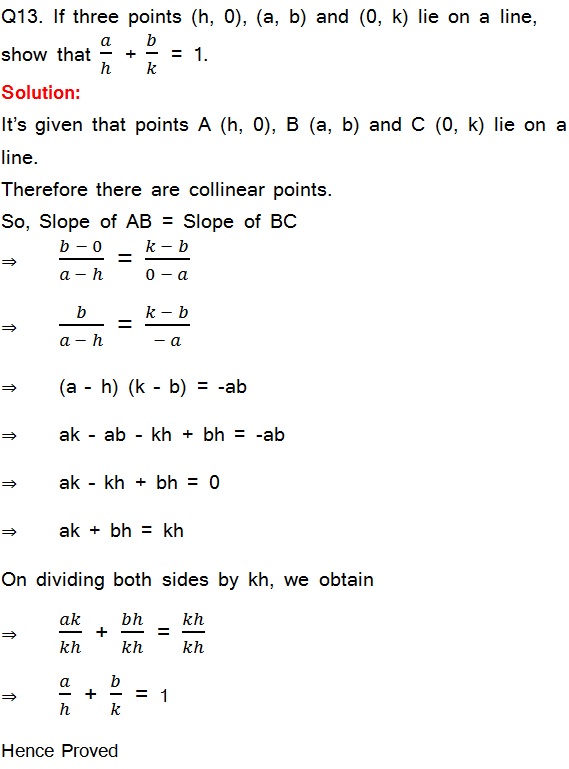
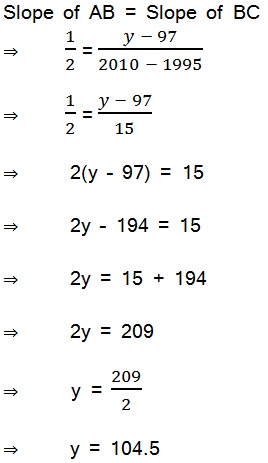
Q14. Consider the following population and year graph, find the slope of the line AB and using it, find what will be the population in the year 2010?
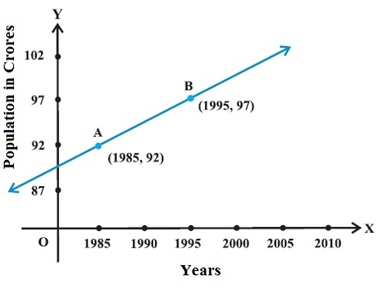
Solution:
Line AB passes through points A(1985, 92) and B(1995, 97).
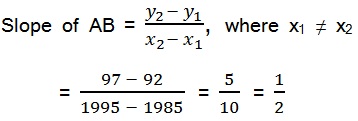
Let y be the population in the year 2010. Then, according to the given graph, line AB must pass through point C (2010, y).

10. Straight Lines
Exercise 10.2
This Page is under construction.
This will be published soon.
Jaust wait ...................
10. Straight Lines
Exercise 10.3
Exercise 10.3
Q1. Reduce the following equations into slope - intercept form and find their slopes and the y - intercepts.
(i) x + 7y = 0,
(ii) 6x + 3y – 5 = 0,
(iii) y = 0.
Solution:

Solution:

Solution:
(iii) y = 0

Q2. Reduce the following equations into intercept form and find their intercepts on the axes.
(i) 3x + 2y – 12 = 0
(ii) 4x – 3y = 6
(iii) 3y + 2 = 0.
Solution: (i) 3x + 2y – 12 = 0
Reducing into intercept form
3x + 2y = 12
Dividing by 12

Solution: (ii) 4x – 3y = 6
Reducing equation into intercept form
4x – 3y = 6
Dividing by 6

Solution: (iii) 3y + 2 = 0
Reducing equation into intercept form
0.x + 3y = - 2
Dividing by -2

Q3. Reduce the following equations into normal form. Find their perpendicular distances from the origin and angle between perpendicular and the positive x-axis.


Required normal form of the line.
X cos 120° + y sin 120° = 4
Perpendicular distance (p) = 4
And angle between perpendicular and the positive x-axis = 120°
Solution: (ii) y – 2 = 0
On reducing the equation we have

Here, comparing with general normal form x cos ω + y sin ω = p
cos ω = , sin ω = and p = 2
Hence point lies on y-axis and θ is in I quadrant.
θ = 90°
∴ ω = 90°
Required normal form of the line.
X cos 90° + y sin 90° = 2
Perpendicular distance (p) = 2
And angle between perpendicular and the positive x-axis = 90°
∴ ω θ
Solution: (iii) x – y = 4
On reducing the equation we have
x - y = 2 …. (1)
A = 1 and B = -1

Hence ω lies in VI quadrant.
θ = 45° [ θ is value of angle between 0 - 90°]
∴ ω = 360° - θ = 360° - 45° = 315°
Required normal form of the line.
x cos 315° + y sin 315° = 2
Perpendicular distance (p) = 2
And angle between perpendicular and the positive x-axis = 315°
Q4. Find the distance of the point (–1, 1) from the line 12(x + 6) = 5(y – 2).
Solution:
Given line is 12(x + 6) = 5(y – 2) which gives
⇒ 12(x + 6) = 5(y – 2)
⇒ 12x + 72 = 5y – 10
⇒ 12x – 5y + 72 + 10 = 0
⇒ 12x – 5y + 82 = 0 ….. (1)
On comparing equation (1) with general equation of line Ax + By + C = 0, we obtain
A = 12, B = - 5 and C = 82
Now distance from given point (-1, 1) to line 12x – 5y + 82 = 0 given by


Solution:

⇒ 4x + 3y = 12
⇒ 4x + 3y - 12 = 0 …..(1)
Comparing equation (1) with general equation of line Ax + By + C = 0
We obtain, A = 4, B = 3 C = -12
Let the point on x-axis be (a, 0) whose distance from given line is 4 units.

Using perpendicular distance formula;

⇒ ±(4a – 12) = 20
Here we take both +ve and –ve signs
⇒ 4a – 12 = 20 Or – 4a + 12 = 20
⇒ 4a = 32 Or – 4a = 20 – 12
⇒ 4a = 32 Or – 4a = 20 – 12 = 8
⇒ a = 8 or a = – 2
Thus the required point on x-axis are (8, 0) and (-2, 0)
Q6. Find the distance between parallel lines
(i) 15x + 8y – 34 = 0 and 15x + 8y + 31 = 0
(ii) l (x + y) + p = 0 and l (x + y) – r = 0.
Solution:
(i) 15x + 8y – 34 = 0 and 15x + 8y + 31 = 0
Q12. Two lines passing through the point (2, 3) intersects each other at an angle of 60°. If slope of one line is 2, find equation of the other line.
Solution:
The slope of one line m1 = 2,
Let the slope of other line be m2.
And the angle between two lines is 60°
⇒ θ = 60°

Now equation of the given live which passes through (2, 3)


Now equation of the given live which passes through (2, 3)
Q13. Find the equation of the right bisector of the line segment joining the points (3, 4) and (–1, 2).
Solution:
Right bisector means perpendicular bisector of given line segment are A(3, 4) and B(-1, 2).
∵ Line bisects AB

The equation of the line passing through (1, 3) and having a slope of –2 is
(y – 3) = –2 (x – 1) y – 3 = –2x + 2
2x + y = 5
Thus, the required equation of the line is 2x + y = 5.
Q14. Find the coordinates of the foot of perpendicular from the point (–1, 3) to the line 3x – 4y – 16 = 0.

Solution:
Equation of given line is
3x – 4y – 16 = 0 …………. (1)


Q15. The perpendicular from the origin to the line y = mx + c meets it at the point (–1, 2). Find the values of m and c.
Solution:
Slope of perpendicular line from origin (0, 0) and (–1, 2).

Q16. If p and q are the lengths of perpendiculars from the origin to the lines x cosθ - ysin θ = k cos2θ and x sec θ + y cosec θ = k, respectively, prove that p2 + 4q2 = k2.
Solution:
x cos θ – y sinθ = k cos 2θ ………………. (1)
x secθ + y cosec θ = k ………………….… (2)
The perpendicular distance (d) of a line Ax + By + C = 0 from a point (x1, y1) is given by


Q17. In the triangle ABC with vertices A (2, 3), B (4, –1) and C (1, 2), find the equation and length of altitude from the vertex A.
Solution:
ABC is the triangle which vertices are A (2, 3), B (4, –1) and C (1, 2).
AD is altitude on side BC from vertex A.


Equation for Altitude AD
⇒ (y – 3) = 1 (x – 2)
⇒ y – 3 = x – 2
⇒ x – y – 2 + 3 = 0
⇒ x – y + 1 = 0
The required equation of Altitude is x – y + 1 = 0.
Now equation for line BC where slope is – 1.
⇒ (y + 1) = –1 (x – 4)
⇒ y + 1 = – x + 4
⇒ x + y + 1 – 4 = 0
⇒ x + y – 3 = 0
Length of AD = Length of the perpendicular from A (2, 3) to BC The equation of BC is x + y – 3 = 0


10. Straight Lines
Miscellaneous Exercise on Chapter - 10
This Page is under construction.
This will be published soon.
Jaust wait ...................

Mathematics
Class 11 (English Medium)
NCERT Mathematics Textbook
Chapter-wise NCERT Solutions for Class 6 to 12 prepared according to the latest CBSE syllabus.
English Medium

NCERT Solutions Class 11 Mathematics
Chapter 2. Relations and Functions Solutions
2. Relations and Functions Open Chapters
Explore Now →
NCERT Solutions Class 11 Mathematics
Chapter 3. Trigonometric Functions Solutions
3. Trigonometric Functions Open Chapters
Explore Now →
NCERT Solutions Class 11 Mathematics
Chapter 4. Principle Of Mathematical Induction Solutions
4. Principle Of Mathematical Induction Open Chapters
Explore Now →
NCERT Solutions Class 11 Mathematics
Chapter 5. Complex Numbers and Quadratic Equations Solutions
5. Complex Numbers and Quadratic Equations Open Chapters
Explore Now →
NCERT Solutions Class 11 Mathematics
Chapter 6. Linear Inequalities Solutions
6. Linear Inequalities Open Chapters
Explore Now →
NCERT Solutions Class 11 Mathematics
Chapter 7. Permutations and Combinations Solutions
7. Permutations and Combinations Open Chapters
Explore Now →
NCERT Solutions Class 11 Mathematics
Chapter 8. Binomial Theorem Solutions
8. Binomial Theorem Open Chapters
Explore Now →
NCERT Solutions Class 11 Mathematics
Chapter 9. Sequences and Series Solutions
9. Sequences and Series Open Chapters
Explore Now →
NCERT Solutions Class 11 Mathematics
Chapter 10. Straight Lines Solutions
10. Straight Lines Open Chapters
Explore Now →
NCERT Solutions Class 11 Mathematics
Chapter 11. Conic Sections Solutions
11. Conic Sections Open Chapters
Explore Now →
NCERT Solutions Class 11 Mathematics
Chapter 12. Introduction to Three Dimensional Geometry Solutions
12. Introduction to Three Dimensional Geometry Open Chapters
Explore Now →
NCERT Solutions Class 11 Mathematics
Chapter 13. Limits and Derivatives Solutions
13. Limits and Derivatives Open Chapters
Explore Now →
NCERT Solutions Class 11 Mathematics
Chapter 14. Mathematical Reasoning Solutions
14. Mathematical Reasoning Open Chapters
Explore Now →
NCERT Solutions Class 11 Mathematics
Chapter 15. Statistics Solutions
15. Statistics Open Chapters
Explore Now →
NCERT Solutions Class 11 Mathematics
Chapter 16. Probability Solutions
16. Probability Open Chapters
Explore Now →
Class 11 NCERT Book Solutions
Chapter-wise NCERT Solutions for Class 6 to 12 prepared according to the latest CBSE syllabus.
ENGLISH MEDIUM
NCERT Solutions Class 11 Mathematics
Class 11 Mathematics Book Solutions
Mathematics Open Book
Explore Now →
NCERT Solutions Class 11 Political Science-I
Class 11 Political Science-I Book Solutions
Open Book
Explore Now →
NCERT Solutions Class 11 History
Class 11 History Book Solutions
Themes In World History Open Book
Explore Now →Benefits of Studying NCERT Solutions
Studying from NCERT Solutions helps students build strong conceptual understanding and improve problem-solving skills. These solutions are especially useful for revision because every answer is written according to the marking scheme followed by CBSE.
- Improve conceptual understanding.
- Learn correct answer-writing techniques.
- Prepare effectively for school examinations.
- Complete syllabus revision in less time.
- Practice important textbook questions.
- Build confidence before examinations.
Prepared According to the Latest CBSE Syllabus
All NCERT Book Solutions for Class 11 available on ATP Education are updated according to the latest CBSE curriculum. Whenever NCERT introduces changes in textbooks or syllabus, our study materials are revised accordingly so that students always receive accurate and updated content.
Helpful for Competitive Examinations
NCERT textbooks form the foundation of many competitive examinations. Students preparing for Olympiads, NTSE, CUET, UPSC Foundation, SSC and several entrance examinations can strengthen their basics through these chapter-wise solutions. Understanding NCERT concepts also improves analytical thinking and logical reasoning.
Simple and Student-Friendly Explanations
Our experts prepare every answer in a simple, clear and student-friendly format. Difficult concepts are explained step by step with proper reasoning so that students of every learning level can understand them easily. This approach helps students remember concepts for a longer period and perform confidently during examinations.
Start Learning with ATP Education
Explore the complete collection of NCERT Solutions for Class 11 and begin your preparation with confidence. Every chapter is available online for free and can be accessed anytime. Whether you want to complete homework, revise important chapters or prepare for examinations, ATP Education provides reliable and high-quality study resources to help you achieve academic success.
Explore Subjects









Why Students Choose Us
Free Study Materials
Get completely free NCERT solutions, notes and board preparation resources.
Updated Notes
Latest CBSE and NCERT syllabus based notes for all major classes.
Practice Tests
Improve performance with chapter-wise MCQ tests and quizzes.
Trending Study Materials
2M+
Monthly Students
50K+
Study Notes
10K+
MCQ Questions
500+
Mock Tests