NCERT Solutions for Class 10 – Complete Chapter-wise Study Material
13. Magnetic Effects of Electric Current is one of the most important chapters in the Class 10 Science English NCERT Solutions curriculum. This chapter plays a significant role in helping students build a strong conceptual foundation while preparing for school examinations, class tests, unit tests, half-yearly examinations, annual examinations, and CBSE board assessments. The chapter has been carefully designed according to the latest NCERT syllabus, making it an essential part of every student's study plan.
The 13. Magnetic Effects of Electric Current - Class 10 Science English NCERT Solutions available on ATP Education explain every question in a simple, accurate, and step-by-step manner. Each answer is prepared according to the latest CBSE guidelines so that students can understand the concepts clearly without confusion. Whether you are completing your homework, revising before examinations, or strengthening your understanding of the subject, these solutions provide reliable academic support throughout your learning journey.
One of the biggest advantages of studying 13. Magnetic Effects of Electric Current is that it helps students understand important concepts, definitions, examples, and textbook exercises in an organized way. Instead of memorizing answers, students learn how to develop logical thinking, improve analytical skills, and write well-structured answers in examinations. This chapter also helps improve problem-solving ability and encourages conceptual learning, which is essential for scoring higher marks in school and competitive examinations.
Our Class 10 Science NCERT Solutions cover all textbook questions, important exercise questions, and chapter-wise explanations in English Medium. Every solution is written in easy-to-understand language, allowing students to revise the chapter quickly before examinations. Regular practice of these solutions improves confidence, strengthens subject knowledge, and reduces examination stress.
Students preparing for school assessments should carefully study 13. Magnetic Effects of Electric Current because questions from this chapter are frequently asked in objective questions, short answer questions, long answer questions, competency-based questions, and case-study questions. Understanding the concepts explained in this chapter also helps students connect related topics from other chapters, making overall learning more effective and meaningful.
At ATP Education, we continuously update our Class 10 Science English NCERT Solutions according to the latest NCERT textbooks and CBSE curriculum. Students can confidently use these chapter-wise solutions for daily study, homework assistance, quick revision, examination preparation, and self-learning. By studying 13. Magnetic Effects of Electric Current thoroughly and practising every question regularly, students can strengthen their concepts, improve writing skills, and achieve better academic performance in both school and board examinations.
13. Magnetic Effects of Electric Current - Class 10 Science English NCERT Solutions
13. Magnetic Effects of Electric Current
Chapter Review
Chapter Review:
- Magnetic field is vector quantity as it has both magnitude and direction.
- The natural magnate is known is magnetite.
- The north needle of compass does not indicate toward the true north exactly, there is some deviation between true north and magnetic north. This deviation of angle between true north and magnetic north is called magnetic declination.
- A coil of many circular turns of insulated copper wire wrapped closely in the shape of a cylinder is called a solenoid.
- MRI method works basis on magnetic field presence in the body to get images from the various organs of the human body.
- Magnetic fields are produced in the human body from flowing ionic current in nervous cells of our body.
- The heart and the brain are two human organs which produe magnetic field.
- Split ring acts as commutator in electric motor.
- A device that reverses the direction of flow of current through a circuit is called a commutator.
- The right hand thumb rule Or Maxwell’s corkscrew rule : You are holding a current carrying straight conductor in your hand such that the thumb point towards the direction of current. Then your finger will wrap around the conductor in the direction of the field lines of the magnetic field.
- There are two types of current (i) Direct current (D.C) (ii) Alternative current (A.C).
- In india A.C has 50 Hz as frequency.
- Direct current always flows in one direction and it is produced by cell or battery.
- The alternating current reverses its direction periodically and it is produced by electric generator.
- There is another wire in domestic electric circuit instead of live wire and neutral wire, which has green insulated wire is called the earth wire.
- The earth wire is used as a safety measure to ensure that any leakage of current to a metallic body does not give any severe electric shock to a user.
- The process by which a changing magnetic field in a conductor induces a current in another conductor. This process is called the electromagnetic induction.
- Electromagnetic induction is discovered by Michael Faradey.
- The direction of field lines is from its south pole and to its north pole.
- The magnetic field lines are closed curve.
- The relative strength (severity) of magnetic field is shown by the degree of closeness of the field lines. Where the magnetic field lines are crowded, magnetic field is stronger there.
- The magnetic field produced by electromagnet is generally very strong.
- Generally the magnetic field produced by permanent magnet is low and moderate.
- The polarity of the magnet can be changed by reversing the direction of current in electromagnet.
- The polarity of the permanent magnet can not be changed.
- Normally soft iron is used for making electro magnets.
- The old convention is red for live, black for neutral and green for earth. The internationally accepted convention is brown for live, light blue for neutral and green or yellow for earth.
- A compass needle is a small magnet. Its one end, which points towards north, is called a north pole, and the other end, which points towards south, is called a south pole.
- A magnetic field exists in the region surrounding a magnet, in which the force of the magnet can be detected.
- Field lines are used to represent a magnetic field. A field line is the path along which a hypothetical free north pole would tend to move.
- The direction of the magnetic field at a point is given by the direction that a north pole placed at that point would take. Field lines are shown closer together where the magnetic field is greater.
- A metallic wire carrying an electric current has associated with it a magnetic field. The field lines about the wire consist of a series of concentric circles whose direction is given by the right-hand rule.
The pattern of the magnetic field around a conductor due to an electric current flowing through it depends on the shape of the conductor. - The magnetic field of a solenoid carrying a current is similar to that of a bar magnet.
- An electromagnet consists of a core of soft iron wrapped around with a coil of insulated copper wire.
- A current-carrying conductor when placed in a magnetic field experiences a force. If the direction of the field and that of the current are mutually perpendicular to each other, then the force acting on the conductor will be perpendicular to both and will be given by Fleming’s left-hand rule. This is the basis of an electric motor. An electric motor is a device that converts electric energy into mechanical energy.
- The phenomenon of electromagnetic induction is the production of induced current in a coil placed in a region where the magnetic field changes with time. The magnetic field may change due to a relative motion between the coil and a magnet placed near to the coil. If the coil is placed near to a current-carrying conductor, the magnetic field may change either due to a change in the current through the conductor or due to the relative motion between the coil and conductor. The direction of the induced current is given by the Fleming’s right-hand rule.
- A generator converts mechanical energy into electrical energy. It works on the basis of electromagnetic induction.
- In our houses we receive AC electric power of 220 V with a frequency of 50 Hz. One of the wires in this supply is with red insulation, called live wire. The other one is of black insulation, which is a neutral wire. The potential difference between the two is 220 V. The third is the earth wire that has green insulation and this is connected to a metallic body deep inside earth. It is used as a safety measure to ensure that any leakage of current to a metallic body does not give any severe shock to a user.
- Fuse is the most important safety device, used for protecting the circuits due to short-circuiting or overloading of the circuits.
13. Magnetic Effects of Electric Current
Text-book Questions
Chapter 13. Magnetic Effects of Electric Current
Text-book Questions:
Page 224:
Q1. Why does a compass needle get deflected when brought near a bar magnet?
Ans: As compass needle is also act like a bar magnet. When a compass needle is placed near a bar magnet due to repulsive force between unlike poles and attraction between two unlike poles take place. The compass needle gets deflected.
Page 228:
Q1. Draw magnetic field lines around a bar magnet.
Ans: The magnetic field lines are as shown in the figure.


Q2. List the properties of magnetic lines of force.
Ans: The properties of magnetic lines of force are as follows:
(i) The magentic field lines emerge from north pole and merge at the south pole.
(ii) Inside the magnet, the direction of field lines is from its south pole to its north pole.
(iii) The magnetic field lines are closed curves.
(iv) The magnetic field is stronger, where the field lines are crowded.
(v) Two field lines do not intersect/cross each other.
Q3. Why don’t two magnetic lines of force intersect each other?
Ans: This is so, magnetic field lines do not intersect each other. If they did, it would mean that at the point of intersection, the compass needle would point
towards two directions, which is not possible.
Page 229:
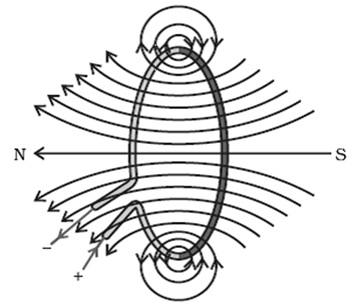
Q1. Consider a circular loop of wire lying in the plane of the table. Let the current pass through the loop clockwise. Apply the right-hand rule to find out the direction of the magnetic field inside and outside the loop.
Ans: According to right-hand rule, we observe that inside the loop, the magnetic field lines are directed perpendicular to the plane of paper in the inward direction. Outside the loop magnetic field lines are directed out of the plane paper.
Q2. The magnetic field in a given region is uniform. Draw a diagram to represent it.
Ans: When the magnetic field in a region is uniform, then the lines are parallel to each other, at the same distance and of equal length.
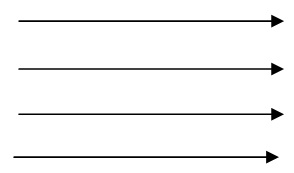
uniform magnetic field lines 
Q3. Choose the correct option.
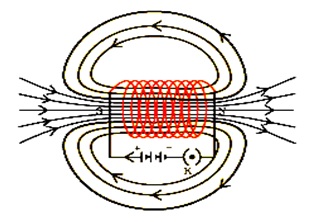
The magnetic field inside a long straight solenoid-carrying current
(a) is zero.
(b) decreases as we move towards its end.
(c) increases as we move towards its end.
(d) is the same at all points.
Ans:
(d) is the same at all points.
Page 231:
Q1. Which of the following property of a proton can change while it moves freely in a magnetic field?
(There may be more than one correct answer.)
| (a) mass | (b) speed |
| (c) velocity | (d) momentum |
Ans: (c) Velocity and (d) momentum
Q2. In Activity 13.7, how do we think the displacement of rod AB will be affected if;
(i) current in rod AB is increased;
(ii) a stronger horse-shoe magnet is used; and
(iii) length of the rod AB is increased?
Ans:
(i) O increasing the current in rod AB its displacement will increase.
(ii) If stronger horse-shoe magnet is used then the displacement of rod AB will increase.
(iii) If length of the rod is increased, force acting on it will increase and hence, displacement of the rod increases.
Q3. A positively-charged particle (alpha-particle) projected towards west is
deflected towards north by a magnetic field. The direction of magnetic
field is
| (a) towards south | (b) towards east |
| (c) downward | (d) upward |
Ans: According to the right hand thumb rule the direction of magnetic field will be vetically (d) upward.
Page 233:
Q1. State Fleming’s left-hand rule.
Ans: Fleming’s left-hand rule:
According to this rule, stretch the thumb, forefinger and middle finger of your left hand such that they are mutually perpendicular. If the first finger points in the direction of magnetic field and the second finger in the direction of current, then the thumb will point in the direction of motion or the force acting on the conductor.

Q2. What is the principle of an electric motor?
Ans: An electric motor is a rotating device that converts electrical energy to
mechanical energy. It is based on the principle in which a current carrying conductor experiences a force when placed in a magnetic field. If the direction of the magnetic field and that of the direction of current which pass through the magnetic field are mutually perpendicular then the direction of the force is given by Fleming’s left-hand rule.
Q3. What is the role of the split ring in an electric motor?
Ans: The split ring in a electric motor works as a commutator. It reverses the flowing of current in moter after a half rotation. Which gives rise to a contunuous roation of the coil and the axle.
Page 236:
Q1. Explain different ways to induce current in a coil.
Ans:
(a) Moving the coil in a magnetic field.
(b) By changing the magnetic field lines around the coil.
(c) It is convenient in most situations to move the coil in a magnetic field.
(d) The motion of a magnet with respect to the coil produces an induced potential difference, which sets up an induced electric current in the circuit.
Page 237:
Q1. State the principle of an electric generator.
Ans: The principle of electric generator is based on electromagnetic induction. When a rectangular coil is rotated in a uniform magnetic field, it produces induced electricity at the ends of the coil. This is the principle of the electric generator.
Q2. Name some sources of direct current.
Ans: Cell, battery and D.C generator or dynamo etc. are the sources of direct current.
Q3. Which sources produce alternating current?
Ans: A.C. Generators and Inverters etc. which generate alternating current.
Q4. Choose the correct option.
A rectangular coil of copper wires is rotated in a magnetic field. The direction of the induced current changes once in each
| (a) two revolutions | (b) one revolution |
| (c) half revolution | (d) one-fourth revolution |
Ans: (c) half revolution
Page 238:
Q1. Name two safety measures commonly used in electric circuits and appliances.
Ans: he names of two safety measures commonly used in electric circuits and appliances are -
(i) use of fuse and
(ii) Use of ground contact wire.
Q2. An electric oven of 2 kW power rating is operated in a domestic electric circuit (220 V) that has a current rating of 5 A. What result do you expect? Explain.
Ans: Power of electric tandoor (P) = 2 kW = 2000 W
Thus, the current drawn by the electric tandoor (I) = P/V
= 2000/220 = 9 A (approx.)
Whereas the current rating of the electric circuit is 5 A and the tandoor draws current at the rate of 9 A, so this circuit will break due to overheating or overloading.
Q3. What precaution should be taken to avoid the overloading of domestic electric circuits?
Ans: The following precautions should be taken to avoid overloading in domestic electrical circuits.
(i) Not more than one device should be connected to a single socket.
(ii) Always connect the electrical equipment in the circuit in parallel.
(iii) Suitable fuse should be used in the circuit.
(iv) Multiple electrical appliances should not be used at the same time to avoid overloading.
13. Magnetic Effects of Electric Current
Exercise
NCERT Solution Exercise
Q1. Which of the following correctly describes the magnetic field near a long straight wire?
(a) The field consists of straight lines perpendicular to the wire.
(b) The field consists of straight lines parallel to the wire.
(c) The field consists of radial lines originating from the wire.
(d) The field consists of concentric circles centred on the wire.
Ans: (d) The field consists of concentric circles centred on the wire.
Q2. The phenomenon of electromagnetic induction is
(a) the process of charging a body.
(b) the process of generating magnetic field due to a current passing through a coil.
(c) producing induced current in a coil due to relative motion between a magnet and the coil.
(d) the process of rotating a coil of an electric motor.
Ans: (c) producing induced current in a coil due to relative motion between a magnet and the coil.
Q3. The device used for producing electric current is called a
(a) generator.
(b) galvanometer.
(c) ammeter.
(d) motor.
Ans: (a) generator.
Q4. The essential difference between an AC generator and a DC generator is that
(a) AC generator has an electromagnet while a DC generator has permanent magnet.
(b) DC generator will generate a higher voltage.
(c) AC generator will generate a higher voltage.
(d) AC generator has slip rings while the DC generator has a commutator.
Ans: (d) AC generator has slip rings while the DC generator has a commutator.
Q5. At the time of short circuit, the current in the circuit
(a) reduces substantially.
(b) does not change.
(c) increases heavily.
(d) vary continuously.
Ans: (c) increases heavily.
Q6. State whether the following statements are true or false.
(a) An electric motor converts mechanical energy into electrical energy. (b) An electric generator works on the principle of electromagnetic induction.
(c) The field at the centre of a long circular coil carrying current will be parallel straight lines.
(d) A wire with a green insulation is usually the live wire of an electric supply.
Ans: (a) Electric motor converts mechanical energy into electrical energy. (Wrong)
(b) Electric generator works on the principle of electromagnetic induction. (Correct)
(c) The magnetic field at the center of a long circular current carrying coil is parallel straight field lines. (Correct)
(d) The green insulating wire is usually an insulating wire. (Wrong)
Q7. List three sources of magnetic fields.
Ans: (a) A natural magnet has a magnetic field around it.
(b) A current carrying straight conductor has a magnetic field around it.
(c) A current carrying solenoid has a magnetic field around it.
Q8. How does a solenoid behave like a magnet? Can you determine the north and south poles of a current–carrying solenoid with the help of a bar magnet? Explain.
Ans: A cylinder-shaped coil with several turns of insulating copper wire wrapped around it is called a solenoid. One end of the current-carrying solenoid acts as the South Pole and the other end as the North Pole. The magnetic field lines inside the solenoid are parallel to each other. This means that the electric field at the center of the solenoid is maximum and is the same everywhere.
Yes, the north pole and south pole of the solenoid can be identified with a compass. If the north pole of the compass needle is attracted towards the solenoid. So this end is the South Pole. Similarly identify the South Pole.
Q9. When is the force experienced by a current–carrying conductor placed in a magnetic field largest?
Ans:
Q10. Imagine that you are sitting in a chamber with your back to one wall. An electron beam, moving horizontally from back wall towards the front wall, is deflected by a strong magnetic field to your right side. What is the direction of magnetic field?
Ans: The magnetic field will be from the direction perpendicular to the plane in which the flow and force of electrons are perpendicular to each other.
Q11. Draw a labelled diagram of an electric motor. Explain its principle and working. What is the function of a split ring in an electric motor? Q12. Name some devices in which electric motors are used.
Ans:
Q12. Name some devices in which electric motors are used.
Ans: Electric motors are used in coolers, fans, air conditioners, pumps etc.
Q13. A coil of insulated copper wire is connected to a galvanometer. What will happen if a bar magnet is
(i) pushed into the coil.
(ii) withdrawn from inside the coil.
(iii) held stationary inside the coil?
Ans: (i) In this case induced current is generated in the coil.
(a) If the north pole is pushed into the coil, then the direction of current in the coil is counter-clockwise.
(b) If the south pole is pushed in the coil, then the direction of current in the coil is clockwise.
(ii) If you take out the South Pole magnet in the coil, then the current in the coil will be in anticlockwise direction and if you take out the North Pole, then the current in the coil will be generated in the clockwise direction.
(iii) In this case no current is generated in the coil.
Q14. Two circular coils A and B are placed closed to each other. If the current in the coil A is changed, will some current be induced in the coil B? Give reason.
Ans: Yes, induced current will be generated.
Due to change of current in coil A, current in B is induced due to change in the number of magnetic field lines passing through A.
Q15. State the rule to determine the direction of a
(i) magnetic field produced around a straight conductor-carrying current. (ii) force experienced by a current-carrying straight conductor placed in a magnetic field which is perpendicular to it.
(iii) current induced in a coil due to its rotation in a magnetic field.
Ans: (i) The direction of the magnetic field produced around a current carrying straight conductor is determined by Maxwell's right-hand rule.
Maxwell's right-hand rule:- If the right hand is holding a current-carrying conductor in such a way that the thumb points in the direction of the current flowing through the conductor, then the fingers holding the conductor are in the direction of the magnetic field.
(ii) The direction of force on a current carrying conductor in a magnetic field is determined by Fleming's left hand law.
Fleming left hand rule: - If the first three fingers of the left hand are placed perpendicular to each other in such a way that the index finger is in the direction of the magnetic field and the middle finger is in the direction of the current, then the direction of the thumb shows the direction of the force acting on the conductor. |
(iii) Fleming's right hand law is used to find the direction of the induced current produced in a conductor moving in a magnetic field.
Fleming's right hand rule: - According to this rule, if the first three fingers of the right hand are kept perpendicular to each other in such a way that the index finger shows the direction of magnetic field and the thumb shows the direction of motion in the conductor, then the amount of induced current in the conductor will be Direction is indicated by Madhyama.
Q16. Explain the underlying principle and working of an electric generator by drawing a labelled diagram. What is the function of brushes?
Ans:
Q17. When does an electric short circuit occur?
Ans: When the neutral wire and neutral wire come in contact with each other in a domestic electric circuit, the value of current in the circuit becomes very high. This phenomenon is called short circuit.
Q18. What is the function of an earth wire? Why is it necessary to earth metallic appliances?
Ans: When the neutral wire and neutral wire come in contact with each other in a domestic electric circuit, the value of current in the circuit becomes very high. This phenomenon is called short circuit.
13. Magnetic Effects of Electric Current
Additional Questions With Solutions
Chapter-13. Magnetic Effects of Electric Current
Que. – By which name the natural magnate is known?
Ans. – Magnetite.
Que. – What is magnetic
Que. – What is solonoide ?
Ans. – A coil of many circular turns of insulated copper wire wrapped closely in the shape of a cylinder is called a solenoid.
Que . – On which basis MRI does work to get images from the various organs of the human body?
Ans. – MRI method works basis on magnetic field presence in the body to get images from the various organs of the human body.
Que. – From where do magnetic fields produce in the human body?
Ans. - Magnetic fields produce in the human body from flowing ionic current in nervous cells of our body.
Que. – Name the parts of human body which produce magnetic field?
Ans. – The heart and The brain.
Que. – Name the device in which converts electric energy into mechanical energy?
Ans. – Electric Motor.
Que. – What is the function of split ring in electric motor?
Ans. - split ring acts as commutator in electric motor.
Que. – What happens to the magnetic field around a straight conductor, when current is passed through it? The conditions are as following:
- Increasing electric current.
- Placing the compass at the farther point from the conducting wire.
- Size of concentric circles, which represent the magnetic field.
Ans. –
- Produced magnetic field increases.
- Deflection in the needle decreases.
- Size of concentric circles, which represent the magnetic field, becomes larger and larger.
Que. – Name a special kind of technology of medical science in which makes base to magnetic field to get images of organs?
Ans. – MRI.
Que. – What is commutator?
Ans. – A device that reverses the direction of flow of current through a circuit is called a commutator.
Que. – A straight conductor produces magnetic field around it. Describe rule to find the direction of such a produced magnetic field by it.
Ans. – This rule is known as the right hand thumb rule. This rule is also known as Maxwell’s corkscrew rule. You are holding a current carrying straight conductor in your hand such that the thumb point towards the direction of current. Then your finger will wrap around the conductor in the direction of the field lines of the magnetic field.
Que. – There is another wire in domestic electric circuit instead of live wire and neutral wire, which has green insulated wire.
- Name this wire.
- What is the advantage of using this wire in domestic circuit?
- Where does another end of this wire is connected instead of domestic circuit and how?
Ans. –
- The earth wire.
- It is used as a safety measure to ensure that any leakage of current to a metallic body does not give any severe electric shock to a user.
- The other end of this wire is connected to a metallic body deep inside earth.
Que. – What is the potential different between live wire and neutral wire?
Ans – 220 V.
Que. – At what volt do we receive AC electric power in our houses and what is its frequency?
Ans. - we receive AC electric power At 220 V and its frequency is 50 Hz.
Que. – Give the answers of the following questions.
(a) What is the electromagnetic induction?
(b) Who discovered the electromagnetic induction?
(c) Write two processes to induce current in a coil.
(d) Which process of both is more convenient to induce current in a coil?
Ans. –
The process by which a changing magnetic field in a conductor induces a current in another conductor. This process is called the electromagnetic induction.
Michael Faraday.
(a) Moving the coil in a magnetic field.
(b) By changing the magnetic field around the coil.
Moving the coil in a magnetic field is move convenient to induce current in a coil.
Que.- What are the two methods of producing magnetic field? Which of these is better and why?
Ans. –
Que. – Give the answers of following question.
- What do you understand by magnetic field?
- Are there magnetic field lines inside the magnet? If yes, then explain, what is their direction?
- Magnetic field is Vector or scalar? How?
- Write three properties of magnetic field.
Ans. –
- The region surrounding a magnet, in which the force of the magnet can be detected, is said to have a magnetic field.
- Yes, there are magnetic field lines inside the magnet. The field lines emerge from North Pole and merge at the South Pole inside the magnet.
- Magnetic field is Sadish Rashi, As It has both direction and magnitude.
- Properties of magnetic field as follow:
- The direction of field lines is from its south pole and to its north pole.
- The magnetic field lines are closed curve.
- It has both direction and magnitude.
Que. – How will you identify the relative strength (severity) of magnetic field?
Ans. – the relative strength (severity) of magnetic field is shown by the degree of closeness of the field lines. Where the magnetic field lines are crowded, magnetic field is stronger there.
Que. – A bar magnet “A” whose magnetic field lines are very closer, while another bar magnet “B” magnetic field lines are farther than “A”. “A” is brought near “B”. Which magnet works stronger, why?
Ans. - Bar magnet “A”. As where the magnetic field lines are crowded, magnetic field is stronger there and that magnet works stronger.
Que. – How much powerful will be the magnetic field produced by a circular coil having n turns than produced by the single turn?
Ans. – n times as larger as that produced by single turn.
Q2. What is the difference between an electromagnet and a permanent magnet?
Ans2.
|
Electromagnet |
Permanent magnet |
|
1. The magnetic field produced is generally very strong. |
1. Generally the magnetic field produced is low and moderate. |
Q3. What is the usual colour code followed for connecting live, neutral and earth wires? Why is it so important?
Ans3. The old convention is red for live, black for neutral and green for earth. The internationally accepted convention is brown for live, light blue for neutral and green or yellow for earth.
The selection of earth wire is made in such a way that it can withstand stronger currents. The thickness of other wires depends upon the power rating of the appliance.
The distinction between the colours is necessary because the wires are taken according to their current carrying capacities.
13. Magnetic Effects of Electric Current
Additional Questions With Solutions
This page is under Construction.
The page writing is going on..........

Science
Class 10 (English Medium)
NCERT Science Textbook
Chapter-wise NCERT Solutions for Class 6 to 12 prepared according to the latest CBSE syllabus.
English Medium
NCERT Solutions Class 10 Science
Chapter 1. Chemical Reactions and Equations Solutions
1. Chemical Reactions and Equations Open Chapters
Explore Now →
NCERT Solutions Class 10 Science
Chapter 2. Acids, Bases and Salts Solutions
2. Acids, Bases and Salts Open Chapters
Explore Now →
NCERT Solutions Class 10 Science
Chapter 3. Metals and Non-metals Solutions
3. Metals and Non-metals Open Chapters
Explore Now →
NCERT Solutions Class 10 Science
Chapter 4. Carbon and its Compounds Solutions
4. Carbon and its Compounds Open Chapters
Explore Now →
NCERT Solutions Class 10 Science
Chapter 5. Periodic Classification of Elements Solutions
5. Periodic Classification of Elements Open Chapters
Explore Now →
NCERT Solutions Class 10 Science
Chapter 6. Life Processes Solutions
6. Life Processes Open Chapters
Explore Now →
NCERT Solutions Class 10 Science
Chapter 7. Control and Coordination Solutions
7. Control and Coordination Open Chapters
Explore Now →
NCERT Solutions Class 10 Science
Chapter 8. How do Organisms Reproduce Solutions
8. How do Organisms Reproduce Open Chapters
Explore Now →
NCERT Solutions Class 10 Science
Chapter 9. Heredity and Evolution Solutions
9. Heredity and Evolution Open Chapters
Explore Now →
NCERT Solutions Class 10 Science
Chapter 10. Light-Reflection and Refraction Solutions
10. Light-Reflection and Refraction Open Chapters
Explore Now →
NCERT Solutions Class 10 Science
Chapter 11. Human Eye and Colourful World Solutions
11. Human Eye and Colourful World Open Chapters
Explore Now →
NCERT Solutions Class 10 Science
Chapter 12. Electricity Solutions
12. Electricity Open Chapters
Explore Now →
NCERT Solutions Class 10 Science
Chapter 13. Magnetic Effects of Electric Current Solutions
13. Magnetic Effects of Electric Current Open Chapters
Explore Now →
NCERT Solutions Class 10 Science
Chapter 14. Sources of Energy Solutions
14. Sources of Energy Open Chapters
Explore Now →
NCERT Solutions Class 10 Science
Chapter 15. Our Environment Solutions
15. Our Environment Open Chapters
Explore Now →
NCERT Solutions Class 10 Science
Chapter 16. Management of Natural Resources Solutions
16. Management of Natural Resources Open Chapters
Explore Now →
Class 10 NCERT Book Solutions
Chapter-wise NCERT Solutions for Class 6 to 12 prepared according to the latest CBSE syllabus.
ENGLISH MEDIUM
NCERT Solutions Class 10 Mathematics
Class 10 Mathematics Book Solutions
Mathematics Open Book
Explore Now →
NCERT Solutions Class 10 English First Flight
Class 10 English First Flight Book Solutions
Open Book
Explore Now →
NCERT Solutions Class 10 Footprints Without Feet
Class 10 Footprints Without Feet Book Solutions
Open Book
Explore Now →
Benefits of Studying NCERT Solutions
Studying from NCERT Solutions helps students build strong conceptual understanding and improve problem-solving skills. These solutions are especially useful for revision because every answer is written according to the marking scheme followed by CBSE.
- Improve conceptual understanding.
- Learn correct answer-writing techniques.
- Prepare effectively for school examinations.
- Complete syllabus revision in less time.
- Practice important textbook questions.
- Build confidence before examinations.
Prepared According to the Latest CBSE Syllabus
All NCERT Book Solutions for Class 10 available on ATP Education are updated according to the latest CBSE curriculum. Whenever NCERT introduces changes in textbooks or syllabus, our study materials are revised accordingly so that students always receive accurate and updated content.
Helpful for Competitive Examinations
NCERT textbooks form the foundation of many competitive examinations. Students preparing for Olympiads, NTSE, CUET, UPSC Foundation, SSC and several entrance examinations can strengthen their basics through these chapter-wise solutions. Understanding NCERT concepts also improves analytical thinking and logical reasoning.
Simple and Student-Friendly Explanations
Our experts prepare every answer in a simple, clear and student-friendly format. Difficult concepts are explained step by step with proper reasoning so that students of every learning level can understand them easily. This approach helps students remember concepts for a longer period and perform confidently during examinations.
Start Learning with ATP Education
Explore the complete collection of NCERT Solutions for Class 10 and begin your preparation with confidence. Every chapter is available online for free and can be accessed anytime. Whether you want to complete homework, revise important chapters or prepare for examinations, ATP Education provides reliable and high-quality study resources to help you achieve academic success.