6. Life Processes - Class 10 Science English CBSE Notes
CBSE Notes for Class 10 are one of the most useful study resources for students who want to understand every chapter clearly and perform well in school examinations. At ATP Education, we provide carefully prepared chapter-wise CBSE Notes for Class 10 based on the latest CBSE syllabus and NCERT curriculum. These notes are designed to simplify learning, improve conceptual understanding, and help students revise important topics quickly before examinations.
CBSE Notes for Class 10 – Chapter-wise Revision Notes
Every chapter is explained in a simple and student-friendly manner so that learners can understand difficult concepts without confusion. Whether you are preparing for class tests, periodic assessments, half-yearly examinations, annual examinations, or board-oriented assessments, our Class 10 CBSE Notes help you revise the complete syllabus in less time while covering all the important concepts.

6. Life Processes - Class 10 Science English CBSE Notes
6. Life Processes
Chapter 6. Life Process
Life process: Those processes of the body which are neccessory to prevent damage and break down and which together perform maintainance job are called life processes.
These are;
(i) Nutrition
(ii) Respiration
(iii) Transportation
(iv) Excretion
All the organisms require energy to perform various cellular work and to servive. Organisms get this energy by the process of nutrition.
All the organisms to survive and requires energy to perform various tasks . This energy is derived from the process of nutrition in organisms. This action is a biochemical process called metabolism in the cells, which are rich in oxygen to be rich and oxygen requires the organism from its external environment receives. This process uses oxygen and generates carbon-dioxide (CO2) to be expelled out is called Respiration. Some single-celled organisms to carry oxygen and carbon-dioxide does not require special organs because their cells are directly exposed to the environment. But for the exchange of gases in multicellular organisms and their cells to pick up the respiratory tract carries a mechanism (transportation system), which is the circulation system (Circulatory System) is called. When using chemical reactions in carbon source and oxygen for energy recovery occurs such product (porducts) helps bring the body's cells are not only unnecessary but can be harmful. These waste products out of the body, is imperative. Because the process includes all maintenance works of the body is therefore called life process.
1. Nutrition: The process happening in the living organisms in which organisms get energy to change complex materials into simple materials by the biochemical process and utilized them, it is called nutrition.
Examples of biological process:
(i) Photosynthesis in plants.
(ii) Digestion in animals
Bio-chemical process:
For this life process organisms get complex material from outer enrgy sources and decomposition and formation take place inside the body. By which these are form to maintain and to growth of body. For this there happen a large series of chemical reactions. these are known as bio-chemical process. There is a bio-chemical process called metabolism which takes place in the cells. These celluar process need oxygen to perform this which is obtained from external environment.
The Process of Nutrition
⇓
Get osition of complex materials
⇓
Changing in simplest useful molecules by bio-chemical process
⇓
Utilizing in the form of energy
⇓
Using in various bio-chemical processes
⇓
Protiens synthesis (Formation of new completes molecules)
⇓
Growth and maintainance of body
Common Chemical Methods for Decomposing of Molecules:
Metabolisms: The decomposing of various molecules in the body are taken place by a chemical proccess is called Metabolism.
Metabolisms are a bio-chemical proccess which occur in all living organisms to ensure life.
There are two kinds of metabolisms:
(i) Catabolism: During this proccess complex organics materials are decomposed into simpler molecules and during cellular respiration this simpler molicules are used to form energy.
(ii) Anabolism: During this proccess store energy is used by cell for various biochemical proccesses take palce. cells utilised energy for repair, maintance works and also for cell generation.
6. Life Processes
Nutrition
1. Nutrition: The process in living organisms in which an organism converts complex substances into simpler substances through biochemical processes, obtains and uses energy, is called nutrition.
Example of a biochemical process:
(i) The process of photosynthesis in plants
(ii) Digestion in animals
The process of making food in green plants is called photosynthesis. In this process organisms obtain simple substances in the form of carbon dioxide and water from inorganic sources. Such organisms are called autotrophs. Example: Green plants and some bacteria having chlorophyll etc.
Enzymes: To break down complex substances into simpler substances, organisms use certain biocatalysts which are called enzymes.
Types of Nutrition:

There are two types of nutrition.
1. Autotrophic Mode of Nutrition: Autotrophic nutrition is the type of nutrition in which organisms synthesize organic matter (food) from inorganic sources on their own. This type of nutrition is done by green plants and autotrophic bacteria.
Examples: All green plants and some bacterias which perform photosynthesis.
2. Hetrotrophic Mode of Nutrition: The mode of nutrition in which the organism obtains its food from other sources. In this, the organism gets its food from plant sources or from animal sources.
Examples: Algee, Fungus, Man, All Animals, etc.
Types of Hetrotrophic Nutrition:
There are three types of hetrotrophic nutrition.
(i) Saprophytic Nutrition: The method of nutrition in which living beings feed themselves from dead and decaying organic matter. Such method of nutrition is called saprophytic nutrition. This type of nutrition occurs in fungi and most bacterias.
(ii) Parasitic Nutrition: Parasitic nutrition is the method of nutrition in which organisms take their food and habitat (shelter) from another organism and absorb their nutritional source is called parasitic nutrition.
Two types of organisms are involved in this process.
(i) Host: The organism from which parasites absorb food is called host.
(ii) Parasite: Parasites are those organisms that live in the body of the host and absorb their own food and use habitat. For example - Plasmodium found in mosquitoes, tapeworm found in human intestine, roundworm, zoo etc. While in plants, cuscuta.
(iii) Holozoic Nutrition : A method of nutrition in which life energy is obtained by ingestion and digestion of organic matter obtained from plant and animal sources. That is, he takes the food, digests it and then takes it out. For example, humans, amoeba and all animals.
Nutrition in Amoeba: Amoeba also receives nutrition like humans and digests inside the body.

6. Life Processes
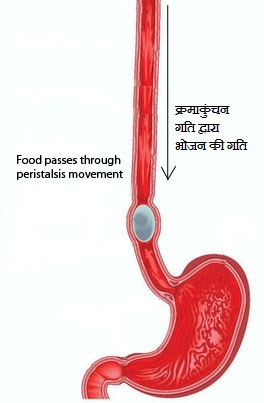
Peristalsis Movement: The movement of the alimentary canal that helps food move from one part of the alimentary canal to another is called peristalsis movement.
Respiration:
During the process of nutrition, we consume food materials. The energy obtained from these food materials is used by the cells. Living organisms use this energy for various life processes.
(1) Cellular Respiration: The breakdown of food in cells to produce energy is called cellular respiration.
(2) Breathing: Breathing is the process that takes place in the lungs, in which an organism takes in oxygen and releases carbon dioxide.
Energy for Various Life Processes:
Cells obtain energy for various life processes through cellular respiration. Different organisms obtain energy by different methods.
(i) In the Absence of Oxygen: Some organisms such as yeast obtain energy through the process of fermentation.
The flow of this process is as follows:
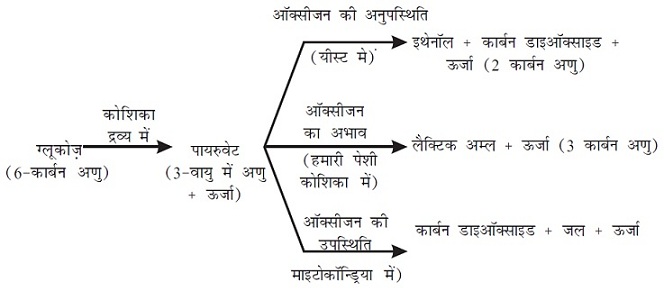
6-carbon glucose ⇒ breaks down into a 3-carbon molecule called pyruvate ⇒ ethanol, carbon dioxide and energy are released.
Since this process takes place in the absence of oxygen, it is called anaerobic respiration.
(ii) In the Deficiency of Oxygen: During excessive exercise or heavy physical work, there may be a deficiency of oxygen in our muscles. This occurs when the supply of oxygen is less than the demand of the body.
The flow of this process is as follows:
6-carbon glucose ⇒ breaks down into a 3-carbon molecule called pyruvate ⇒ lactic acid and energy are released.
(iii) In the Presence of Oxygen: This process takes place in the mitochondria of our cells in the presence of oxygen.
The flow of this process is as follows:
6-carbon glucose ⇒ breaks down into a 3-carbon molecule called pyruvate ⇒ carbon dioxide, water and a large amount of energy are released.
Since this process takes place in the presence of oxygen, it is called aerobic respiration.
Flow Diagram of the Breakdown of Glucose through Different Pathways:
Aerobic Respiration: The process of glucose breakdown that takes place in the presence of oxygen is called aerobic respiration.
Anaerobic Respiration: The process of glucose breakdown that takes place in the absence of oxygen is called anaerobic respiration.
Difference Between Aerobic and Anaerobic Respiration:
Anaerobic Respiration
1. It produces 2 ATP molecules of energy.
2. This process takes place in the cytoplasm of the cell.
3. It occurs in lower organisms such as yeast cells.
4. This type of respiration takes place in the absence of oxygen.
5. Along with energy, ethanol and carbon dioxide are released.
Aerobic Respiration:
1. It produces a large amount of ATP energy.
2. This process takes place in the mitochondria.
3. It is found in higher organisms.
4. This type of respiration takes place in the presence of oxygen.
5. Along with energy, carbon dioxide and water are released.
Utilization of Energy: The energy released during cellular respiration is immediately used for the synthesis of a molecule called ATP, which acts as fuel for other activities of the cell.
(i) The breakdown of ATP releases a certain amount of energy, which drives the endothermic reactions occurring inside the cell.
(ii) This energy is also used by the body to synthesize various complex molecules, including proteins. The synthesis of proteins helps in the formation of new cells in the body.
(iii) ATP is also used for muscle contraction, transmission of nerve impulses and many other activities.
Essential Requirements for Aerobic Respiration in Aerobic Organisms:
(i) They should take in sufficient amounts of oxygen.
(ii) Respiratory cells should be in contact with air.
Difference Between Respiration and Breathing:
Respiration:
1. It is a complex biochemical process in which digested food is oxidized.
2. This process takes place in the mitochondria.
3. Energy is produced during this process.
Breathing:
1. The process of taking in oxygen and giving out carbon dioxide is called breathing.
2. This process takes place in the lungs.
3. Energy is not produced by breathing. It oxygenates the blood and removes carbon dioxide from it.
Diffusion: The exchange of certain gases through cell membranes is called diffusion.
Direction of Diffusion in Plants:
The direction of diffusion depends on environmental conditions and the requirements of the plant.
(i) Plants Respire at Night: When photosynthesis does not take place, plants release carbon dioxide and take in oxygen.
(ii) Plants Carry Out Photosynthesis During the Day: The carbon dioxide released during respiration is used in photosynthesis; therefore, no carbon dioxide is released. At this time, the release of oxygen is the main event.
Respiratory Rate Increases During Vigorous Exercise:
During vigorous exercise, the breathing rate increases because the rate of respiration in the cells increases due to strenuous exercise, resulting in greater energy consumption. The demand for oxygen by the cells increases and more carbon dioxide is produced, causing the breathing rate to increase.
6. Life Processes
This page is under construction.
6. Life Processes
Assignment:
Q1: What do you mean by residual volume of air? What is its function?
Q2:.Why is diffusion insufficient to meet the oxygen requirement of the body?
Q3: Explain the events of photosynthesis.
Q4: Give schematic figure showing break down of glucose by various pathways.
Q5: Why is breathing rate much faster in aquatic organism than others?
Q6: Differentiate artery and vein with respect to
i. Wall
ii. Direction of blood flow.
iii. Valves
Q7: Why are capillaries thin walled?
Q8: The wall of ventricle is thicker than atrium. Why?
Q9:. Write the functions of Valve of heart.
Q10: Why do plants need low energy than animals?
Q11: Name the process of movement of ions into the root cells.
Q12: How does water rise in tall trees?
Q13: Which process transports soluble products of Photosynthesis?
Q14: In which form photosynthetic is transported in phloem tissue?
Q15: Explain the mechanism of transport of photosynthate?
Q16: Define excretion?
Q16: Name two main constituent of urine.
Q17: Describe the mechanism of urine formation.
Q18: Name three causes that reduce the activity of kidney.
Q19: What are the various ways of excretion by plant?
Q20: Draw the labeled diagram of:
i. Main organs of excretion in human.
ii. Main organs of respiration.
iii. Digestive system.
iv. Human heart.
v. Nutrition in Amoeba.
vi. Stomata.
vii. Glomerulus.
Why Choose CBSE Notes for Class 10?
Reading the complete textbook is essential for building knowledge, but revision notes help students organize that knowledge effectively. Our CBSE Revision Notes for Class 10 summarize every chapter by highlighting important concepts, definitions, keywords, formulas, examples, and important points that students should remember during examinations. This approach saves valuable study time and makes revision much easier.
Students often find it difficult to revise lengthy chapters before examinations. Our notes solve this problem by presenting important information in a structured format that is easy to understand and remember. Regular revision using these notes helps improve confidence and strengthens conceptual clarity.
Chapter-wise Study Material
Each chapter included in the CBSE Notes for Class 10 section is prepared according to the latest academic session. Every topic is explained in simple language while maintaining accuracy and completeness. Students can easily revise important concepts, learn key points, and strengthen their understanding of each chapter.
The notes are suitable for daily classroom learning, homework preparation, revision before examinations, and self-study. They also serve as an excellent companion to NCERT textbooks by presenting the most important information in an organized manner.

Explore CBSE Notes Class 10 Science
Chapter-wise NCERT Solutions for Class 6 to 12 prepared according to the latest CBSE syllabus.
English Medium

CBSE Notes Class 10 Science
Chapter 1. Chemical Reactions and Equations (CBSE NOTES)
1. Chemical Reactions and Equations ()
Explore Now →
CBSE Notes Class 10 Science
Chapter 2. Acids, Bases and Salts (CBSE NOTES)
2. Acids, Bases and Salts ()
Explore Now →
CBSE Notes Class 10 Science
Chapter 3. Metals and Non-metals (CBSE NOTES)
3. Metals and Non-metals ()
Explore Now →
CBSE Notes Class 10 Science
Chapter 4. Carbon and its Compounds (CBSE NOTES)
4. Carbon and its Compounds ()
Explore Now →
CBSE Notes Class 10 Science
Chapter 5. Periodic Classification of Elements (CBSE NOTES)
5. Periodic Classification of Elements ()
Explore Now →
CBSE Notes Class 10 Science
Chapter 6. Life Processes (CBSE NOTES)
6. Life Processes ()
Explore Now →
CBSE Notes Class 10 Science
Chapter 6. Life Processes (CBSE NOTES)
6. Life Processes (Science)
Explore Now →
CBSE Notes Class 10 Science
Chapter 7. Control and Coordination (CBSE NOTES)
7. Control and Coordination (Science)
Explore Now →
CBSE Notes Class 10 Science
Chapter 7. Control and Coordination (CBSE NOTES)
7. Control and Coordination ()
Explore Now →
CBSE Notes Class 10 Science
Chapter 8. How do Organisms Reproduce (CBSE NOTES)
8. How do Organisms Reproduce ()
Explore Now →
CBSE Notes Class 10 Science
Chapter 9. Heredity and Evolution (CBSE NOTES)
9. Heredity and Evolution ()
Explore Now →
CBSE Notes Class 10 Science
Chapter 10. Light-Reflection and Refraction (CBSE NOTES)
10. Light-Reflection and Refraction ()
Explore Now →
CBSE Notes Class 10 Science
Chapter 11. Human Eye and Colourful World (CBSE NOTES)
11. Human Eye and Colourful World ()
Explore Now →
CBSE Notes Class 10 Science
Chapter 13. Magnetic Effects of Electric Current (CBSE NOTES)
13. Magnetic Effects of Electric Current ()
Explore Now →
CBSE Notes Class 10 Science
Chapter 14. Sources of Energy (CBSE NOTES)
14. Sources of Energy ()
Explore Now →
CBSE Notes Class 10 Science
Chapter 15. Our Environment (CBSE NOTES)
15. Our Environment ()
Explore Now →
CBSE Notes Class 10 Science
Chapter 16. Management of Natural Resources (CBSE NOTES)
16. Management of Natural Resources ()
Explore Now →Benefits of Using ATP Education Notes
- Latest CBSE syllabus based notes.
- Chapter-wise revision material.
- Easy-to-understand explanations.
- Important concepts and key points.
- Quick revision before examinations.
- Useful for school tests and annual exams.
- Available in Hindi and English Medium.
- Free educational resources for every student.
Your CBSE Notes Library Class 10:
Chapter-wise CBSE Notes for Class 6 to 12 prepared according to the latest CBSE syllabus.
HINDI MEDIUM
CBSE Class 10 Economics
Class 10 Economics CBSE Notes
Arthik Vikas ki Samajh Open Notes
Explore Now →
Your CBSE Notes Library For Class 10
Chapter-wise CBSE Notes for Class 6 to 12 prepared according to the latest CBSE syllabus.
ENGLISH MEDIUM
NCERT Solutions Class 10 SOCIAL SCIENCE-HISTORY
Class 10 SOCIAL SCIENCE-HISTORY CBSE Notes
India and the Contemporary World-II Open Book
Explore Now →
NCERT Solutions Class 10 History
Class 10 History CBSE Notes
India and the Contemporary World-II Open Book
Explore Now →
NCERT Solutions Class 10 Economics
Class 10 Economics CBSE Notes
Understanding Economic Development Open Book
Explore Now →Prepare with Confidence
Success in examinations depends on regular practice, conceptual understanding, and effective revision. Our Class 10 CBSE Notes are designed to help students study smarter instead of studying longer. By revising chapter-wise notes regularly, learners can improve their understanding, remember important concepts for a longer period, and write better answers during examinations.
Along with these notes, students can also explore NCERT Solutions, MCQ Questions, Online Tests, Important Questions, Study Materials, and other learning resources available on ATP Education. Together, these resources provide complete academic support for effective learning and better examination preparation.
Start exploring the CBSE Notes for Class 10 today and make your learning journey easier with well-organized chapter-wise notes, quick revision material, and reliable study resources prepared especially for CBSE students.
Benefits of Studying with Our CBSE Notes
- Chapter-wise Coverage: Every chapter is explained in a structured and easy-to-follow format.
- Latest CBSE Syllabus: Notes are prepared according to the latest CBSE curriculum and NCERT guidelines.
- Quick Revision: Revise important concepts, formulas, definitions, and key points in less time.
- Simple Language: Difficult topics are explained in clear and student-friendly language for better understanding.
- Concept-Based Learning: Focus on understanding concepts instead of memorizing answers.
- Exam-Oriented Preparation: Helps students prepare effectively for class tests, unit tests, half-yearly, annual, and board examinations.
- Subject-wise Organization: Easily access notes for Mathematics, Science, English, Hindi, Social Science, Physics, Chemistry, Biology, Economics, and more.
- Time-Saving Study Material: Well-organized notes reduce study time and improve learning efficiency.
- Improves Answer Writing: Learn important points and present answers in a better and more organized manner.
- Boosts Confidence: Regular revision strengthens concepts and increases confidence before examinations.
- Free Learning Resource: Access high-quality CBSE Notes without any subscription or hidden charges.
- Available in Hindi & English Medium: Study comfortably in your preferred medium with chapter-wise notes.