13. Magnetic Effects of Electric Current - Class 10 Science English CBSE Notes
CBSE Notes for Class 10 are one of the most useful study resources for students who want to understand every chapter clearly and perform well in school examinations. At ATP Education, we provide carefully prepared chapter-wise CBSE Notes for Class 10 based on the latest CBSE syllabus and NCERT curriculum. These notes are designed to simplify learning, improve conceptual understanding, and help students revise important topics quickly before examinations.
CBSE Notes for Class 10 – Chapter-wise Revision Notes
Every chapter is explained in a simple and student-friendly manner so that learners can understand difficult concepts without confusion. Whether you are preparing for class tests, periodic assessments, half-yearly examinations, annual examinations, or board-oriented assessments, our Class 10 CBSE Notes help you revise the complete syllabus in less time while covering all the important concepts.

13. Magnetic Effects of Electric Current - Class 10 Science English CBSE Notes
13. Magnetic Effects of Electric Current
Chapter 13. Magnetic Effects of Electric Current
Magnetic field: The region surrounding a magnet, in which the force of the magnet can be detected, is called a magnetic field.
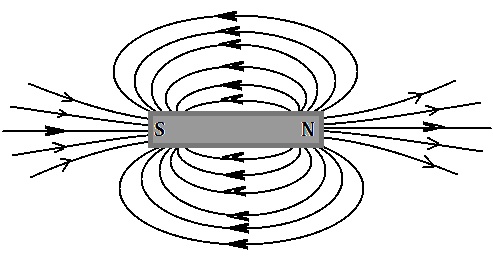
Magnetic field lines: There are many lines forms around a magnet, which are originated from north pole and it seems to end with south pole of magent such line are known as magnetic field lines.
Properties of magnetic field lines:
(i) The magentic field lines emerge from north pole and merge at the south pole.
(ii) Inside the magnet, the direction of field lines is from its south pole to its north pole.
(iii) The magnetic field lines are closed curves.
(iv) The magnetic field is stronger, where the field lines are crowded.
(v) Two field lines do not intersect/cross each other.
Magnetic field lines do not intersect each other:
This is so, magnetic field lines do not intersect each other. If they did, it would
mean that at the point of intersection, the compass needle would point
towards two directions, which is not possible.
Magnetic field around a current-carrying conductor:
- An electric current through a metallic conductor produces a magnetic field around it.
- When a current carrying conductor is kept over a compass and parallel to its needle, when the direction of flowing of electric current reversed the deviation of compass is in opposite direction.
- If the current is increased, the deflection also increases.
- The magnitude of the magnetic field produced at a given point increases as the current through the wire increases.
- When we place the compass at a farther point from the conducting
wire, the deflection in the needle decreases.
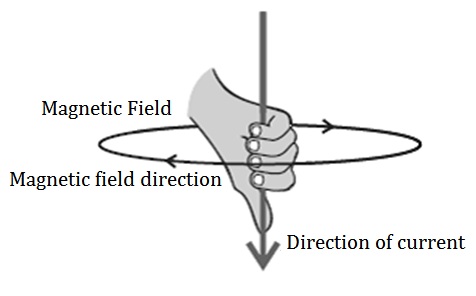
Right-Hand Thumb Rule:
Imagine that you are holding a current-carrying straight conductor in your right hand such that the thumb points towards the direction of current. Then your fingers will wrap around the conductor in the direction of the field lines of the magnetic field. This is known as the right-hand thumb rule. This rule is also known as Maxwell’s corkscrew rule.
Magnetic Field due to a Current through a Circular Loop:
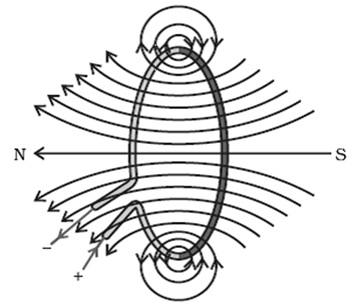
The magnetic field produced by a current-carrying straight wire depends inversely on the distance from it. Similarly at every point of a current-carrying circular loop, the concentric circles representing the magnetic field around it would become larger and larger as we move away from the wire.
Properties of magnetic field line of a current through a circular loop:
(i) At the center of this loop the magnetic field lines are a straight line.
(ii) Every point on the wire carrying current would give rise to the magnetic field appearing as straight lines at the center of the loop.
(iii) Section of the wire contributes to the magnetic field lines in the same direction within the loop.
- The magnetic field produced by a current-carrying wire at a given point depends directly on the current passing through it.
- if there is a circular coil having n turns, the field produced is n times as large as that produced by a single turn. This is because the current in each circular turn has the same direction, and the field due to each turn then just adds up.
13. Magnetic Effects of Electric Current
Solenoid: A coil of many circular turns of insulated copper wire wrapped closely in the shape of a cylinder is called a solenoid.
Magnetic Field due to a Current in a Solenoid:
When electric current is passes through a solenoid, It's one end behaves as a magnetic north pole, while the other end behaves as the south pole.
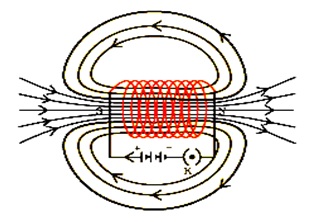
Properties of the field lines inside the solenoid:
- The field lines inside the solenoid are in the form of parallel straight lines.
- This indicates that the magnetic field is the same at all points inside the solenoid. Therefore, the field is uniform inside the solenoid.
- The field lines inside the solenoid are in the form of parallel straight lines. This property is used to make an electromagnet.
- A strong magnetic field produced inside a solenoid.
Electromagnet: A magnet is made by magnetic field produced inside a solenoid using magnetic materials like soft iron is called an electromagnet.
Some properties of electromagnet:
1. The magnetic field produced is generally very strong.
2. The strength of the magnetic-field can be controlled by controlling various factors such as the current and the number of turns in the solenoid.
3. The polarity of the magnet can be changed by reversing the direction of current while magnetic field is being produced by solenoid.
Differences between electromagnet and parmanent magnet:
| Electromagnet | Permanent magnet |
| 1. The magnetic field produced is generally very strong. |
1. Generally the magnetic field produced is low and moderate. |
| 2. The strength of the magnetic-field can be controlled by controlling various factors such as the current and the number of turns in the solenoid. | 2. The strength of the magnetic-field of a permanent magnet is permanent but changes (decreases) with the temperature. |
| 3. The polarity of the magnet can be changed by reversing the direction of current. | 3. The polarity of the magnet can not be changed. |
| 4. Normally soft iron is used for making electro magnets. | 4. Cobalt, steel etc., are used for the purpose. |
FORCE ON A CURRENT-CARRYING CONDUCTOR IN A MAGNETIC FIELD:
When a a strong horse-shoe magnet is placed in such a way that the rod lies between the two poles with the magnetic field directed upwards. For this the north pole of the magnet is kept vertically below and south pole is kept vertically above the aluminium rod. When a current is passed through the aluminium rod from end B to end A. It is observed that the rod is displaced. It is also observed when the direction of current flowing is reversed through rod the direction of displacement is also reversed.
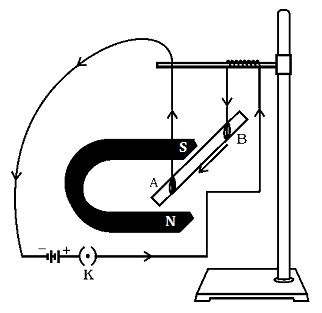
Conclusion:
(i) A magnetic field exerts a force on a magnet placed in the vicinity of the conductor.
(ii) A force is exerted on the current-carrying aluminium rod when it is placed
in a magnetic field.
(iii) The direction of force is also reversed when the direction of current through the conductor is reversed.
(iv) The direction of force acting on the current-carrying rod gets reversed when
the direction of current is reversed.
(v) The force on the conductor depends upon the direction of current and the direction of the magnetic field.
The force on the conductor:
The force on the conductor depends upon the flowing two things:
(i) The direction of current and
(ii) The direction of the magnetic field.
13. Magnetic Effects of Electric Current
Fleming's left-hand rule:
According to this rule, stretch the thumb, forefinger and middle finger of your left hand such that they are mutually perpendicular. If the first finger points in the direction of magnetic field and the second finger in the direction of current, then the thumb will point in the direction of motion or the force acting on the conductor.

Devices that use current-carrying conductors and magnetic fields:
Electric motor, electric generator, loudspeakers, microphones and measuring instruments etc.
Magnetism in medicine:
MRI: The magnetic field inside the body forms the basis of obtaining the images of different body parts. This is done using a technique called Magnetic Resonance Imaging (MRI).
Propertie of magnetic field inside the body:
- Magnetic field is produced in our body which travels along the nerve cells.
- This nerve impulse produces a temporary magnetic field.
- These fields are very weak and are about one-billionth of the earth’s magnetic field.
- Human heart and brain are two organs which produce magnetic field.
Electric Motor:
An electric motor is a device which converts electric energy into mechanical energy.
Uses of Electric Motor: Electric fans, mixers, grinders, blenders, cutters, DVD players, computers, washing machines etc.
Principle of Electric Motor: An electric Motor works on the principle that a current carrying conductor experiences a force when placed in a magnetic field. If the direction of the magnetic field and that of the direction of current which pass through the magnetic field are mutually perpendicular then the direction of the force is given by Fleming’s left-hand rule.

(A) Split rings: These are cylindrical shape metalic rings which are divided into two halves. The inner sides of these halves are insulated and attached to an axle.
Role of split rings in Electric Motor:
It works as commutator in electric motor that reverses the direction of the flowing of electric current.
Commutator: Commutator is a device which is used to reverse the direction of the flowing of electric current.
(B) Armatures: It is a rectangular coil which has a large number of turns of thin insulated copper wire turned over a soft iron core. The armature is placed between the two poles of the field magnet such that the arm AB and CD are perpendicular to the direction of the magnetic field.
Role of armature in Electric Motor:
(i) The armature operates by rotating along with a magnetic field.
(ii) The armature will rest when the resultant field is aligned with the stator (or static) field.
(C) Axle: Axle is a rotating rod like structure which is situated in the centre of armature and split rings are fitted on it.
The properties of commercial motors: Commercial motors are powerful motors. Due to following properties these are powerfull.
(i) Electric magnet is used in commercial motor inspite of parmanent magnet.
(ii) No of turns of insulated copper wire is more in current carrying coil.
(iii) Soft iron crode is used to wrap the coil, by which power is incresed.
13. Magnetic Effects of Electric Current
Electro Magnetic Induction: The process, by which a changing magnetic field in a conductor induces a current in another conductor, is called electromagnetic induction.
- The discovery of electromagnetic induction was by made Michael Faraday.
- The induced current is found to be the highest when the direction of motion of the coil is at right angles to the magnetic field.
Using of a moving magnet can be produced/induced electric current by this discovery of Faradey.

Inducing Electric current:
When we place a moving magnet inside a coil, there produces electric current in the coil's circuit. which can be shown in Galvanometer by deflection of it's needle. The motion of magnet with respect to coil induces a induced potential difference, due to which flows induced electric current in circuit.
The method to induce electric current in a coil:
(i) we can induce current in a coil either by moving it in a magnetic field.
(ii) By changing the magnetic field around it.
Which is convenient :
It is convenient in most situations to move the coil in a magnetic field.
The method to know the direction of such induced current is called "Fleming's Right-hand Rule".
Galvanometer : Galvanometer is a device which is used to detect induced electric current in a circuit.

Fleming's Right-hand Rule : According to this rule
"Stretch the thumb, forefinger and middle finger of right hand so that
they are perpendicular to each other, If the forefinger indicates the direction of the magnetic field and the thumb shows the direction of motion of conductor, then the middle finger will show the direction of induced current. This simple rule is called Fleming’s right-hand rule.".
13. Magnetic Effects of Electric Current
The page is under construction.
Why Choose CBSE Notes for Class 10?
Reading the complete textbook is essential for building knowledge, but revision notes help students organize that knowledge effectively. Our CBSE Revision Notes for Class 10 summarize every chapter by highlighting important concepts, definitions, keywords, formulas, examples, and important points that students should remember during examinations. This approach saves valuable study time and makes revision much easier.
Students often find it difficult to revise lengthy chapters before examinations. Our notes solve this problem by presenting important information in a structured format that is easy to understand and remember. Regular revision using these notes helps improve confidence and strengthens conceptual clarity.
Chapter-wise Study Material
Each chapter included in the CBSE Notes for Class 10 section is prepared according to the latest academic session. Every topic is explained in simple language while maintaining accuracy and completeness. Students can easily revise important concepts, learn key points, and strengthen their understanding of each chapter.
The notes are suitable for daily classroom learning, homework preparation, revision before examinations, and self-study. They also serve as an excellent companion to NCERT textbooks by presenting the most important information in an organized manner.

Explore CBSE Notes Class 10 Science
Chapter-wise NCERT Solutions for Class 6 to 12 prepared according to the latest CBSE syllabus.
English Medium

CBSE Notes Class 10 Science
Chapter 1. Chemical Reactions and Equations (CBSE NOTES)
1. Chemical Reactions and Equations ()
Explore Now →
CBSE Notes Class 10 Science
Chapter 2. Acids, Bases and Salts (CBSE NOTES)
2. Acids, Bases and Salts ()
Explore Now →
CBSE Notes Class 10 Science
Chapter 3. Metals and Non-metals (CBSE NOTES)
3. Metals and Non-metals ()
Explore Now →
CBSE Notes Class 10 Science
Chapter 4. Carbon and its Compounds (CBSE NOTES)
4. Carbon and its Compounds ()
Explore Now →
CBSE Notes Class 10 Science
Chapter 5. Periodic Classification of Elements (CBSE NOTES)
5. Periodic Classification of Elements ()
Explore Now →
CBSE Notes Class 10 Science
Chapter 6. Life Processes (CBSE NOTES)
6. Life Processes ()
Explore Now →
CBSE Notes Class 10 Science
Chapter 6. Life Processes (CBSE NOTES)
6. Life Processes (Science)
Explore Now →
CBSE Notes Class 10 Science
Chapter 7. Control and Coordination (CBSE NOTES)
7. Control and Coordination (Science)
Explore Now →
CBSE Notes Class 10 Science
Chapter 7. Control and Coordination (CBSE NOTES)
7. Control and Coordination ()
Explore Now →
CBSE Notes Class 10 Science
Chapter 8. How do Organisms Reproduce (CBSE NOTES)
8. How do Organisms Reproduce ()
Explore Now →
CBSE Notes Class 10 Science
Chapter 9. Heredity and Evolution (CBSE NOTES)
9. Heredity and Evolution ()
Explore Now →
CBSE Notes Class 10 Science
Chapter 10. Light-Reflection and Refraction (CBSE NOTES)
10. Light-Reflection and Refraction ()
Explore Now →
CBSE Notes Class 10 Science
Chapter 11. Human Eye and Colourful World (CBSE NOTES)
11. Human Eye and Colourful World ()
Explore Now →
CBSE Notes Class 10 Science
Chapter 13. Magnetic Effects of Electric Current (CBSE NOTES)
13. Magnetic Effects of Electric Current ()
Explore Now →
CBSE Notes Class 10 Science
Chapter 14. Sources of Energy (CBSE NOTES)
14. Sources of Energy ()
Explore Now →
CBSE Notes Class 10 Science
Chapter 15. Our Environment (CBSE NOTES)
15. Our Environment ()
Explore Now →
CBSE Notes Class 10 Science
Chapter 16. Management of Natural Resources (CBSE NOTES)
16. Management of Natural Resources ()
Explore Now →Benefits of Using ATP Education Notes
- Latest CBSE syllabus based notes.
- Chapter-wise revision material.
- Easy-to-understand explanations.
- Important concepts and key points.
- Quick revision before examinations.
- Useful for school tests and annual exams.
- Available in Hindi and English Medium.
- Free educational resources for every student.
Your CBSE Notes Library Class 10:
Chapter-wise CBSE Notes for Class 6 to 12 prepared according to the latest CBSE syllabus.
HINDI MEDIUM
CBSE Class 10 Economics
Class 10 Economics CBSE Notes
Arthik Vikas ki Samajh Open Notes
Explore Now →
Your CBSE Notes Library For Class 10
Chapter-wise CBSE Notes for Class 6 to 12 prepared according to the latest CBSE syllabus.
ENGLISH MEDIUM
NCERT Solutions Class 10 SOCIAL SCIENCE-HISTORY
Class 10 SOCIAL SCIENCE-HISTORY CBSE Notes
India and the Contemporary World-II Open Book
Explore Now →
NCERT Solutions Class 10 History
Class 10 History CBSE Notes
India and the Contemporary World-II Open Book
Explore Now →
NCERT Solutions Class 10 Economics
Class 10 Economics CBSE Notes
Understanding Economic Development Open Book
Explore Now →Prepare with Confidence
Success in examinations depends on regular practice, conceptual understanding, and effective revision. Our Class 10 CBSE Notes are designed to help students study smarter instead of studying longer. By revising chapter-wise notes regularly, learners can improve their understanding, remember important concepts for a longer period, and write better answers during examinations.
Along with these notes, students can also explore NCERT Solutions, MCQ Questions, Online Tests, Important Questions, Study Materials, and other learning resources available on ATP Education. Together, these resources provide complete academic support for effective learning and better examination preparation.
Start exploring the CBSE Notes for Class 10 today and make your learning journey easier with well-organized chapter-wise notes, quick revision material, and reliable study resources prepared especially for CBSE students.
Benefits of Studying with Our CBSE Notes
- Chapter-wise Coverage: Every chapter is explained in a structured and easy-to-follow format.
- Latest CBSE Syllabus: Notes are prepared according to the latest CBSE curriculum and NCERT guidelines.
- Quick Revision: Revise important concepts, formulas, definitions, and key points in less time.
- Simple Language: Difficult topics are explained in clear and student-friendly language for better understanding.
- Concept-Based Learning: Focus on understanding concepts instead of memorizing answers.
- Exam-Oriented Preparation: Helps students prepare effectively for class tests, unit tests, half-yearly, annual, and board examinations.
- Subject-wise Organization: Easily access notes for Mathematics, Science, English, Hindi, Social Science, Physics, Chemistry, Biology, Economics, and more.
- Time-Saving Study Material: Well-organized notes reduce study time and improve learning efficiency.
- Improves Answer Writing: Learn important points and present answers in a better and more organized manner.
- Boosts Confidence: Regular revision strengthens concepts and increases confidence before examinations.
- Free Learning Resource: Access high-quality CBSE Notes without any subscription or hidden charges.
- Available in Hindi & English Medium: Study comfortably in your preferred medium with chapter-wise notes.