10. Light-Reflection and Refraction - Class 10 Science English CBSE Notes
CBSE Notes for Class 10 are one of the most useful study resources for students who want to understand every chapter clearly and perform well in school examinations. At ATP Education, we provide carefully prepared chapter-wise CBSE Notes for Class 10 based on the latest CBSE syllabus and NCERT curriculum. These notes are designed to simplify learning, improve conceptual understanding, and help students revise important topics quickly before examinations.
CBSE Notes for Class 10 – Chapter-wise Revision Notes
Every chapter is explained in a simple and student-friendly manner so that learners can understand difficult concepts without confusion. Whether you are preparing for class tests, periodic assessments, half-yearly examinations, annual examinations, or board-oriented assessments, our Class 10 CBSE Notes help you revise the complete syllabus in less time while covering all the important concepts.

10. Light-Reflection and Refraction - Class 10 Science English CBSE Notes
10. Light-Reflection and Refraction
10. Light-Reflection and Refraction
Light makes things visible. The sun light helps us to see the objects during light.
How we able to see any object?
An object reflects light that falls on it. This reflected light, when received by our eyes, enables us to see things.
A ray of light: When light travels from its source of light, it looks like straight line, this line is called a ray of light.
Shadow: When a beam of light pass through an opaque object and get reflected and it form a shadow of that opaque object.
Diffraction of light : If an opaque object on the path of light becomes very small, light has a tendency to bend around it and not walk in a straight line – an effect known as the diffraction of light.
Reflection Of Light:
When a ray of light falls on polished surface, it turns or reflects most of the light in the same medium from which it comes. This phenomenom is known as reflection of light.
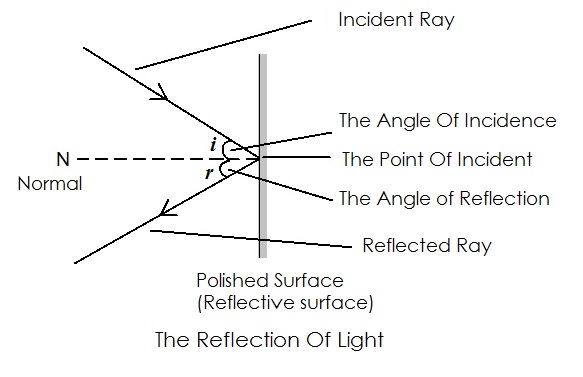
The laws of reflection of light:
(i) The angle of incidence is equal to the angle of reflection, and
(ii) The incident ray, the normal to the mirror at the point of incidence and the reflected ray, all lie in the same plane.
These laws of reflection are applicable to all types of reflecting surfaces
including spherical surfaces.
Some common wonderful phenomena
There occur some common wonderful phenomena due to reflection of light. These are followings;
Image formation by mirrors, the twinkling of stars, the beautiful colours of a rainbow, bending of light by a medium.
Type of Reflection:
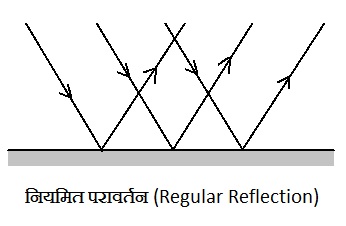
1. Specular or regular reflection: Such type of reflection takes place from shiny or polished surface and incident rays remain parallel to each other after reflection.
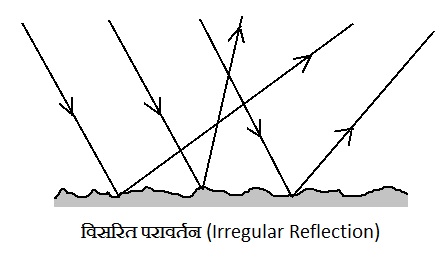
2. Diffused or irregular reflection: Such type of reflection takes place from
rough surface and incident rays do not remain parallel to each other after
reflection.
Mirror : This is a shiny and more polished reflecting surface, which make the image of an object kept front of it.
Types of Mirror:
There are two types of mirror.
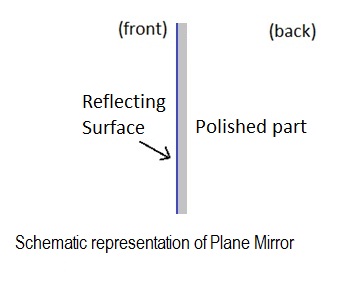
(A) Plane Mirror : Its reflecting surface is straight and flat.
(B) Spherical Mirror : It has curved reflecting surface. This curved reflecting surface can be curved inward or out outwart.
On the basis of this curvature, spherical mirror are two types.
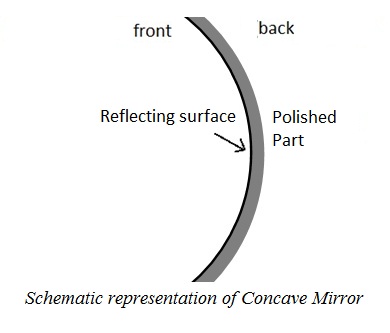
(i) Concave Mirror : Its reflecting surface is inward.
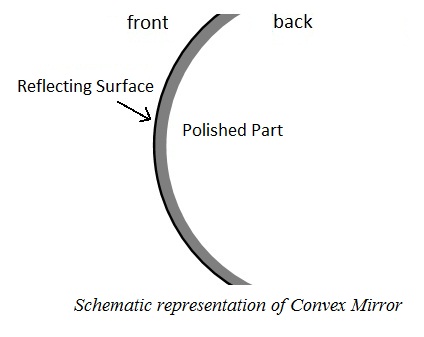
(ii) Convex Mirror : Its reflecting surface is outward.
The Parts Of Spherical Mirror :
(i) Pole : The centre of reflecting surface of spherical mirror is called its pole. It is denoted by English letter P.
(ii) The Centre of Curvature : The reflecting surface of a spherical mirror forms a part of a sphere. This sphere has a centre. This point is called the centre of curvature of the spherical mirror.
(iii) The Radius of Curvature : The distance between Pole of the spherical mirror and the center of curvature is known as the radius of curvature.
(iv) Principal Axis : The straight line passing through the pole and the centre of curvature of spherical mirror is known as principal axis.
(v) Principal Focus : There is an another point F on principal axis lie between half of the pole and the center of curvature which is called the principal focus. Incident rays parallel to the principal axis intersect at principal focus after reflection in concave mirror and it seems to intersect in convex mirror.
(vi) Focal Length : Distance between the pole and the principal focus of the mirror is called Focal Length. It is denoted by small 'f' of English alphabets. This distance is half of the radius of the curvature.
(vii) Aperture : The reflecting surface of a spherical mirror is by and large spherical. The surface, then, has a circular outline. The diameter of the reflecting surface of spherical mirror is called its aperture.
The Position, Nature and Size of Image:
The position of object: The place where an object is placed.
The position of Image : The place where mirror forms the image of an
object.
The Size of Image : This is the size of image which tells that the image of object is formed either smaller or larger than the object.
The nature of image : It is known by the nature of image that what type of image is formed by mirror like virtual and errect or real and inverted.
There are two types of nature of images.
(i) Real and inverted : This types of images always form infront of mirror.
(ii) Virtual and errect : This types of images always form behind the mirror.
Image Formation by Spherical Mirrors:
The formation of image in concave mirror is depended on the position of an object. An object placed between the pole (P) and principal focus (F) form only virtual and errect image otherwise all others images are real and inverted that kept any other places before the concave mirror.
Some positions, natures and sizes of images formed by concave mirror.
- The image of an object placed at infinity is real and inverted and very small like a point size and Image forms at Focus.
- The Image of an object placed far away from centre of curvature C forms real and inverted and very small image between Focus and centre of curvature.
- The Image of an object placed at Centre of curvature (C) forms real and inverted at C and equal in size of object.
- The image of an object placed between centre of curvature and principal focus forms real and inverted, far aways from C and magnified.
- The image of an object placed at principal focus forms real and inverted and very large to object at infinity.
- The image is virtual and errect, larger than object and behind the mirror when object placed between P and F.
Use Of Concave Mirror:
(i) Concave mirrors are commonly used in torches, search-lights and vehicles headlights to get powerful parallel beams of light.
(ii) They are often used as shaving mirrors to see a larger image of the face.
(iii) Concave mirrors are used to see large images of the teeth of patients by the dentists.
(iv) Large concave mirrors are used to concentrate sunlight to produce heat in solar furnaces.
Image Formation By Convex mirror:
The image formed by convex mirror is always virtual and errect and smaller than the object.
Use Of Convex Mirror:
(i) Convex mirrors are commonly used as rear-view (wing) mirrors in vehicles.
(ii) It is used as reflector for street lighting purposes.
(iii) Convex mirrors are useful for inspecting places difficult to get to.
(iv) convex mirrors are also used for security situations.
Sign Convention for Reflection by Spherical Mirrors:
Reflection of light by spherical mirrors form a cartesian plane which is a
set of sign conventions called the New Cartesian sign Convention.
These are as follows -
- The pole (P) of the mirror is taken as the origin.
- The principal axis of the mirror is taken as the x-axis (X’X) of the
coordinate system. - The object is always placed to the left of the mirror. This implies
that the light from the object falls on the mirror from the left-hand
side. - All distances parallel to the principal axis are measured from the
pole of the mirror. - All the distances measured to the right of the origin (along
+ x-axis) are taken as positive while those measured to the left of
the origin (along – x-axis) are taken as negative. - Distances measured perpendicular to and above the principal axis
(along + y-axis) are taken as positive. - Distances measured perpendicular to and below the principal axis
(along –y-axis) are taken as negative.
Mirror Formula:
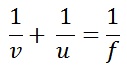
Uses of Mirror formula:
Example 1: An object is placed 20 cm in front of a concave mirror of focal length 15 cm. Find the position of object, nature and size of image.
Solution:
Object-distance (u) = - 20 cm [ Distance of object is always negative (-) ]
focal length (f) = - 15 cm [Focal length in concave mirror is negative (-) ]
Image-Distance (v) = ?
Using mirror formula;
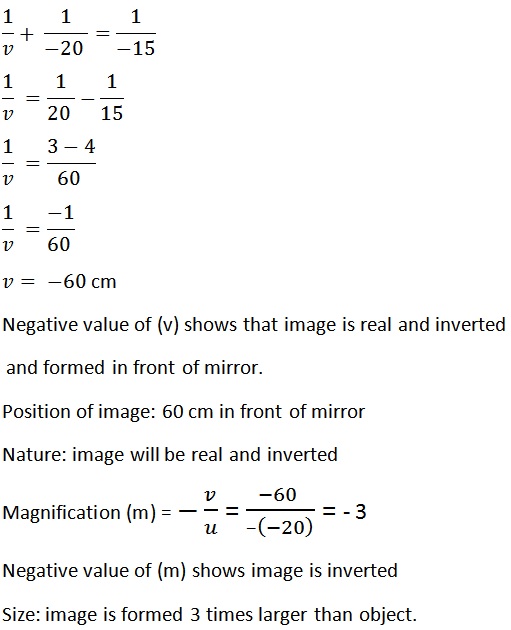
Example 2. An object of height 5 cm is placed 15 cm away from a convex mirror of focal length 15 cm. Find the position, nature and size of image formed.
Solution:
Object-distance (u) = -15 cm
Focal length (f) = 15 cm [ Focal length in convex mirror is positive (+) ]
Image-distance (v) = ?
Using mirror formula:
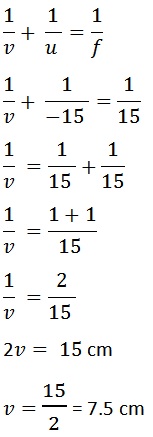
Position of image: 7.5 cm back of mirror
Nature of image: Vertual and irect

Size: Half of the object (smaller).
10. Light-Reflection and Refraction
Chapter 10. Light-Reflection and Refraction
Refraction of light:
When a ray of light enters from one transparent medium to another transparent medium it changes its direction or it bends. This bending of light path is called refraction of light.
The refraction of light only takes place through transparent materials like glass, air and water etc.
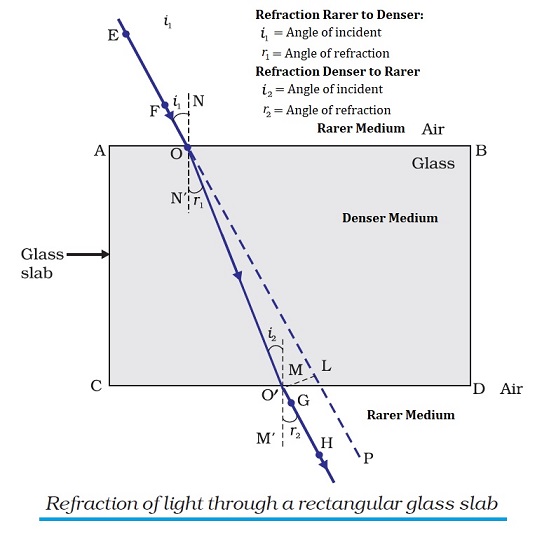
There are two situation of this bending.
(i) When a ray of light enters from rarer medium to denser medium it bends towards the normal.
(ii) When a ray of light enters from denser medium to rarer medium it bends away from normal.
Cause of the refraction of light: The refraction of light occurs due to changing in speed of light it enter on transparent medium to another.
The Law of refraction:
The following are the laws of refraction of light:
(i) The incident ray, the refracted ray and the normal to the interface of two transparent media at the point of incidence, all lie in the same plane.
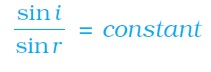
(ii) The ratio of sine of angle of incidence to the sine of angle of refraction is a constant, for the light of a given colour and for the given pair of media. This law is also known as Snell’s law of refraction.
Snell's Law: The ratio of sine of angle of incidence to the sine of angle of refraction is a constant, for the light of a given colour and for the given pair of media. This law is also known as Snell’s law of refraction.
Denser Medium: The medium which has greater refractive index is called dender medium. The particles of this medium is denser.
Rarer Medium: The medium which has smaller refractive index is called rarer medium.
Refractive Index: The ratio of sine of angle of incidence to the sine of angle of refraction is a constant, for the light of a given colour and for the given pair of media. This constant value is called refractive index of the second medium with respect to the first medium.
- The refractive index can be linked to an important physical quantity, the relative speed of propagation of light in different media. It turns out that light propagates with different speeds in different media. Light travels the fastest in vacuum with the highest speed of 3×10⁸ m s–1.
- In air, the speed of light is only marginally less, compared to that in vacuum.
- It reduces considerably in glass or water. The value of the refractive index for a given pair of media depends upon the speed of light in the two media.
- Refractive index with higher value of material has less speed of light through it.
- Refractive index with lower value of material has high speed of light through it.
Example: The refractive index of diamond is 2.42, it means the ratio of speed of light in air and speed of light in diamond is 2.42. Diamond has higher refractive index and when the light will pass through it, the speed of light will be less. The material media of higher refractive index reduce the speed of light than normal and the material media of lower refractive index increase the speed of light when pass through it.
Absolute refractive index of some material media:
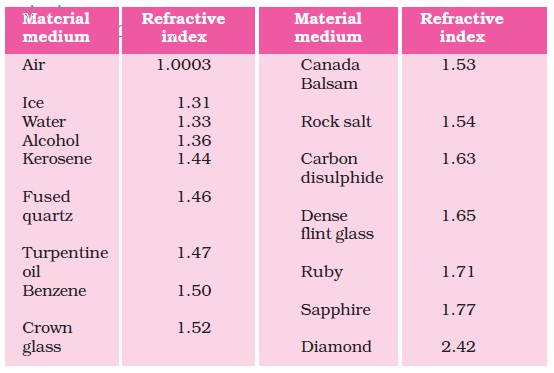
An optically denser medium may not possess greater mass density. For example, kerosene having higher refractive index, is optically denser than water, although its mass density is less than water.
Optically Denser Medium: In comparing two media, the one with the larger refractive index is optically denser medium than the other.
Optically Rarer Medium: In comparing two media, the one with the lower refractive index is optically rarer medium than the other.
Refractive Index of Medium2 with respect to Medium1:
The refractive index of medium 2 with respect to medium 1 is given by the ratio of the speed of light in medium 1 and the speed of light in medium 2. This is usually represented by the symbol n21.

Example: The speed of light in air is 3 x 10⁸ ms-1 and the speed of light in water is 2.25 x 10⁸ ms-1. Find the refractive index of water with respect to air.
Solution: Speed of light in air = 3 x 10⁸ ms-1.
Speed of light in water - 2.25 x 10⁸ ms-1.
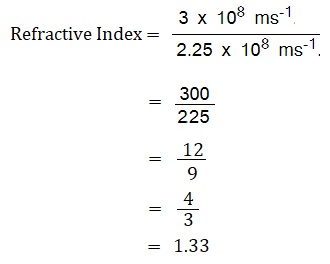
Refractive Index of Water is 1.33
Refractive Index of Medium1 with respect to Medium2:
The refractive index of medium1 with respect to medium 2 is represented as n12. It is given by

Example: Speed of light in water is 2.25 x 10⁸ ms-1 and the speed of light in Kerosene is 2.08×10⁸ ms-1. Find the Refractive index of water with respect to Kerosene.
Solution: Speed of light in water (V1) = 2.25 x 10⁸ ms-1.
Speed of light in Kerosene (V2) = 2.08 x 10⁸ ms-1.
Refractive Index of water = Speed of light in Kerosene (V2)/Speed of light in water (V1)
= 2.08 x 10⁸ ms-1/2.25 x 108 ms-1
= 2.08/2.25
= 0.924
Refractive Index of water with respect to Kerosene = 0.924
Questions for Practice:
Q1. What is refractive index?
Q2. Write the law of refraction of light.
Q3. What are the two situation of bending the path of light during refraction of light.
Q4. The refractive index of diamond is 2.42. What is the meaning of this statement?
Q5. Light enters from air to glass having refractive index 1.50. What is the speed of light in the glass? The speed of light in vacuum is 3 × 10⁸ m s–1.
Q6. Define Optically denser medium and Optically rarer medium.
Q7. Write the Snell's law.
Q8. The Refractive Index Of Kerosene Is 1.44 . Find The Speed Of Light In Kerosene.
Q9. You are given kerosene, turpentine and water. In which of these does the light travel fastest?
Q10. Give the examples of the medium having highest optical density.
Also give the example of the medium with lowest optical density.
10. Light-Reflection and Refraction
Refraction by Spherical Lenses:
Lens: A piece of glass or other transparent material bound by two
surfaces, of which one or both surfaces are spherical, forms a lens. This means that a lens is bound by at least one spherical surface.
Category of Lens: There are two types of lens.
(i) Convex lens: A lens which spherical surfaces bulging outward, such a lens is called a double convex lens. It is simply called a convex lens. It converges light rays hence convex lenses are also called converging lenses.
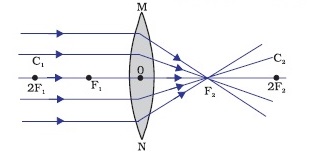
Features of convex lens:
(i) It is thicker at the middle as compared to the edges.
(ii) Convex lens converges light rays.
(ii) Concave Lens: A lens which is bounded by two spherical surfaces and curved inwards such lens is called concave lens. Concave lens is thicker at the edges than at the middle and it diverge light rays so it is called diverging lens. A double concave lens is simply called a concave lens.
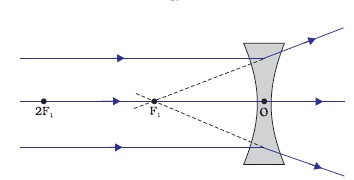
Features of concave lens:
(i) Concave lens is thicker at the edges than at the middle.
(ii) It diverge light rays
Parts of Spherical Lens:
(i) Centers of Curvature: A lens, either a convex lens or a concave lens, has two spherical surfaces. Each of these surfaces forms a part of a sphere. The centres of these spheres are called centres of curvature of the lens.
The centre of curvature of a lens is usually represented by the letter C.
Since there are two centres of curvature, we may represent them as C1
and C2.
(ii) Principal axis: An imaginary straight line passing through the two centres of curvature of a lens is called its principal axis.
(iii) Optical Centre: The central point of a lens is its optical centre. It is usually represented by the letter O.
(iv) Aperture: The effective diameter of the circular outline of a spherical lens is called its aperture.
(v) Thin lens with small aperture: Lenses whose aperture is much less than its radius of curvature. Such lenses are called thin lenses with small apertures.
(vi) Principal Focus of convex lens: A point on the principal axis on which light rays after refraction from the lens converge, this point is called principal focus of convex lens.
(vii) Principal Focus of concave lens: Light rays after refraction from the lens, are appearing to diverge from a point on the principal axis. This point on the principal axis is called the principal focus of the concave lens.
Letter F is usually used to represent principal focus. However, a lens has two principal foci. They are represented by F1 and F2.
See the fig.
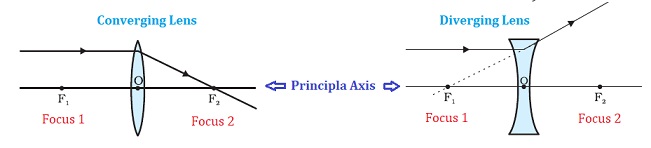
Image of sun on paper sheet by using lens:
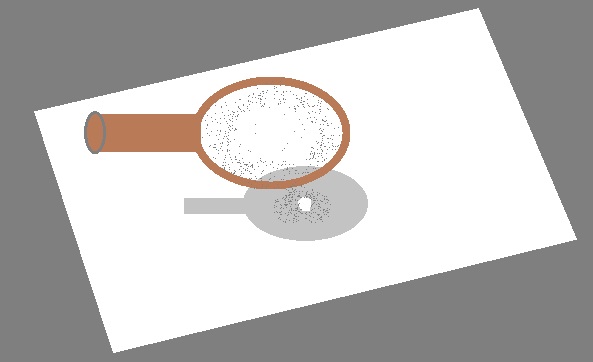
When we point a lens over a paper sheet for sometimes. The paper begins to burn producing smoke. It may even catch fire after a while. The light from the Sun constitutes parallel rays of light. These rays were converged by the lens at the sharp bright spot formed on the paper. In fact, the bright spot you got on the paper is a real image of the Sun. The concentration of the sunlight at a point generated heat. This caused the paper to burn.
(viii) Focal Length: The distance of the principal focus from the optical centre of a lens is called its focal length. The letter f is used to represent the focal length.
10. Light-Reflection and Refraction
Image Formation by Lenses:
Refracting the light from a lens after passing through an object the lens forms an image of the object.
A. Nature of the Image: The image formed by a lens can either be real and inverted or be virtual and erect, these are called the nature of Image.
Type of Nature of Images:
(I) Real and Inverted : The image which can be shown on a screen is called real image and forming upside of an image down or in the opposite position is called inverted image.
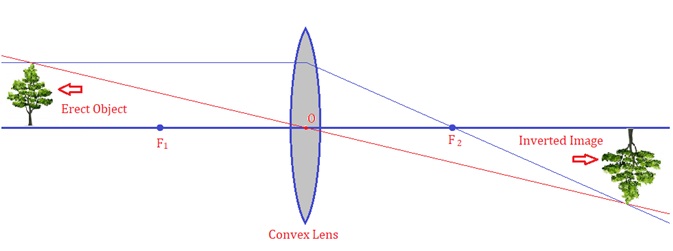
(II) Virtual and Erect: The image which can not be printed on a screen is called vertual image and Erect means upward in straight position.
B. Position of the image: The place where the image forms is called the position of the image. Position is a vector quantity which may be negative or positive in magnitude. All positions in a lens is measured from optic centre. From where the light enters or the object is placed is measured as negative and where the light refracts is measured as positive.
Position of the object: Where the object is placed is called the position of the object. It may be at infinity, beyond 2F1, between F1 and 2F1, at focus F1 and between F1 and optical centre.
Position of the object always measured as negative because objects are placed where the light enters.
C. Relative size of the image: There are various sizes of images formed by the lenses. It may be point size, highly diminished, diminished same size enlarged or highly enlarge.
See the table: Nature, position and relative size of the image formed by a convex lens for various positions of the objects.
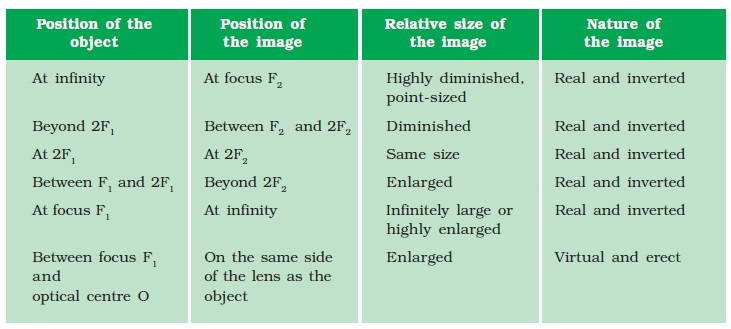 Nature, position and relative size of the image formed by a concave lens for various positions of the objects.
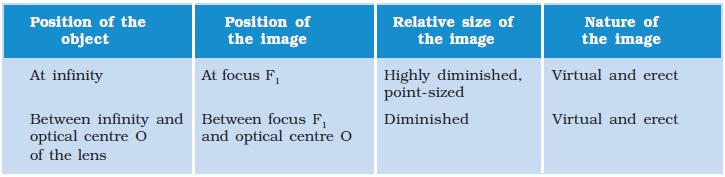
Image Formation in Lenses Using Ray Diagrams:
To understand the ray diagram we have to study the two rays;
(i) Ray passing through the object parallel to principal axis.
(ii) Ray passing through the object and optical centre.
In convex lens:
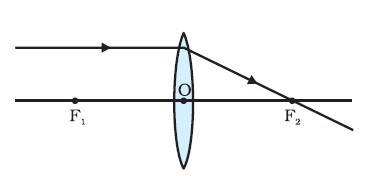
(i) A ray of light from the object, parallel to the principal axis, after refraction from a convex lens, passes through the principal focus on the other side of the lens.
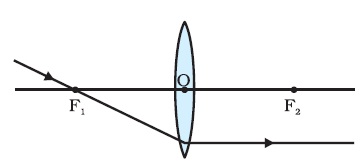
(ii) A ray of light passing through a principal focus, after refraction
from a convex lens, will emerge parallel to the principal axis.
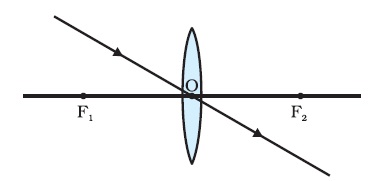
(iii) A ray of light passing through the optical centre of a lens will
emerge without any deviation.
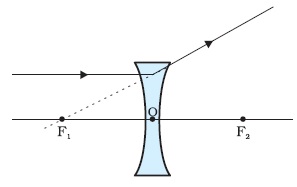
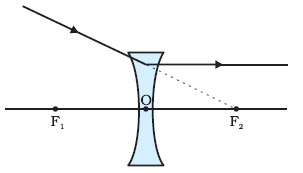
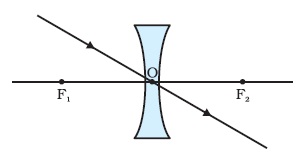
In Concave lens:
(i) A ray of light from the object, parallel to the principal axis, after
refraction from a concave lens, the ray appears to diverge from the principal focus located on the same side of the lens.
(ii) A ray of light appearing to meet at the principal focus of a concave lens, after refraction, will emerge parallel to the principal axis.
(iii) A ray of light passing through the optical centre of a lens will emerge without any deviation.
10. Light-Reflection and Refraction
This page is under construction.
Why Choose CBSE Notes for Class 10?
Reading the complete textbook is essential for building knowledge, but revision notes help students organize that knowledge effectively. Our CBSE Revision Notes for Class 10 summarize every chapter by highlighting important concepts, definitions, keywords, formulas, examples, and important points that students should remember during examinations. This approach saves valuable study time and makes revision much easier.
Students often find it difficult to revise lengthy chapters before examinations. Our notes solve this problem by presenting important information in a structured format that is easy to understand and remember. Regular revision using these notes helps improve confidence and strengthens conceptual clarity.
Chapter-wise Study Material
Each chapter included in the CBSE Notes for Class 10 section is prepared according to the latest academic session. Every topic is explained in simple language while maintaining accuracy and completeness. Students can easily revise important concepts, learn key points, and strengthen their understanding of each chapter.
The notes are suitable for daily classroom learning, homework preparation, revision before examinations, and self-study. They also serve as an excellent companion to NCERT textbooks by presenting the most important information in an organized manner.

Explore CBSE Notes Class 10 Science
Chapter-wise NCERT Solutions for Class 6 to 12 prepared according to the latest CBSE syllabus.
English Medium

CBSE Notes Class 10 Science
Chapter 1. Chemical Reactions and Equations (CBSE NOTES)
1. Chemical Reactions and Equations ()
Explore Now →
CBSE Notes Class 10 Science
Chapter 2. Acids, Bases and Salts (CBSE NOTES)
2. Acids, Bases and Salts ()
Explore Now →
CBSE Notes Class 10 Science
Chapter 3. Metals and Non-metals (CBSE NOTES)
3. Metals and Non-metals ()
Explore Now →
CBSE Notes Class 10 Science
Chapter 4. Carbon and its Compounds (CBSE NOTES)
4. Carbon and its Compounds ()
Explore Now →
CBSE Notes Class 10 Science
Chapter 5. Periodic Classification of Elements (CBSE NOTES)
5. Periodic Classification of Elements ()
Explore Now →
CBSE Notes Class 10 Science
Chapter 6. Life Processes (CBSE NOTES)
6. Life Processes ()
Explore Now →
CBSE Notes Class 10 Science
Chapter 6. Life Processes (CBSE NOTES)
6. Life Processes (Science)
Explore Now →
CBSE Notes Class 10 Science
Chapter 7. Control and Coordination (CBSE NOTES)
7. Control and Coordination (Science)
Explore Now →
CBSE Notes Class 10 Science
Chapter 7. Control and Coordination (CBSE NOTES)
7. Control and Coordination ()
Explore Now →
CBSE Notes Class 10 Science
Chapter 8. How do Organisms Reproduce (CBSE NOTES)
8. How do Organisms Reproduce ()
Explore Now →
CBSE Notes Class 10 Science
Chapter 9. Heredity and Evolution (CBSE NOTES)
9. Heredity and Evolution ()
Explore Now →
CBSE Notes Class 10 Science
Chapter 10. Light-Reflection and Refraction (CBSE NOTES)
10. Light-Reflection and Refraction ()
Explore Now →
CBSE Notes Class 10 Science
Chapter 11. Human Eye and Colourful World (CBSE NOTES)
11. Human Eye and Colourful World ()
Explore Now →
CBSE Notes Class 10 Science
Chapter 13. Magnetic Effects of Electric Current (CBSE NOTES)
13. Magnetic Effects of Electric Current ()
Explore Now →
CBSE Notes Class 10 Science
Chapter 14. Sources of Energy (CBSE NOTES)
14. Sources of Energy ()
Explore Now →
CBSE Notes Class 10 Science
Chapter 15. Our Environment (CBSE NOTES)
15. Our Environment ()
Explore Now →
CBSE Notes Class 10 Science
Chapter 16. Management of Natural Resources (CBSE NOTES)
16. Management of Natural Resources ()
Explore Now →Benefits of Using ATP Education Notes
- Latest CBSE syllabus based notes.
- Chapter-wise revision material.
- Easy-to-understand explanations.
- Important concepts and key points.
- Quick revision before examinations.
- Useful for school tests and annual exams.
- Available in Hindi and English Medium.
- Free educational resources for every student.
Your CBSE Notes Library Class 10:
Chapter-wise CBSE Notes for Class 6 to 12 prepared according to the latest CBSE syllabus.
HINDI MEDIUM
CBSE Class 10 Economics
Class 10 Economics CBSE Notes
Arthik Vikas ki Samajh Open Notes
Explore Now →
Your CBSE Notes Library For Class 10
Chapter-wise CBSE Notes for Class 6 to 12 prepared according to the latest CBSE syllabus.
ENGLISH MEDIUM
NCERT Solutions Class 10 SOCIAL SCIENCE-HISTORY
Class 10 SOCIAL SCIENCE-HISTORY CBSE Notes
India and the Contemporary World-II Open Book
Explore Now →
NCERT Solutions Class 10 History
Class 10 History CBSE Notes
India and the Contemporary World-II Open Book
Explore Now →
NCERT Solutions Class 10 Economics
Class 10 Economics CBSE Notes
Understanding Economic Development Open Book
Explore Now →Prepare with Confidence
Success in examinations depends on regular practice, conceptual understanding, and effective revision. Our Class 10 CBSE Notes are designed to help students study smarter instead of studying longer. By revising chapter-wise notes regularly, learners can improve their understanding, remember important concepts for a longer period, and write better answers during examinations.
Along with these notes, students can also explore NCERT Solutions, MCQ Questions, Online Tests, Important Questions, Study Materials, and other learning resources available on ATP Education. Together, these resources provide complete academic support for effective learning and better examination preparation.
Start exploring the CBSE Notes for Class 10 today and make your learning journey easier with well-organized chapter-wise notes, quick revision material, and reliable study resources prepared especially for CBSE students.
Benefits of Studying with Our CBSE Notes
- Chapter-wise Coverage: Every chapter is explained in a structured and easy-to-follow format.
- Latest CBSE Syllabus: Notes are prepared according to the latest CBSE curriculum and NCERT guidelines.
- Quick Revision: Revise important concepts, formulas, definitions, and key points in less time.
- Simple Language: Difficult topics are explained in clear and student-friendly language for better understanding.
- Concept-Based Learning: Focus on understanding concepts instead of memorizing answers.
- Exam-Oriented Preparation: Helps students prepare effectively for class tests, unit tests, half-yearly, annual, and board examinations.
- Subject-wise Organization: Easily access notes for Mathematics, Science, English, Hindi, Social Science, Physics, Chemistry, Biology, Economics, and more.
- Time-Saving Study Material: Well-organized notes reduce study time and improve learning efficiency.
- Improves Answer Writing: Learn important points and present answers in a better and more organized manner.
- Boosts Confidence: Regular revision strengthens concepts and increases confidence before examinations.
- Free Learning Resource: Access high-quality CBSE Notes without any subscription or hidden charges.
- Available in Hindi & English Medium: Study comfortably in your preferred medium with chapter-wise notes.