
NCERT Solutions for Class 9 – Complete Chapter-wise Study Material
Orienting Yourself: The Use of Coordinates is one of the most important chapters in the Class 9 Mathematics Ganita Manjari English NCERT Solutions curriculum. This chapter plays a significant role in helping students build a strong conceptual foundation while preparing for school examinations, class tests, unit tests, half-yearly examinations, annual examinations, and CBSE board assessments. The chapter has been carefully designed according to the latest NCERT syllabus, making it an essential part of every student's study plan.
The Orienting Yourself: The Use of Coordinates - Class 9 Mathematics Ganita Manjari English NCERT Solutions available on ATP Education explain every question in a simple, accurate, and step-by-step manner. Each answer is prepared according to the latest CBSE guidelines so that students can understand the concepts clearly without confusion. Whether you are completing your homework, revising before examinations, or strengthening your understanding of the subject, these solutions provide reliable academic support throughout your learning journey.
One of the biggest advantages of studying Orienting Yourself: The Use of Coordinates is that it helps students understand important concepts, definitions, examples, and textbook exercises in an organized way. Instead of memorizing answers, students learn how to develop logical thinking, improve analytical skills, and write well-structured answers in examinations. This chapter also helps improve problem-solving ability and encourages conceptual learning, which is essential for scoring higher marks in school and competitive examinations.
Our Class 9 Mathematics Ganita Manjari NCERT Solutions cover all textbook questions, important exercise questions, and chapter-wise explanations in English Medium. Every solution is written in easy-to-understand language, allowing students to revise the chapter quickly before examinations. Regular practice of these solutions improves confidence, strengthens subject knowledge, and reduces examination stress.
Students preparing for school assessments should carefully study Orienting Yourself: The Use of Coordinates because questions from this chapter are frequently asked in objective questions, short answer questions, long answer questions, competency-based questions, and case-study questions. Understanding the concepts explained in this chapter also helps students connect related topics from other chapters, making overall learning more effective and meaningful.
At ATP Education, we continuously update our Class 9 Mathematics Ganita Manjari English NCERT Solutions according to the latest NCERT textbooks and CBSE curriculum. Students can confidently use these chapter-wise solutions for daily study, homework assistance, quick revision, examination preparation, and self-learning. By studying Orienting Yourself: The Use of Coordinates thoroughly and practising every question regularly, students can strengthen their concepts, improve writing skills, and achieve better academic performance in both school and board examinations.
Orienting Yourself: The Use of Coordinates - Class 9 Mathematics Ganita Manjari English NCERT Solutions
Orienting Yourself: The Use of Coordinates
Exercise Set 1.1
Fig. 1.3 shows Reiaan’s room with points OABC marking its corners. The x- and y-axes are marked in the figure. Point O is the origin.
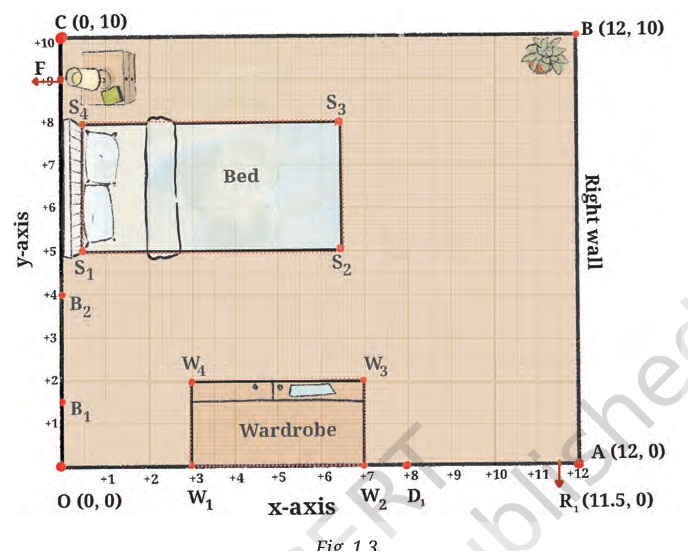
Referring to Fig. 1.3, answer the following questions:
(i) If D1R1 represents the door to Reiaan’s room, how far is the door from the left wall (the y-axis) of the room? How far is the door from the x-axis?
(ii) What are the coordinates of D1?
(iii) If R1 is the point (11.5, 0), how wide is the door? Do you think this is a comfortable width for the room door? If a person in a wheelchair wants to enter the room, will he/she be able to do so easily?
(iv) If B1 (0, 1.5) and B2 (0, 4) represent the ends of the bathroom door, is the bathroom door narrower or wider than the room door?
Solutions:
(i) Given that D₁R₁ is the door. From figure D₁ ≈ (8, 0). Distance from y-axis (left wall) = 8 units. Distance from x-axis = 0 units. So, door is 8 units away from left wall and 0 units from x-axis.
(ii) From observation, D₁ = (8, 0).
(iii) Given R₁ = (11.5, 0) and D₁ = (8, 0). Door width = 11.5 − 8 = 3.5 units (ft). This is a comfortable width. A wheelchair can also pass easily (standard ~3 ft).
(iv) Given B₁ = (0, 1.5) and B₂ = (0, 4). Bathroom door width = 4 − 1.5 = 2.5 ft. Since room door = 3.5 ft and bathroom door = 2.5 ft, the bathroom door is narrower.
Orienting Yourself: The Use of Coordinates
Exercise Set 1.2
On a graph sheet, mark the x-axis and y-axis and the origin O. Mark points from (– 7, 0) to (13, 0) on the x-axis and from (0, – 15) to (0, 12) on the y-axis. (Use the scale 1 cm = 1 unit.) Using Fig. 1.5, answer the given questions.
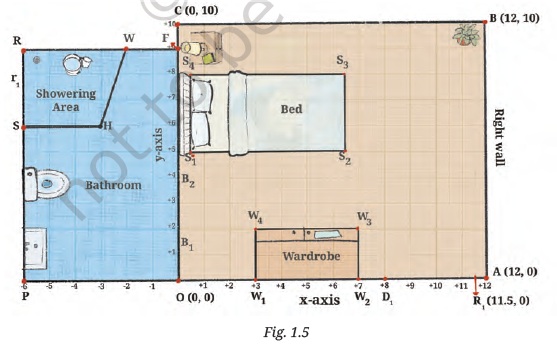
Q1. Place Reiaan’s rectangular study table with three of its feet at the points (8, 9), (11, 9) and (11, 7).
(i) Where will the fourth foot of the table be?
(ii) Is this a good spot for the table?
(iii) What is the width of the table? The length? Can you make out the height of the table?
Solutions: Q1
(i) Given three feet of the table:
(8, 9), (11, 9), (11, 7)
The top of the table is a rectangle shape
So fourth foot will be (8, 7)
(ii) Yes, It is a good spot and right placement for study table.
Because,
- it is not touching the bed and any wall.
- it is far away from wardrobe.
- And it is near by right wall.
(iii) Length = x direction = 11 − 8 = 3 units (ft)
Width = y direction = 9 − 7 = 2 units (ft)
👉 Length = 3 ft, Width = 2 ft
Hieght can't be find by 2D graphs.
Q2. If the bathroom door has a hinge at B1 and opens into the bedroom, will it hit the wardrobe? Are there any changes you would suggest if the door is made wider?
Solutions:
Given that hinge is at point B₁ (0, 3) and the door opens into the bedroom.
From the figure, the wardrobe is located approximately between x = 4 to x = 7, which is sufficiently far from the door.
👉 Therefore, the door will not hit the wardrobe.
If the door is made wider, it may create obstruction inside the bedroom (possibly towards the bed area), so it should not be made wider than the available space (about 3 units).
Q3. Look at Reiaan’s bathroom.
(i) What are the coordinates of the four corners O, F, R, and P of the bathroom?
(ii) What is the shape of the showering area SHWR in Reiaan’s bathroom? Write the coordinates of the four corners.
(iii) Mark off a 3 ft × 2 ft space for the washbasin and a 2 ft × 3 ft space for the toilet. Write the coordinates of the corners of these spaces.
Solutions: Q3.
(i) the coordinates of the four corners O, F, R, and P of the bathroom are
👉 O = (0, 0)
👉 P = (–6, 0)
👉 R = (–6, 10)
👉 F = (0, 10)
(ii) Shape of Bathroom is Rectangle.
And coordinates of SHWR are
👉 S = (–6, 6)
👉 H = (–2, 6)
👉 W = (–2, 10)
👉 R = (–6, 10)
(iii) Washbasin & Toilet
Example placement (inside bathroom):
Washbasin (3 × 2):
- (–6, 0), (–3, 0), (–3, 2), (–6, 2)
Toilet (2 × 3):
- (–3, 0), (–1, 0), (–1, 3), (–3, 3)
Q4. Other rooms in the house:
(i) Reiaan’s room door leads from the dining room which has the length 18 ft and width 15 ft. The length of the dining room extends from point P to point A. Sketch the dining room and mark the coordinates of its corners.
(ii) Place a rectangular 5 ft × 3 ft dining table precisely in the centre of the dining room. Write down the coordinates of the feet of the table.
Solutions: Q4.
(i) Coordinates of Dining Room
Given:
- Length = 18 ft (P to A) → from (–6, 0) to (12, 0) ✔
- Width = 15 ft (downward)
👉 Coordinates:
- P = (–6, 0)
- A = (12, 0)
- New point = (12, –15)
- New point = (–6, –15)
(ii) Dining Table (5 × 3) at centre

Table half dimensions:
- Length = 5 → half = 2.5
- Width = 3 → half = 1.5
👉 Coordinates:
- (3 − 2.5, -7.5 − 1.5) = (0.5, -9)
- (3 + 2.5, -7.5 − 1.5) = (5.5, -9)
- (5.5, -6)
- (0.5, -6)
Orienting Yourself: The Use of Coordinates
End-of-Chapter Exercises
Q1. What are the x-coordinate and y-coordinate of the point of intersection of the two axes?
Solutions:
Q1. The point of intersection of x-axis and y-axis is the origin. So, coordinates = (0, 0).
Q2. Point W has x-coordinate equal to – 5. Can you predict the coordinates of point H which is on the line through W parallel to the y-axis? Which quadrants can H lie in?
Solutions:
Q2. Given W has x-coordinate = –5. Since H lies on a line parallel to y-axis, its x-coordinate will also be –5. So, H = (–5, y). Depending on y value, H can lie in Quadrant II (if y > 0) or Quadrant III (if y < 0).
Q3. Consider the points R (3, 0), A (0, – 2), M (– 5, – 2) and P (– 5, 2). If they are joined in the same order, predict:
(i) Two sides of RAMP that are perpendicular to each other.
(ii) One side of RAMP that is parallel to one of the axes.
(iii) Two points that are mirror images of each other in one axis. Which axis will this be?
Now plot the points and verify your predictions.
Solutions:
Q3. Given points: R(3, 0), A(0, –2), M(–5, –2), P(–5, 2)
(i) AM is horizontal (same y = –2) and MP is vertical (same x = –5). So, AM ⟂ MP.
(ii) AM is parallel to x-axis (y constant), and MP is parallel to y-axis (x constant). So, one such side is AM ∥ x-axis.
(iii) Points M(–5, –2) and P(–5, 2) are mirror images of each other across the x-axis.
Q4. Plot point Z (5, – 6) on the Cartesian plane. Construct a right-angled triangle IZN and find the lengths of the three sides.
(Comment: Answers may differ from person to person.)
Q5. What would a system of coordinates be like if we did not have negative numbers? Would this system allow us to locate all the points on a 2-D plane?
Q*6. Are the points M (– 3, – 4), A (0, 0) and G (6, 8) on the same straight line? Suggest a method to check this without plotting and joining the points.
Q*7. Use your method (from Problem 6) to check if the points
R (– 5, – 1), B (– 2, – 5) and C (4, – 12) are on the same straight line.
Now plot both sets of points and check your answers.
Q*8. Using the origin as one vertex, plot the vertices of:
(i) A right-angled isosceles triangle.
(ii) An isosceles triangle with one vertex in Quadrant III and the other in Quadrant IV.
Q*9. The following table shows the coordinates of points S, M and T. In each case, state whether M is the midpoint of segment ST. Justify your answer.
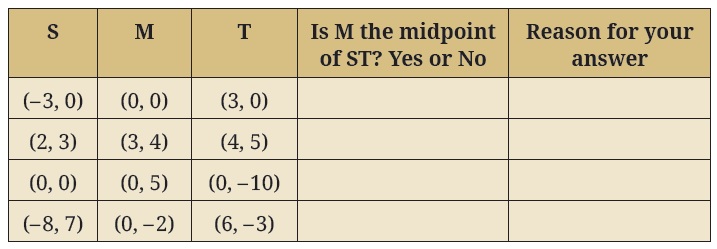
When M is the mid-point of ST, can you find any connection between the coordinates of M, S and T?
Q*10. Use the connection you found to find the coordinates of B given that M (–7, 1) is the midpoint of A (3, – 4) and B (x, y).
Q*11. Let P, Q be points of trisection of AB, with P closer to A, and Q closer to B. Using your knowledge of how to find the coordinates of the midpoint of a segment, how would you find the coordinates of P and Q? Do this for the case when the points are A (4, 7) and B (16, –2).
Q*12. (i) Given the points A (1, – 8), B (– 4, 7) and C (–7, – 4), show that they lie on a circle K whose center is the origin O (0, 0). What is the radius of circle K?
(ii) Given the points D (– 5, 6) and E (0, 9), check whether D and E lie within the circle, on the circle, or outside the circle K.
Q*13. The midpoints of the sides of triangle ABC are the points D, E, and F. Given that the coordinates of D, E, and F are (5, 1), (6, 5), and (0, 3), respectively, find the coordinates of A, B and C.
Q14. A city has two main roads which cross each other at the centre of the city. These two roads are along the North–South (N–S) direction and East–West (E–W) direction. All the other streets of the city run parallel to these roads and are 200 m apart. There are 10 streets in each direction.
(i) Using 1 cm = 200 m, draw a model of the city in your notebook. Represent the roads/streets by single lines.
(ii) There are street intersections in the model. Each street intersection is formed by two streets — one running in the N–S direction and another in the E–W direction. Each street intersection is referred to in the following manner: If the second street running in the N–S direction and 5th street in the E–W direction meet at some crossing, then we call this street intersection (2, 5). Using this convention, find:
(a) how many street intersections can be referred to as (4, 3).
(b) how many street intersections can be referred to as (3, 4).
Q15. A computer graphics program displays images on a rectangular screen whose coordinate system has the origin at the bottom-left corner. The screen is 800 pixels wide and 600 pixels high. A circular icon of radius 80 pixels is drawn with its centre at the point A (100, 150). Another circular icon of radius 100 pixels is drawn with its centre at the point B (250, 230). Determine:
(i) whether any part of either circle lies outside the screen.
(ii) whether the two circles intersect each other.
Q16. Plot the points A (2, 1), B (–1, 2), C (–2, –1), and D (1, –2) in the coordinate plane. Is ABCD a square? Can you explain why? What is the area of this square?

Mathematics Ganita Manjari
Class 9 (English Medium)
NCERT Mathematics Ganita Manjari Textbook
Chapter-wise NCERT Solutions for Class 6 to 12 prepared according to the latest CBSE syllabus.
English Medium

NCERT Solutions Class 9 Mathematics Ganita Manjari
Chapter Orienting Yourself: The Use of Coordinates Solutions
Orienting Yourself: The Use of Coordinates Open Chapters
Explore Now →
NCERT Solutions Class 9 Mathematics Ganita Manjari
Chapter Introduction to Linear Polynomials Solutions
Introduction to Linear Polynomials Open Chapters
Explore Now →
NCERT Solutions Class 9 Mathematics Ganita Manjari
Chapter The World of Numbers Solutions
The World of Numbers Open Chapters
Explore Now →
NCERT Solutions Class 9 Mathematics Ganita Manjari
Chapter Exploring Algebraic Identities Solutions
Exploring Algebraic Identities Open Chapters
Explore Now →
NCERT Solutions Class 9 Mathematics Ganita Manjari
Chapter I’m Up and Down, and Round and Round Solutions
I’m Up and Down, and Round and Round Open Chapters
Explore Now →
NCERT Solutions Class 9 Mathematics Ganita Manjari
Chapter Measuring Space: Perimeter and Area Solutions
Measuring Space: Perimeter and Area Open Chapters
Explore Now →
NCERT Solutions Class 9 Mathematics Ganita Manjari
Chapter Introduction to Probability Solutions
Introduction to Probability Open Chapters
Explore Now →
NCERT Solutions Class 9 Mathematics Ganita Manjari
Chapter Exploring Sequences and Progressions Solutions
Exploring Sequences and Progressions Open Chapters
Explore Now →
Class 9 NCERT Book Solutions
Chapter-wise NCERT Solutions for Class 6 to 12 prepared according to the latest CBSE syllabus.
ENGLISH MEDIUM
NCERT Solutions Class 9 Mathematics
Class 9 Mathematics Book Solutions
Mathematics Open Book
Explore Now →
NCERT Solutions Class 9 Beehive (English)
Class 9 Beehive (English) Book Solutions
Open Book
Explore Now →
NCERT Solutions Class 9 Mathematics Ganita Manjari
Class 9 Mathematics Ganita Manjari Book Solutions
GANITA MANJARI Open Book
Explore Now →
NCERT Solutions Class 9 Social Science
Class 9 Social Science Book Solutions
Understanding Society India and Beyond PART-I Open Book
Explore Now →Benefits of Studying NCERT Solutions
Studying from NCERT Solutions helps students build strong conceptual understanding and improve problem-solving skills. These solutions are especially useful for revision because every answer is written according to the marking scheme followed by CBSE.
- Improve conceptual understanding.
- Learn correct answer-writing techniques.
- Prepare effectively for school examinations.
- Complete syllabus revision in less time.
- Practice important textbook questions.
- Build confidence before examinations.
Prepared According to the Latest CBSE Syllabus
All NCERT Book Solutions for Class 9 available on ATP Education are updated according to the latest CBSE curriculum. Whenever NCERT introduces changes in textbooks or syllabus, our study materials are revised accordingly so that students always receive accurate and updated content.
Helpful for Competitive Examinations
NCERT textbooks form the foundation of many competitive examinations. Students preparing for Olympiads, NTSE, CUET, UPSC Foundation, SSC and several entrance examinations can strengthen their basics through these chapter-wise solutions. Understanding NCERT concepts also improves analytical thinking and logical reasoning.
Simple and Student-Friendly Explanations
Our experts prepare every answer in a simple, clear and student-friendly format. Difficult concepts are explained step by step with proper reasoning so that students of every learning level can understand them easily. This approach helps students remember concepts for a longer period and perform confidently during examinations.
Start Learning with ATP Education
Explore the complete collection of NCERT Solutions for Class 9 and begin your preparation with confidence. Every chapter is available online for free and can be accessed anytime. Whether you want to complete homework, revise important chapters or prepare for examinations, ATP Education provides reliable and high-quality study resources to help you achieve academic success.
Explore Subjects






Why Students Choose Us
Free Study Materials
Get completely free NCERT solutions, notes and board preparation resources.
Updated Notes
Latest CBSE and NCERT syllabus based notes for all major classes.
Practice Tests
Improve performance with chapter-wise MCQ tests and quizzes.
Trending Study Materials
2M+
Monthly Students
50K+
Study Notes
10K+
MCQ Questions
500+
Mock Tests