
NCERT Solutions for Class 8 – Complete Chapter-wise Study Material
2. From Trade to Territory is one of the most important chapters in the Class 8 History English NCERT Solutions curriculum. This chapter plays a significant role in helping students build a strong conceptual foundation while preparing for school examinations, class tests, unit tests, half-yearly examinations, annual examinations, and CBSE board assessments. The chapter has been carefully designed according to the latest NCERT syllabus, making it an essential part of every student's study plan.
The 2. From Trade to Territory - Class 8 History English NCERT Solutions available on ATP Education explain every question in a simple, accurate, and step-by-step manner. Each answer is prepared according to the latest CBSE guidelines so that students can understand the concepts clearly without confusion. Whether you are completing your homework, revising before examinations, or strengthening your understanding of the subject, these solutions provide reliable academic support throughout your learning journey.
One of the biggest advantages of studying 2. From Trade to Territory is that it helps students understand important concepts, definitions, examples, and textbook exercises in an organized way. Instead of memorizing answers, students learn how to develop logical thinking, improve analytical skills, and write well-structured answers in examinations. This chapter also helps improve problem-solving ability and encourages conceptual learning, which is essential for scoring higher marks in school and competitive examinations.
Our Class 8 History NCERT Solutions cover all textbook questions, important exercise questions, and chapter-wise explanations in English Medium. Every solution is written in easy-to-understand language, allowing students to revise the chapter quickly before examinations. Regular practice of these solutions improves confidence, strengthens subject knowledge, and reduces examination stress.
Students preparing for school assessments should carefully study 2. From Trade to Territory because questions from this chapter are frequently asked in objective questions, short answer questions, long answer questions, competency-based questions, and case-study questions. Understanding the concepts explained in this chapter also helps students connect related topics from other chapters, making overall learning more effective and meaningful.
At ATP Education, we continuously update our Class 8 History English NCERT Solutions according to the latest NCERT textbooks and CBSE curriculum. Students can confidently use these chapter-wise solutions for daily study, homework assistance, quick revision, examination preparation, and self-learning. By studying 2. From Trade to Territory thoroughly and practising every question regularly, students can strengthen their concepts, improve writing skills, and achieve better academic performance in both school and board examinations.
2. From Trade to Territory - Class 8 History English NCERT Solutions
2. From Trade to Territory
Chapter Rerview
Chapter Review:
- The last powerful Mughal ruler was Aurangzeb and after his death in 1707, many Mughal governors (subadars) and big zamindars began asserting their authority and establishing regional kingdoms. By the second half of the eighteenth century, a new power emerged on the political horizon – the British.
- The East India Company, in 1600, acquired a charter from the ruler of England, Queen Elizabeth I, granting the Company sole right to trade with the East. According to the charter, the Company could venture across the oceans, looking for new lands to buy goods at a cheaper price, and carry them back to Europe to sell at higher prices. The Portuguese established their presence on the western coast of India and had their base in Goa. By the early seventeenth century, the Dutch were exploring the possibilities of trade in the Indian Ocean and very soon the French arrived on the scene.
- All the companies are interested in buying the same things. The fine qualities of cotton, silk, pepper, cloves, cardamom and cinnamon were in great demand. The urge to secure markets led to fierce battles between the trading companies. Trade was carried on with arms and trading posts were protected through fortification.
- In 1651, the first English factory was set up. It was the base from which the Company’s traders, known as “factors”, operated. In the warehouse of the factory, goods for export were stored. The Company by 1696 built a fort around the settlement. The Company continuously tried to press for more concessions and manipulate existing privileges.
- The conflict between the Company and the nawabs of Bengal intensified. The Bengal nawabs refused to grant the Company concessions, demanded large tributes for the Company’s right to trade, denied it any right to mint coins, and stopped it from extending its fortifications. They also claimed that the Company was depriving the Bengal government of huge amounts of revenue and undermining the authority of the nawab. The conflicts led to confrontations and finally culminated in the famous Battle of Plassey.
- Mysore, under the leadership of powerful rulers like Haidar Ali (ruled from 1761 to 1782) and his famous son Tipu Sultan (ruled from 1782 to 1799) had grown in strength. It controlled the profitable trade of the Malabar coast where the Company purchased pepper and cardamom. Tipu Sultan, in 1785, stopped the export of sandalwood, pepper and cardamom. The Company fought four wars with Mysore (1767-69, 1780-84, 1790-92 and 1799). Finally, in the last – the Battle of Seringapatam – the Company achieved victory.
- Paramountcy a new policy was initiated under Lord Hastings (GovernorGeneral from 1813 to 1823). The Company claimed that its power was greater than that of Indian states. In the late 1830s, the East India Company became worried about Russia. It imagined that Russia might expand across Asia and enter India from the north-west. The Company fought a prolonged war with Afghanistan between 1838 and 1842 and established indirect Company rule there. Punjab was annexed in 1849, after two prolonged wars.
2. From Trade to Territory
Exercise NCERT
2. From Trade to Territory
Let’s recall
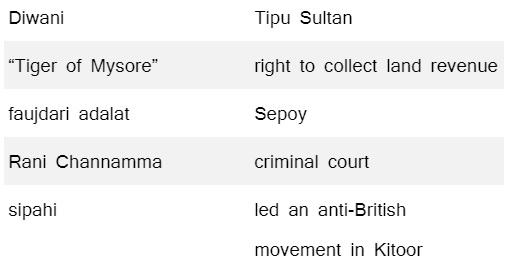
Q1. Match the following:
Solution:
| Diwani | right to collect land revenue |
| “Tiger of Mysore” | Tipu Sultan |
| faujdari adalat | Criminal Court |
| Rani Channamma | Led an anti-British movement in Kitoor |
| sipahi | Sepoy |
Q2. Fill in the blanks:
(a) The British conquest of Bengal began with the Battle of ___________.
(b) Haidar Ali and Tipu Sultan were the rulers of ___________
(c) Dalhousie implemented the Doctrine of ___________.
(d) Maratha kingdoms were located mainly in the ___________ part of India.
Answer:
(a) The British conquest of Bengal began with the Battle of Plassey.
(b) Haidar Ali and Tipu Sultan were the rulers of Mysore.
(c) Dalhousie implemented the Doctrine of Lapse.
(d) Maratha kingdoms were located mainly in the South-western part of India.
Q3. State whether true or false:
(a) The Mughal empire became stronger in the eighteenth century.
(b) The English East India Company was the only European company that traded with India.
(c) Maharaja Ranjit Singh was the ruler of Punjab.
(d) The British did not introduce administrative changes in the territories they conquered.
Answer:
(a) False
(b) False
(c) True
(d) False
Let’s discuss
Q4. What attracted European trading companies to India?
Answer: European trading companies were attracted to India for the following reasons.
(i) There was a great demand for fine cotton cloth and silk made from India in the markets of Europe.
(ii) Apart from these there was a demand for black pepper, cloves, cardamom and cinnamon.
(iii) By buying goods at cheap prices from here, they used to sell them at expensive prices, which made them more profitable.
Q5. What were the areas of conflict between the Bengal nawabs and the East India Company?
Answer:
(i) The Nawabs of Bengal refused to give principality to the company.
(ii) Instead of giving the right to trade, they used to ask the company for a gift.
(iii) The right to put coins from them was also taken away.
(iv) Stopped from increasing his fortification.
(v) The East India Company was not willing to pay tax.
(vi) English officers wrote insulting letters to him
(vii) An attempt was made to humiliate the Nawabs and their officers.
Q6. How did the assumption of Diwani benefit the East India Company?
Answer: The East India Company benefited from getting Diwani in the following way.
(i) The company started acquiring more princely states.
(ii) were engaged in taking maximum advantage of the rights already existing officers.
(iii) The company got control over the huge revenue resources of Bengal due to getting Diwani.
(iv) The Mughal emperor appointed the company as the Diwan of Bengal province.
(v) After getting Diwani, the company no longer needed golds from Britain, because with this income the company could buy cotton and silk cloth in India, take care of its forces and take the cost of forts and offices in Calcutta.
Q7. Explain the system of “subsidiary alliance”.
Answer: The princely state which accepted this settlement did not get the right to keep its independent armies. He used to get security from the company and used to give money to the company for maintenance of the auxiliary army. If the Indian ruler had missed paying the money, the company would have taken possession of his area as a fine.
Q8. In what way was the administration of the Company different from that of Indian rulers?
Answer:
(i) The Indian rulars had divided the administrative and revenue divisions of their kingdom into different units. But these units were not as effective as the British administrative and revenue units. The British created a new administrative units in the form of Presidency. The governor was the head.
(ii) Civil and Criminal Courts were established in the district from 1772.
(iii) The Supreme Court was established in Kolkata by the Regulatory Act of 1773.
(iv) Even the police and the revenue system were greatly improved by the British.
Q9. Describe the changes that occurred in the composition of the Company’s army.
Answer:
(i) The company reinstated professional soldiers in place of foot and rider soldiers.
(ii) These soldiers were trained in European style with new warfare techniques.
(iii) These soldiers were equipped with new and sophisticated weapons like muskets and matchlock etc.
(iv) The company also upgraded its artillery and made minor changes.
Q10. Why did the East India Company consider Tipu Sultan a threat?
Answer:
(i) Tipu Sultan stopped the export of sandal wood, black pepper and cardamom from the ports falling in his kingdom.
(ii) Tipu Sultan developed close relations with the French merchants living in India. With his help, he modernized his army.
(iii) The local merchants from Tipu Sultan were also barred from doing business with the company.
(iv) Tipu Sultan looked very ambitious, arrogant and dangerous, the British felt that it was necessary to control and crush such kings.
2. From Trade to Territory
Additional Questions
2. From Trade to Territory:
Question: Name the last powerful Mughal ruler?
Answer: Aurangzeb |
Question: Why did the Mughal Empire weaken?
Answer: After the death of Aurangzeb, many Mughal governors started establishing their respective regional states. This weakened the Mughal Empire.
Question: When and where was the East India Company established?
Answer: East India Company was founded in 1600 in London.
Question: Who did the company to do business with the former (letter of permission)?
Answer: Queen Elizabeth I |
Question: Which Western power first came to India?
Answer: Portuguese |
Question: Who discovered the sea route to India and when?
Answer: Portuguese navigator Vasco di Gama discovered the sea route to India in 1498.
Question: Where was the Portuguese road in India?
Answer: Happened in Goa.
Question: What is the main trade item for European powers?
Answer: Cotton and silk cloth, black pepper, long, cardamom, etc.
Question: When and where was the first English factory (Karkhana) established?
Answer: The first factory was established in 1651 on the banks of river Hooghly.
Question: Who was called the factor?
Answer: The merchants of the company used to run their work from the banks of Hooghly River, these traders were called Factors at that time.
Question: Where and when did the first English factory start?
Answer: The first English factory started in 1651 AD on the banks of the Hooghly River.
Question: What does the Decree mean?
Answer: Decree means a royal order.
Question: Who was the first Nawab of Bengal?
Answer: Nawab Murshid Quli Khan was.
Question: Who was the last Nawab of Bengal?
Answer: Nawab Surajudaula |
Question: How was Plassey named?
Answer: Actually, the real name was Palashi, which was spoiled by the British. This place was called Palashi, due to the flowers of Palash found here.
Question: When did Alivardi Khan die?
Answer: In 1756.
Question: When did the Battle of Buxar take place?
Answer: In 1764 |
Question: How old was Robert Clive when he came to India from England?
Answer: Robert Clive came to Madras in 1743 when he was 18 years old.
Question: Who started the merger policy?
Answer: Lord Dalhousie.
Question: Why was the battle of Palashi considered important?
Answer: The battle of Plassey was important because it was the first major victory of the company in India.
Question: When did the third battle of Panipat take place?
Answer: In 1761 |
Question: Who lost in the battle of Buxar?
Answer: Mir Qasim lost.
Question: Where was Tipu Sultan the ruler?
Answer: Was the ruler of Mysore.
Question: What did it mean to be a Nawab?
Answer: To become a Nawab meant slavery of the British, the company had all the strength and power.
Question: When did Tipu Sultan die?
Answer: On 4 May 1799.
Question: When did Tipu Sultan become the king of Mysore?
Answer: In 1782 |
Question: Write the meaning of Qazi.
Answer: Qazi means a judge.
Question: On what logic was the principle of merger policy?
Answer: This theory was based on the logic that if a ruler dies and has no male heir, then the British used to merge that state with themselves.
Question: Who was called Presidency?
Answer: North British areas were broadly divided into administrative units called Presidencies.
Question: How many and which were the presidencies at that time?
Answer: At that time there were three presidencies, Bengal Madras and Mumbai.
Question: When did Maharaja Ranjit Singh die?
Answer: In 1839 |
Question: Who is called impeachment?
Answer: When a person was accused of misconduct in the House of Commons in England, then in the House of Lords, a person is prosecuted then he is called impeachment.
Question: When was the trial on Warren Hastings released?
Answer: In 1789 |
Question: When did Warren Hasting return to England?
Answer: In 1785 |
Question: When and why did Robert Clive commit suicide?
Answer: Robert Clive was accused of corruption. In 1772, he had to answer the charge of corruption in the British Parliament. Later he was acquitted. But in 1774, he committed suicide.
Question: Who was Chennamma?
Answer: Chennamma was the queen of Kitur in Karnataka?
Question: When and where did Chennamma die?
Answer: Chennamma died in jail in 1829?
Question: How did Rani Chennamma die in prison?
Answer: When the British tried to capture the small kingdom of Kitur, Rani Chennamma took up arms and launched a movement against the British.
Question: What was the purpose of East India Company coming to India?
Answer: East India Company came from India for the purpose of trade.
Question: Which Indian items were in demand in the European markets?
Answer: There was a huge demand for cotton bastards, silk garments and spices like pepper, cloves, cardamom and cinnamon in Europe markets.
Question: Explain the meaning of the word commercial.
Answer: A business enterprise in which profits are made mainly by trade, by buying things at a cheaper price and selling at a higher price.
Question: Which areas were occupied by the British as a result of the subsidiary treaty?
Answer: Governor-

History
Class 8 (English Medium)
NCERT History Textbook
Chapter-wise NCERT Solutions for Class 6 to 12 prepared according to the latest CBSE syllabus.
English Medium
NCERT Solutions Class 8 History
Chapter 1. How When and Where Solutions
1. How When and Where Open Chapters
Explore Now →
NCERT Solutions Class 8 History
Chapter 2. From Trade to Territory Solutions
2. From Trade to Territory Open Chapters
Explore Now →
NCERT Solutions Class 8 History
Chapter 3. Ruling the Countryside Solutions
3. Ruling the Countryside Open Chapters
Explore Now →
NCERT Solutions Class 8 History
Chapter 4. Tribals Dikus and the Vision of a Golden Age Solutions
4. Tribals Dikus and the Vision of a Golden Age Open Chapters
Explore Now →
NCERT Solutions Class 8 History
Chapter 5. When People Rebel Solutions
5. When People Rebel Open Chapters
Explore Now →
NCERT Solutions Class 8 History
Chapter 6. Colonialism and the City Solutions
6. Colonialism and the City Open Chapters
Explore Now →
NCERT Solutions Class 8 History
Chapter 7. Weavers Iron Smelters and Factory Owners Solutions
7. Weavers Iron Smelters and Factory Owners Open Chapters
Explore Now →
NCERT Solutions Class 8 History
Chapter 8. Civilising the Native Educating the Nation Solutions
8. Civilising the Native Educating the Nation Open Chapters
Explore Now →
NCERT Solutions Class 8 History
Chapter 9. Women Caste and Reform Solutions
9. Women Caste and Reform Open Chapters
Explore Now →
NCERT Solutions Class 8 History
Chapter 10. The Changing World of Visual Arts Solutions
10. The Changing World of Visual Arts Open Chapters
Explore Now →
NCERT Solutions Class 8 History
Chapter 11. The Making of the National Movement: 1870s-1947s Solutions
11. The Making of the National Movement: 1870s-1947s Open Chapters
Explore Now →
NCERT Solutions Class 8 History
Chapter 12. India after Independence Solutions
12. India after Independence Open Chapters
Explore Now →
Class 8 NCERT Book Solutions
Chapter-wise NCERT Solutions for Class 6 to 12 prepared according to the latest CBSE syllabus.
ENGLISH MEDIUM
NCERT Solutions Class 8 Its So Happened (English)
Class 8 Its So Happened (English) Book Solutions
Open Book
Explore Now →
NCERT Solutions Class 8 Honey Dew (English)
Class 8 Honey Dew (English) Book Solutions
Open Book
Explore Now →
NCERT Solutions Class 8 HoneyDew (English Poem)
Class 8 HoneyDew (English Poem) Book Solutions
Open Book
Explore Now →Benefits of Studying NCERT Solutions
Studying from NCERT Solutions helps students build strong conceptual understanding and improve problem-solving skills. These solutions are especially useful for revision because every answer is written according to the marking scheme followed by CBSE.
- Improve conceptual understanding.
- Learn correct answer-writing techniques.
- Prepare effectively for school examinations.
- Complete syllabus revision in less time.
- Practice important textbook questions.
- Build confidence before examinations.
Prepared According to the Latest CBSE Syllabus
All NCERT Book Solutions for Class 8 available on ATP Education are updated according to the latest CBSE curriculum. Whenever NCERT introduces changes in textbooks or syllabus, our study materials are revised accordingly so that students always receive accurate and updated content.
Helpful for Competitive Examinations
NCERT textbooks form the foundation of many competitive examinations. Students preparing for Olympiads, NTSE, CUET, UPSC Foundation, SSC and several entrance examinations can strengthen their basics through these chapter-wise solutions. Understanding NCERT concepts also improves analytical thinking and logical reasoning.
Simple and Student-Friendly Explanations
Our experts prepare every answer in a simple, clear and student-friendly format. Difficult concepts are explained step by step with proper reasoning so that students of every learning level can understand them easily. This approach helps students remember concepts for a longer period and perform confidently during examinations.
Start Learning with ATP Education
Explore the complete collection of NCERT Solutions for Class 8 and begin your preparation with confidence. Every chapter is available online for free and can be accessed anytime. Whether you want to complete homework, revise important chapters or prepare for examinations, ATP Education provides reliable and high-quality study resources to help you achieve academic success.
Explore Subjects



Why Students Choose Us
Free Study Materials
Get completely free NCERT solutions, notes and board preparation resources.
Updated Notes
Latest CBSE and NCERT syllabus based notes for all major classes.
Practice Tests
Improve performance with chapter-wise MCQ tests and quizzes.
Trending Study Materials
2M+
Monthly Students
50K+
Study Notes
10K+
MCQ Questions
500+
Mock Tests