4. Quadratic Equations - Class 10 Mathematics English CBSE Notes
CBSE Notes for Class 10 are one of the most useful study resources for students who want to understand every chapter clearly and perform well in school examinations. At ATP Education, we provide carefully prepared chapter-wise CBSE Notes for Class 10 based on the latest CBSE syllabus and NCERT curriculum. These notes are designed to simplify learning, improve conceptual understanding, and help students revise important topics quickly before examinations.
CBSE Notes for Class 10 – Chapter-wise Revision Notes
Every chapter is explained in a simple and student-friendly manner so that learners can understand difficult concepts without confusion. Whether you are preparing for class tests, periodic assessments, half-yearly examinations, annual examinations, or board-oriented assessments, our Class 10 CBSE Notes help you revise the complete syllabus in less time while covering all the important concepts.

4. Quadratic Equations - Class 10 Mathematics English CBSE Notes
4. Quadratic Equations
Quadratic Equations
Introduction:
The equation ax2 + bx + c = 0, is the standard form of a quadratic equation, where a, b and c are real numbers and a ≠ 0.
Example:
1. 3x2 - 5x = 0,
This equation can be expressed in the form of ax2 + bx + c = 0. then
a = 3, b = -5, c = 0,
Here c = 0, As Term c is disappear.
This also showing a ≠ 0. Hence this is a quadratic equation.
2. 5x2 + 2x -7=0,
Here a = 5, b = 2, c = -7, so it can be also expressed in the form of ax2 + bx + c =0,
3. 3x2 ,
This is single term polynomial i.e mononomial. It can be also expressed in the form of ax2 + bx + c = 0. In which a= 3, b = 0, c = 0, Here b = 0, c = 0 but there is no a ≠ 0.
So, this is also a quadratic equation.
4. 4x + 9,
This cannot be expressed in the form of ax2 + bx + c = 0. As the ax2 term is disappear. Hence a = 0. Which can not fulfill the condition of to be a quadratic equation.
- All quadratic polinomials can be expressed in the form of quadratic equation ax2 + bx + c = 0.
- ax2 + bx + c = 0, a ≠ 0 is called the standard form of a quadratic equation.
Another equations which are not a quadratic equation.
1. x3 + 3x2 + 4x + 5, 2x3 + 4x, 4x3 - 5x2 + 7 and all cubic polynomials.
2. All linear equations like 4x + 3, 5x, 7x + 2 etc.
4. Polynomials of power more than 2 and less than 2.
Nature of Roots:
Roots of Quadratic equations:
- Each quadratic equation has two roots. they are said to be α and β.
- A real number α is said to be a root of the quadratic equation ax2 + bx + c = 0, a ≠ 0. If ax2 + bx + c = 0, the zeroes of quadratic polynomial ax2 + bx + c and the roots of the quadratic equation ax2 + bx + c = 0 are the same.
- The roots of a quadratic equation ax2 + bx + c = 0, a ≠ 0 gives;
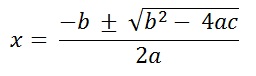
Where b2 - 4ac ≥ 0.
Since b2 – 4ac determines whether the quadratic equation ax2 + bx + c = 0 has real roots or not, b2 – 4ac is called the discriminant of this quadratic equation and Discriminant is denoded by capital Letter D.
Hence,
D = b2 – 4ac,
Nature of Roots of Quadratic Equations:
Nature of Roots:
Using Quadratic formula we have

See here b2 - 4ac given in under root.
This valuue b2 - 4ac is called Discriminant.
Which is denoted by "D".
∴ D = b2 - 4ac
[ Nature of root is determined by the value of Discriminant;]
There are three natures of roots.
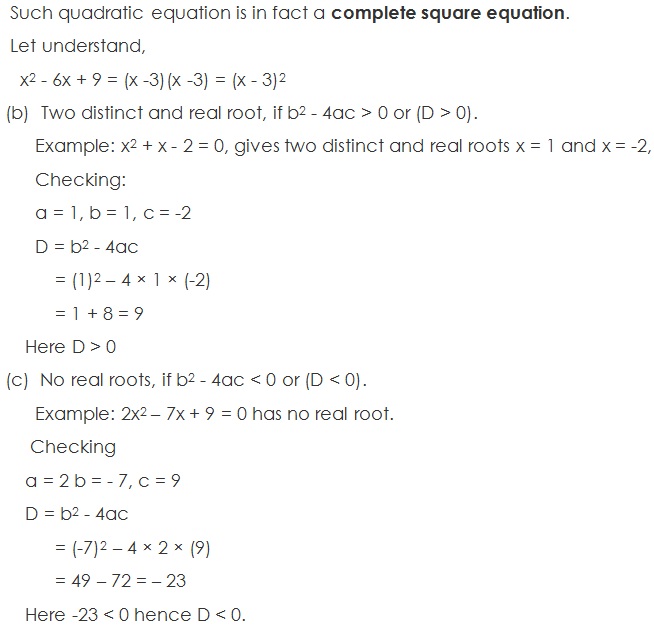
(a) D = 0; [Two equal and real roots, if b2 - 4ac = 0 or (D = 0)]
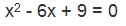
Example:
Solution:
x2 - 6x + 9 = 0
a = 1, b = -6, c = 9
Checking for existance of roots,
D = b2 - 4ac
D = (-6)2 - 4 × 1 × 9
D = 36 - 36
D = 0
Hence D = 0
∴ There is two equal and real roots [Nature-I ]
This equation gives two equal and real roots x = 3, and x = 3.
Such equation which have equal and real root is also called a complete square equation.
(b) D > 0; [ Two real and distinct root]
Example;
7x2 + 2x - 3 = 0
Solution:
7x2 + 2x - 3 = 0
a = 7, b = 2, c = -3
Checking for existance of roots,
D = b2 - 4ac
D = (2)2 - 4 × 7 × -3
D = 4 - (-84)
D = 4 + 84
D = 88
Hence D > 0
∴ There is two real and distinct roots [Nature-II]
(c) D < 0; No Real roots
Example
8x2 + 5x + 3 = 0
Solution:
8x2 + 5x + 3 = 0
a = 8, b = 5, c = 3
Checking for existance of roots,
D = b2 - 4ac
D = (5)2 - 4 × 8 × 3
D = 25 - 96
D = -71
Hence D < 0
∴ There is no roots [Nature-III]
4. Quadratic Equations
Finding Solutions of Quadratic Equations:
There are three method to find solution of quadratic equation.
(A) By Factorisation Method:
(B) By Completing Square Method:
(C) By Quadratic Formula:
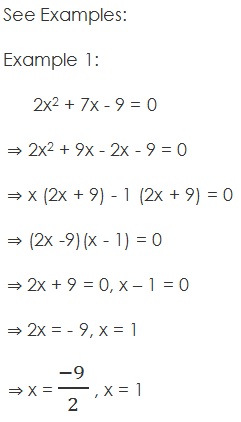
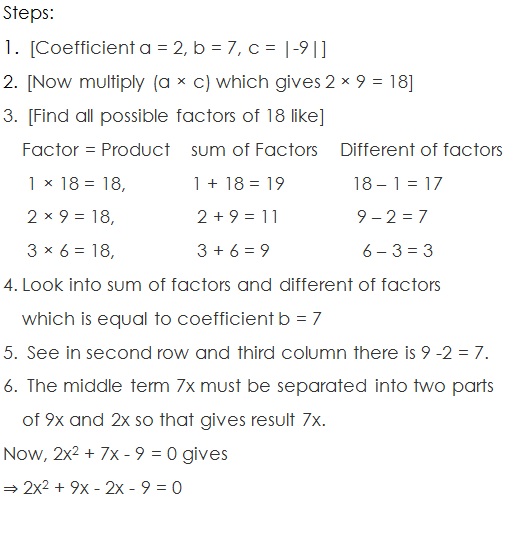
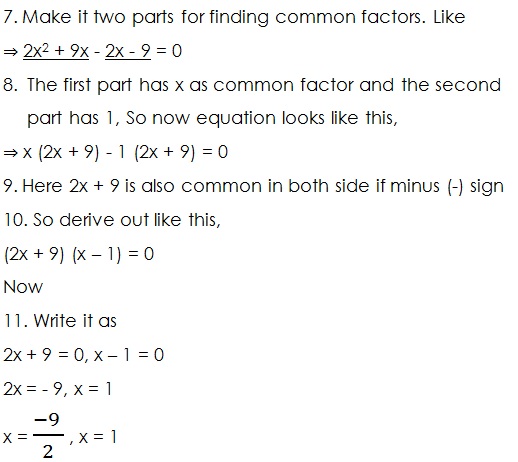
Factorisation Method: In this method the middle term is seperated into two part and then there is found the two common factors.
(B) Completing Square Method:
(i) Using Division
(ii) Using Multiplication
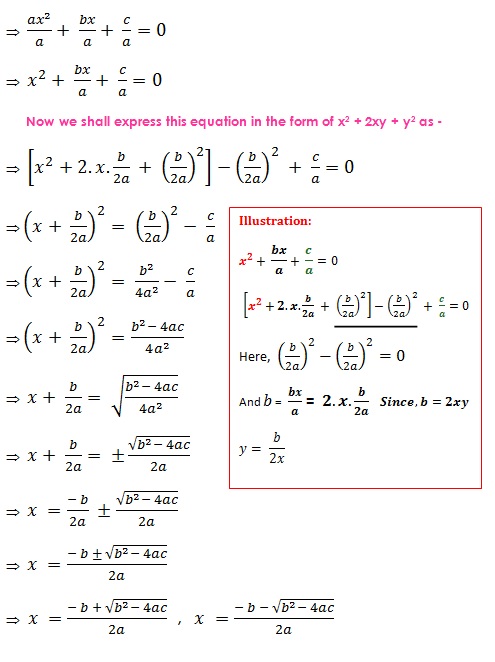
(i) Using Division:
Example 1:
Solving quadratic equation ax2 + bx + c = 0 for x.
Dividing the equation by a.
(i) Using Division:
Example 2: Find the roots of the equation 2x2 – 5x + 3 = 0 by the method of completing the square.
Solution:
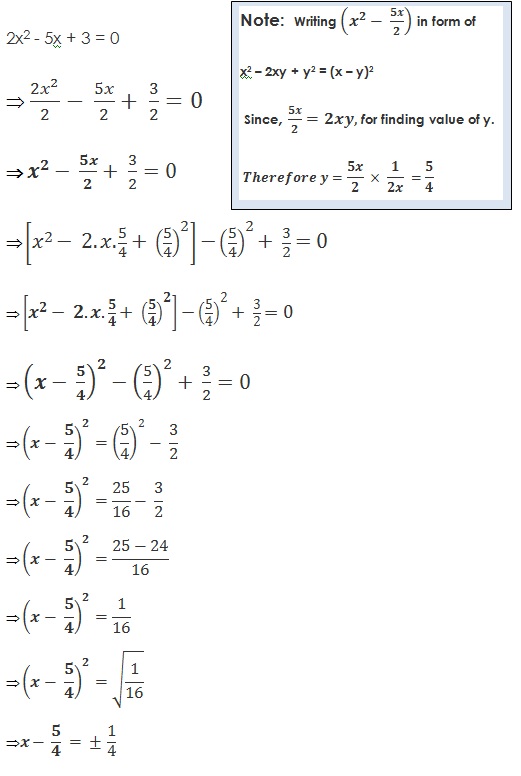
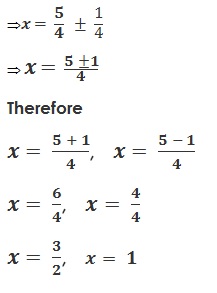
(ii) Using multiplication:
Example 2. Solve for x using complete squaring method 2x2 + 3x - 7 = 0;


4. Quadratic Equations
Quadratic Equations
Questions for practice
1 Marks questions;
Q1. Write the discriminant of the quadratic equation 3x2 - 5x - 11 = 0.
Q2. For what value of k quadratic equation x2 - kx + 4 = 0 has equal
roots.
Q3. Write the nature of the roots of equation 4x2 - 12x + 8 = 0.
Q4. What will be the value of D when given quadratic equation is a
complete square.
Q5. Find the value of x in equation x2 - 3 = 0.
Q6. Write the value of x in equation x2 - 15 = 0.
Q7. If x = - 2 is a root of the quadratic equation 3x2 - 5x + 2k = 0. Then
find the value of k.
Q8. For what value of k for which x = 3 is a solution of kx2 - 2x - 1 = 0.
Q9. For what value of p the quadratic equation 2x2 - 6x + p = 0 has
real and distinct roots.
Q10. If one root of the equation x2 + 7x + k = 0 is - 2, then find the value
of k and other root.
Q11. For what value of k the given quadratic equation will be a
complete square.
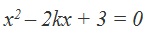
Q12. Find the solution of quadratic equation ax2 – 2abx = 0.
Q13. Write a quadratic equation whose two roots are - 3 and 4.
Q14. Find the nature of equation (x – 2a ) (x – 2b ) = 4ab.
Q15. What is the middle term of a quadratic equation which roots are
- 4 and - 5 ?
Q16. 2 is the one of the root of quadratic equation 3x2 - 11x + p = 0 then
find the value of p.
Q17. Write the discriminant of the quadratic equation .
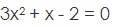
Q18. What is the nature of this equation.
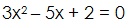
Q19. For what value of k the equation x2 + kx + 4 = 0 has no real roots?
Q20. For what value of p the equation

has real roots?
Q21. Find the roots of given quadratic equation by the method of
completing the square.
Q22. Find the value of a nad b such that x = 1, x = - 2 are the solution
of the quadratic equation x2 + ax + b = 0.
Q23. Solve for x
abx2 + (b2 - ac) x - bc = 0
Q24. solve for x
3y2 + (6 + 4a)y + 8a = 0
Q25. Divide 51 in to two parts such that their product is 378.
Q26. if the roots of the equation (b-c)x2 + (c - a)x + (a - b) = 0 are equal
then prove that 2b = a + c.
Q27. Find the value of k from the given equation so that equation
has equal roots.

Q28. Product of two number is 36 and difference is 9, find those number.
Q29. Find the value of k if the equation has two equal and real roots.
Q30. Find the nature of following quadratic equations:
(A) x2 + 4x + 9 = 0
(B) 3x2 - 2x - 8 = 0
(C) 11x2 + 8x - 3 = 0
(D) x2 + 7x + 4 = 0
(E) x2 + 4x + 4 = 0
(F) 3x2 + 10x + 8 = 0
(G) 4x2 + 3x + 5 = 0
(H) 7x2 + 12x + 5 = 0
(I) 5x2 - 10x + 5 = 0
Long-Answered Questions:
Q31. A journey of 192km from Mumbai to Pune takes 2hrs less by a fast train then by a slower train. If the speed of the slower train is 16 km/hr less than the faster train, find the speed of each train.
Q32. A part of monthly expenses of a family is constant and the remaining varies with the price of wheat. When the rate of wheat is Rs.250 per quintal, the total monthly expense if the family is Rs.1000 and when it is Rs.240 per quintal, the total monthly expense is Rs.980. Find the total monthly expenses of the family when cost wheat is Rs.350 per quintal.
Q33. A man travels 600km partly by train and partly by car. If he covers 400km by train and rest by car, it takes him 6hrs and 30minutes. But if he travels 200km by train and rest by car, he takes half an hour more. Find the speed of the train and that of the car.
Why Choose CBSE Notes for Class 10?
Reading the complete textbook is essential for building knowledge, but revision notes help students organize that knowledge effectively. Our CBSE Revision Notes for Class 10 summarize every chapter by highlighting important concepts, definitions, keywords, formulas, examples, and important points that students should remember during examinations. This approach saves valuable study time and makes revision much easier.
Students often find it difficult to revise lengthy chapters before examinations. Our notes solve this problem by presenting important information in a structured format that is easy to understand and remember. Regular revision using these notes helps improve confidence and strengthens conceptual clarity.
Chapter-wise Study Material
Each chapter included in the CBSE Notes for Class 10 section is prepared according to the latest academic session. Every topic is explained in simple language while maintaining accuracy and completeness. Students can easily revise important concepts, learn key points, and strengthen their understanding of each chapter.
The notes are suitable for daily classroom learning, homework preparation, revision before examinations, and self-study. They also serve as an excellent companion to NCERT textbooks by presenting the most important information in an organized manner.

Explore CBSE Notes Class 10 Mathematics
Chapter-wise NCERT Solutions for Class 6 to 12 prepared according to the latest CBSE syllabus.
English Medium

CBSE Notes Class 10 Mathematics
Chapter 1. Real Numbers (CBSE NOTES)
1. Real Numbers ()
Explore Now →
CBSE Notes Class 10 Mathematics
Chapter 3. Pair of Linear Equations in Two Variables (CBSE NOTES)
3. Pair of Linear Equations in Two Variables ()
Explore Now →
CBSE Notes Class 10 Mathematics
Chapter 4. Quadratic Equations (CBSE NOTES)
4. Quadratic Equations ()
Explore Now →
CBSE Notes Class 10 Mathematics
Chapter 5. Arithmetic Progressions (CBSE NOTES)
5. Arithmetic Progressions ()
Explore Now →
CBSE Notes Class 10 Mathematics
Chapter 7. Coordinate Geometry (CBSE NOTES)
7. Coordinate Geometry ()
Explore Now →
CBSE Notes Class 10 Mathematics
Chapter 8. Introduction to Trigonometry (CBSE NOTES)
8. Introduction to Trigonometry ()
Explore Now →
CBSE Notes Class 10 Mathematics
Chapter 9. Some Applications of Trigonometry (CBSE NOTES)
9. Some Applications of Trigonometry ()
Explore Now →
CBSE Notes Class 10 Mathematics
Chapter 11. Constructions (CBSE NOTES)
11. Constructions ()
Explore Now →
CBSE Notes Class 10 Mathematics
Chapter 12. Areas Related to Circles (CBSE NOTES)
12. Areas Related to Circles ()
Explore Now →
CBSE Notes Class 10 Mathematics
Chapter 13. Surface Areas and Volumes (CBSE NOTES)
13. Surface Areas and Volumes ()
Explore Now →
CBSE Notes Class 10 Mathematics
Chapter 15. Probability (CBSE NOTES)
15. Probability ()
Explore Now →Benefits of Using ATP Education Notes
- Latest CBSE syllabus based notes.
- Chapter-wise revision material.
- Easy-to-understand explanations.
- Important concepts and key points.
- Quick revision before examinations.
- Useful for school tests and annual exams.
- Available in Hindi and English Medium.
- Free educational resources for every student.
Your CBSE Notes Library Class 10:
Chapter-wise CBSE Notes for Class 6 to 12 prepared according to the latest CBSE syllabus.
HINDI MEDIUM
CBSE Class 10 Economics
Class 10 Economics CBSE Notes
Arthik Vikas ki Samajh Open Notes
Explore Now →
Your CBSE Notes Library For Class 10
Chapter-wise CBSE Notes for Class 6 to 12 prepared according to the latest CBSE syllabus.
ENGLISH MEDIUM
NCERT Solutions Class 10 SOCIAL SCIENCE-HISTORY
Class 10 SOCIAL SCIENCE-HISTORY CBSE Notes
India and the Contemporary World-II Open Book
Explore Now →
NCERT Solutions Class 10 History
Class 10 History CBSE Notes
India and the Contemporary World-II Open Book
Explore Now →
NCERT Solutions Class 10 Economics
Class 10 Economics CBSE Notes
Understanding Economic Development Open Book
Explore Now →Prepare with Confidence
Success in examinations depends on regular practice, conceptual understanding, and effective revision. Our Class 10 CBSE Notes are designed to help students study smarter instead of studying longer. By revising chapter-wise notes regularly, learners can improve their understanding, remember important concepts for a longer period, and write better answers during examinations.
Along with these notes, students can also explore NCERT Solutions, MCQ Questions, Online Tests, Important Questions, Study Materials, and other learning resources available on ATP Education. Together, these resources provide complete academic support for effective learning and better examination preparation.
Start exploring the CBSE Notes for Class 10 today and make your learning journey easier with well-organized chapter-wise notes, quick revision material, and reliable study resources prepared especially for CBSE students.
Benefits of Studying with Our CBSE Notes
- Chapter-wise Coverage: Every chapter is explained in a structured and easy-to-follow format.
- Latest CBSE Syllabus: Notes are prepared according to the latest CBSE curriculum and NCERT guidelines.
- Quick Revision: Revise important concepts, formulas, definitions, and key points in less time.
- Simple Language: Difficult topics are explained in clear and student-friendly language for better understanding.
- Concept-Based Learning: Focus on understanding concepts instead of memorizing answers.
- Exam-Oriented Preparation: Helps students prepare effectively for class tests, unit tests, half-yearly, annual, and board examinations.
- Subject-wise Organization: Easily access notes for Mathematics, Science, English, Hindi, Social Science, Physics, Chemistry, Biology, Economics, and more.
- Time-Saving Study Material: Well-organized notes reduce study time and improve learning efficiency.
- Improves Answer Writing: Learn important points and present answers in a better and more organized manner.
- Boosts Confidence: Regular revision strengthens concepts and increases confidence before examinations.
- Free Learning Resource: Access high-quality CBSE Notes without any subscription or hidden charges.
- Available in Hindi & English Medium: Study comfortably in your preferred medium with chapter-wise notes.