Describing Motion Around Us - Class 9 Science Exploration English CBSE Notes
CBSE Notes for Class 9 are one of the most useful study resources for students who want to understand every chapter clearly and perform well in school examinations. At ATP Education, we provide carefully prepared chapter-wise CBSE Notes for Class 9 based on the latest CBSE syllabus and NCERT curriculum. These notes are designed to simplify learning, improve conceptual understanding, and help students revise important topics quickly before examinations.
CBSE Notes for Class 9 – Chapter-wise Revision Notes
Every chapter is explained in a simple and student-friendly manner so that learners can understand difficult concepts without confusion. Whether you are preparing for class tests, periodic assessments, half-yearly examinations, annual examinations, or board-oriented assessments, our Class 9 CBSE Notes help you revise the complete syllabus in less time while covering all the important concepts.

Describing Motion Around Us - Class 9 Science Exploration English CBSE Notes
Describing Motion Around Us
Chapter 4. Describing Motion Around Us
Motion is one of the most common phenomena observed in nature. From moving vehicles and running athletes to falling objects and revolving planets, everything around us exhibits motion. To understand motion scientifically, we describe it using physical quantities such as position, distance, displacement, speed, velocity and acceleration. These quantities help us explain motion accurately with numbers, equations and graphs. This chapter introduces linear motion, uniform circular motion, graphical representation of motion and equations of motion, enabling students to analyse and compare different types of motion in everyday life.
Chapter Highlights
- Motion and Rest – Motion is identified by the change in an object's position with respect to a reference point over time, while an object is at rest if its position does not change.
- Reference Point and Position – The position of an object is described by specifying both its distance and direction from a fixed reference point.
- Distance and Displacement – Distance is the total path travelled, whereas displacement is the shortest distance between the initial and final positions along with direction.
- Average Speed – Average speed is calculated by dividing the total distance travelled by the total time taken. It is a scalar quantity.
- Average Velocity – Average velocity is the displacement divided by the time interval and includes both magnitude and direction. :contentReference[oaicite:5]{index=5}
- Average Acceleration – Acceleration is the rate of change of velocity with time and indicates whether an object is speeding up or slowing down.
- Uniform and Non-uniform Motion – An object moving equal distances in equal intervals of time has uniform motion, while unequal distances in equal intervals indicate non-uniform motion.
- Graphical Representation of Motion – Position-time, velocity-time and acceleration-time graphs help analyse motion visually and compare different types of motion.
- Equations of Motion – Mathematical equations relate displacement, velocity, acceleration and time for objects moving with constant acceleration.
- Uniform Circular Motion – An object moving in a circular path with constant speed continuously changes its direction and therefore experiences acceleration.
- Motion – Motion is the change in the position of an object with time relative to a reference point.
- Reference Point – The position of an object is always described with respect to a fixed reference point.
- Rest and Motion are Relative – The same object may appear at rest to one observer and in motion to another.
- Distance – Distance is the total length of the actual path travelled by an object and is a scalar quantity.
- Displacement – Displacement is the shortest straight-line distance between the initial and final positions and is a vector quantity.
- Speed – Speed is the distance travelled per unit time and indicates how fast an object moves.
- Average Speed – Average speed is the total distance travelled divided by the total time taken.
- Velocity – Velocity is the displacement per unit time and includes both magnitude and direction.
- Average Velocity – Average velocity is the total displacement divided by the total time taken.
- Acceleration – Acceleration is the rate of change of velocity with time and is measured in m/s².
- Uniform Motion – In uniform motion, an object covers equal distances in equal intervals of time.
- Non-uniform Motion – In non-uniform motion, an object covers unequal distances in equal intervals of time.
- Uniform Circular Motion – An object moving along a circular path with constant speed is said to be in uniform circular motion, but its velocity changes continuously because its direction changes.
- Position–Time Graph – The slope of a position-time graph represents the velocity of an object.
- Distance–Time Graph – The slope of a distance-time graph represents the speed of an object.
- Velocity–Time Graph – The slope gives acceleration, while the area under the graph gives displacement.
- Acceleration–Time Graph – It shows how acceleration changes with time.
- Equations of Motion – The three equations of motion are applicable only when an object moves with constant acceleration.
- Applications of Motion – The concepts of motion are widely used in transportation, sports, engineering, aviation, space science and everyday life.
- CBSE Key Learning – Understanding the relationship between distance, displacement, speed, velocity, acceleration and motion graphs is essential for solving competency-based, numerical and case-study questions.
- Quick Formula Revision
- Speed = Distance ÷ Time
- Velocity = Displacement ÷ Time
- Acceleration = (Final Velocity − Initial Velocity) ÷ Time
- v = u + at
- s = ut + ½at²
- v² = u² + 2as
Always remember the three golden graph rules: Distance–Time Graph → Slope = Speed, Position–Time Graph → Slope = Velocity, and Velocity–Time Graph → Slope = Acceleration while Area = Displacement. These concepts are frequently tested in CBSE competency-based and numerical questions.
Learning Outcomes
- Define motion using a suitable reference point.
- Differentiate between distance and displacement.
- Calculate average speed, average velocity and average acceleration.
- Identify uniform and non-uniform motion.
- Interpret and draw graphs related to motion.
- Apply equations of motion to solve numerical problems.
- Explain the characteristics of uniform circular motion.
- Relate concepts of motion to everyday life situations.
Why This Chapter is Important
This chapter forms the foundation of mechanics in Physics. The concepts of motion, speed, velocity and acceleration are used extensively in higher classes and are essential for solving numerical problems, interpreting graphs and understanding real-life applications such as transportation, sports, satellite motion and road safety.
Describing Motion Around Us
Chapter 4. Describing Motion Around Us
This section explains the basic concepts of motion, reference point, position, motion in a straight line, distance travelled and displacement. These concepts form the foundation for understanding speed, velocity and acceleration in later sections of the chapter.
1. Motion
Everything around us, from moving vehicles to planets and living organisms, is constantly in motion. Motion helps us describe how the position of an object changes with time.
Definition
Motion is the change in the position of an object with respect to a reference point as time passes.
Examples of Motion
- Moving Car – Travels along a road.
- Running Athlete – Changes position continuously.
- Falling Ball – Moves vertically downward.
- Train – Moves along railway tracks.
- Earth – Revolves around the Sun.
2. Motion in a Straight Line (Linear Motion)
When an object moves along a straight path, its motion is called linear motion or motion in a straight line. It is the simplest type of motion studied in Physics.
Definition
Linear motion is the motion of an object along a straight path.
Examples
- Swimming Race – Swimmer moves in a straight lane.
- Highway Car – Car moves on a straight road.
- Train – Travels on a straight railway track.
- Freely Falling Ball – Moves vertically downward.
3. Reference Point
To describe the position of an object, we first select a fixed point called the reference point. Every position is measured relative to this point.
Definition
A reference point is a fixed point with respect to which the position of an object is measured.
Importance
- Determines Position – Helps locate an object.
- Identifies Motion – Motion is observed only when position changes relative to the reference point.
- Makes Measurement Easy – Provides a common starting point.
4. Position of an Object
The position of an object is described using both its distance and direction from the reference point. Simply knowing the distance is not sufficient.
Definition
The position of an object is its distance and direction from a fixed reference point at a particular instant of time.
Important Points
- Positive Direction – Usually taken towards the right of the origin.
- Negative Direction – Usually taken towards the left of the origin.
- Origin – The reference point is generally represented by O (zero position).
5. Rest and Motion
Object at Rest
An object is said to be at rest if its position with respect to the reference point does not change with time.
Object in Motion
An object is said to be in motion if its position changes with time relative to the reference point.
Examples
- Parked Car – At rest with respect to the road.
- Moving Bus – In motion with respect to roadside trees.
- Passenger Sitting in Bus – At rest relative to the bus but in motion relative to the ground.
6. Direction in Straight Line Motion
For motion along a straight line, only two directions are possible. These are represented by positive (+) and negative (−) signs.
Direction Convention
- Positive (+) – Right side of the origin.
- Negative (−) – Left side of the origin.
7. Instant of Time and Time Interval
The chapter clearly distinguishes between an instant of time and a time interval, which are often confused by students.
Instant of Time
A single reading of a clock at a particular moment.
Time Interval
The duration between two instants of time.
Example
- Instant – 10:00 a.m.
- Time Interval – From 10:00 a.m. to 10:15 a.m. (15 minutes).
8. ATP Education Classroom Tips
- Motion is Relative – The same object may appear at rest for one observer and in motion for another.
- Reference Point is Essential – Motion cannot be described without choosing a reference point.
- Position Always Includes Direction – Distance alone cannot completely describe the position of an object.
- Remember the Difference – Instant of time is a moment, whereas time interval is a duration.
Describing Motion Around Us
Chapter 4. Describing Motion Around Us
This section explains the concepts of distance, displacement, average speed, average velocity and acceleration. These physical quantities help us describe motion accurately and compare the movement of different objects.
9. Distance Travelled
Whenever an object moves, it covers a certain path. The total length of this actual path is called the distance travelled. Distance depends only on the path followed and not on the direction of motion.
Definition
Distance is the total length of the actual path travelled by an object between two points.
Characteristics
- Scalar Quantity – It has only magnitude.
- No Direction – Direction is not considered.
- Always Positive – Distance can never be negative.
- Depends on Path – Different paths may have different distances.
SI Unit
The SI unit of distance is metre (m).
10. Displacement
Displacement represents the shortest straight-line distance between the initial and final positions of an object. Unlike distance, it also specifies the direction of motion.
Definition
Displacement is the shortest distance between the initial and final positions of an object in a specified direction.
Characteristics
- Vector Quantity – It has both magnitude and direction.
- Shortest Distance – Always the minimum possible distance.
- May be Zero – If an object returns to its starting point, displacement becomes zero.
- Independent of Path – Depends only on the initial and final positions.
SI Unit
The SI unit of displacement is metre (m).
11. Difference Between Distance and Displacement
| Distance | Displacement |
|---|---|
| Total length of the actual path travelled. | Shortest distance between two positions. |
| Scalar quantity. | Vector quantity. |
| No direction. | Direction is essential. |
| Always positive. | May be positive, negative or zero. |
| Depends on the path followed. | Depends only on initial and final positions. |
12. Speed
Speed tells us how fast an object moves. It is one of the most commonly used quantities to describe motion.
Definition
Speed is the distance travelled by an object per unit time.
Formula
Speed = Distance ÷ Time
SI Unit
The SI unit of speed is metre per second (m/s).
Other Unit
Kilometre per hour (km/h) is commonly used for vehicles.
13. Average Speed
An object may move at different speeds during a journey. Therefore, we calculate the average speed for the entire journey.
Definition
Average speed is the total distance travelled divided by the total time taken.
Formula
Average Speed = Total Distance Travelled ÷ Total Time Taken
Important Points
- Scalar Quantity – Has only magnitude.
- Based on Distance – Uses the total path travelled.
- Always Positive – Cannot have a negative value.
14. Velocity
Velocity describes both the speed and the direction of motion. Two objects may have the same speed but different velocities if they move in different directions.
Definition
Velocity is the displacement of an object per unit time in a specified direction.
Formula
Velocity = Displacement ÷ Time
Characteristics
- Vector Quantity – Has magnitude and direction.
- Depends on Displacement – Not on the total path.
- May be Positive or Negative – Depends on the direction of motion.
15. Difference Between Speed and Velocity
| Speed | Velocity |
|---|---|
| Based on distance. | Based on displacement. |
| Scalar quantity. | Vector quantity. |
| No direction. | Direction is necessary. |
| Always positive. | May be positive, negative or zero. |
16. Average Velocity
When the velocity of an object changes during motion, the average velocity gives the overall rate of displacement.
Definition
Average velocity is the total displacement divided by the total time taken.
Formula
Average Velocity = Total Displacement ÷ Total Time Taken
17. Acceleration
Sometimes an object speeds up, slows down or changes its direction. Such changes indicate acceleration.
Definition
Acceleration is the rate of change of velocity with respect to time.
Formula
Acceleration = Change in Velocity ÷ Time Taken
SI Unit
The SI unit of acceleration is metre per second squared (m/s²).
Types of Acceleration
- Positive Acceleration – Velocity increases with time.
- Negative Acceleration (Retardation) – Velocity decreases with time.
- Zero Acceleration – Velocity remains constant.
ATP Education Tip
For CBSE examinations, remember these four formulas: Speed = Distance ÷ Time, Average Speed = Total Distance ÷ Total Time, Velocity = Displacement ÷ Time, and Acceleration = Change in Velocity ÷ Time. Also remember that Distance & Speed are scalar quantities, whereas Displacement, Velocity and Acceleration are vector quantities.
Describing Motion Around Us
Chapter 4. Describing Motion Around Us
This section explains the different types of motion, uniform and non-uniform motion, equations describing motion with constant acceleration, and uniform circular motion. These concepts help students understand how objects move under different conditions.
18. Types of Motion
Objects move in different ways depending on the path they follow and how their position changes with time. Based on these characteristics, motion can be classified into different types.
Classification of Motion
- Linear Motion – Motion along a straight line.
- Circular Motion – Motion along a circular path.
- Periodic Motion – Motion that repeats itself after equal intervals of time.
- Oscillatory Motion – Motion to and fro about a mean position.
Examples
- Linear Motion – Train moving on a straight track.
- Circular Motion – A stone tied to a string and rotated.
- Periodic Motion – Rotation of the Earth around the Sun.
- Oscillatory Motion – Swing moving to and fro.
19. Uniform Motion
Sometimes an object covers equal distances in equal intervals of time. Such motion is called uniform motion because the speed remains constant throughout the journey.
Definition
Uniform motion is the motion in which an object covers equal distances in equal intervals of time.
Characteristics
- Constant Speed – Speed does not change.
- Zero Acceleration – Acceleration remains zero.
- Predictable Motion – Position changes uniformly with time.
Examples
- Train – Moving with constant speed on a straight track.
- Conveyor Belt – Moving continuously at a fixed speed.
20. Non-uniform Motion
In real life, most moving objects do not travel at a constant speed. They cover unequal distances in equal intervals of time.
Definition
Non-uniform motion is the motion in which an object covers unequal distances in equal intervals of time.
Characteristics
- Changing Speed – Speed increases or decreases.
- Acceleration Present – Velocity changes with time.
- Irregular Motion – Motion is not constant.
Examples
- Car in City Traffic – Speed changes frequently.
- Cyclist on a Busy Road – Continuously speeds up and slows down.
21. Difference Between Uniform and Non-uniform Motion
| Uniform Motion | Non-uniform Motion |
|---|---|
| Equal distances in equal intervals of time. | Unequal distances in equal intervals of time. |
| Speed remains constant. | Speed changes continuously. |
| Acceleration is zero. | Acceleration is present. |
| Simple to predict. | Difficult to predict accurately. |
22. Equations of Motion (Introduction)
When an object moves with constant acceleration, its displacement, velocity, acceleration and time are related by mathematical equations called the equations of motion.
Conditions
- Motion in a Straight Line
- Constant Acceleration
Main Symbols
| Symbol | Meaning |
|---|---|
| u | Initial Velocity |
| v | Final Velocity |
| a | Acceleration |
| t | Time Taken |
| s | Displacement |
Equations
- First Equation – v = u + at
- Second Equation – s = ut + ½at²
- Third Equation – v² = u² + 2as
Applications
- Vehicle Motion – Finding speed and distance.
- Sports – Analysing the movement of athletes.
- Engineering – Designing safe transportation systems.
23. Uniform Circular Motion
An object moving along a circular path with constant speed is said to be in uniform circular motion. Although the speed remains constant, the direction changes continuously; therefore, the velocity also changes.
Definition
Uniform circular motion is the motion of an object along a circular path with constant speed.
Characteristics
- Constant Speed – Magnitude of speed remains the same.
- Changing Direction – Direction changes continuously.
- Changing Velocity – Velocity changes because direction changes.
- Acceleration Present – The object experiences centripetal acceleration towards the centre.
Examples
- Earth Revolving Around the Sun
- Moon Revolving Around the Earth
- Ceiling Fan Blades
- Hands of a Clock
- Stone Rotating on a String
24. ATP Education Concept Builder
| Concept | Key Point |
|---|---|
| Uniform Motion | Equal distances in equal time intervals. |
| Non-uniform Motion | Unequal distances in equal time intervals. |
| Uniform Circular Motion | Constant speed but changing direction. |
| Acceleration | Change in velocity per unit time. |
| Equations of Motion | Applicable only for constant acceleration. |
ATP Education Tip
Remember these important CBSE concepts: Uniform motion has constant speed and zero acceleration, whereas non-uniform motion has changing speed and non-zero acceleration. Also, in uniform circular motion the speed remains constant, but the velocity changes because the direction changes continuously. Questions based on this concept are frequently asked in competency-based and case-study sections.
Describing Motion Around Us
Chapter 4. Describing Motion Around Us
This section explains the graphical representation of motion. Motion graphs help us understand how the position, speed, velocity and acceleration of an object change with time. They make it easier to compare different types of motion and solve numerical problems.
25. Graphical Representation of Motion
A graph is a visual method of representing the relationship between two physical quantities. In the study of motion, graphs are drawn by taking time on the X-axis (horizontal axis) and another physical quantity on the Y-axis (vertical axis).
Importance of Motion Graphs
- Easy Interpretation – Motion can be understood quickly.
- Comparison – Different types of motion can be compared easily.
- Numerical Problems – Helps calculate speed, velocity, acceleration and displacement.
- CBSE Competency Questions – Graph-based questions are frequently asked in examinations.
26. Position–Time Graph
A position-time graph shows how the position of an object changes with time.
Axes
- X-axis – Time (t)
- Y-axis – Position (x)
Interpretation
- Horizontal Line – Object is at rest.
- Straight Inclined Line – Uniform motion.
- Curved Line – Non-uniform motion.
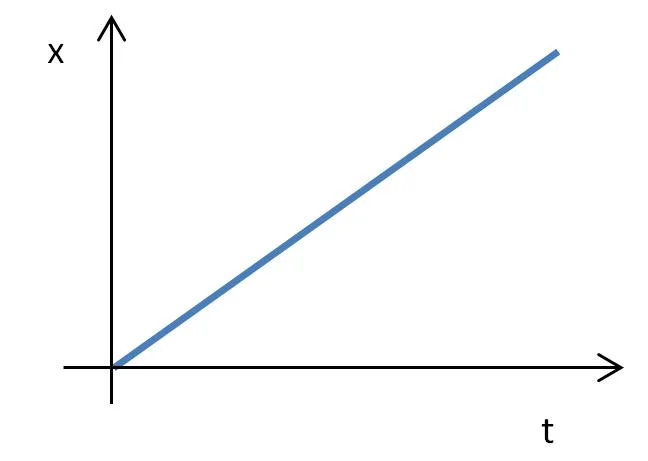
Figure (i) Position–Time Graph
- Horizontal line → Object at rest
- Straight inclined line → Uniform velocity
- Curved line → Changing velocity
Slope of Position-Time Graph
The slope of a position-time graph represents the velocity of the object.
27. Distance–Time Graph
A distance-time graph shows how the distance travelled by an object changes with time.
Axes
- X-axis – Time
- Y-axis – Distance
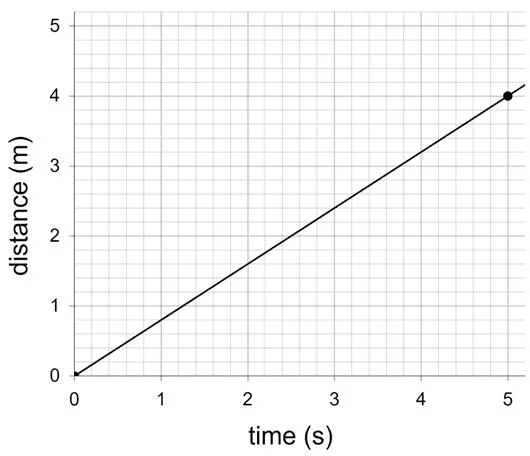
Figure (ii) Distance–Time Graph
- Straight line → Uniform speed
- Curved line → Non-uniform speed
- Slope = Speed
Interpretation
| Graph | Meaning |
|---|---|
| Horizontal Line | Object is at rest. |
| Straight Line | Uniform speed. |
| Curved Line | Changing speed (non-uniform motion). |
Important Point
The slope of a distance-time graph gives the speed of the object.
28. Velocity–Time Graph
A velocity-time graph shows how the velocity of an object changes with time.
Axes
- X-axis – Time
- Y-axis – Velocity
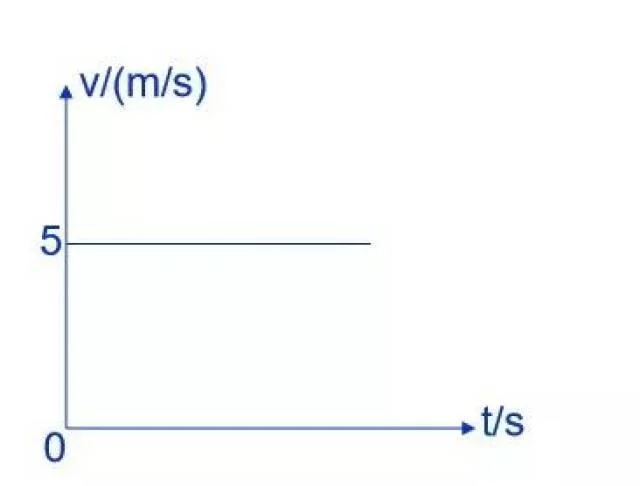
Figure (iii) Velocity–Time Graph
- Horizontal line → Constant velocity
- Slope = Acceleration
- Area under graph = Displacement
Interpretation
- Horizontal Line – Uniform velocity.
- Upward Sloping Line – Positive acceleration.
- Downward Sloping Line – Negative acceleration (retardation).
- Line on X-axis – Zero velocity.
Slope of Velocity-Time Graph
The slope of a velocity-time graph gives the acceleration.
Area Under Velocity-Time Graph
The area enclosed between the graph and the time axis represents the displacement of the object.
29. Acceleration–Time Graph
An acceleration-time graph shows how the acceleration of an object changes with time.
Axes
- X-axis – Time
- Y-axis – Acceleration
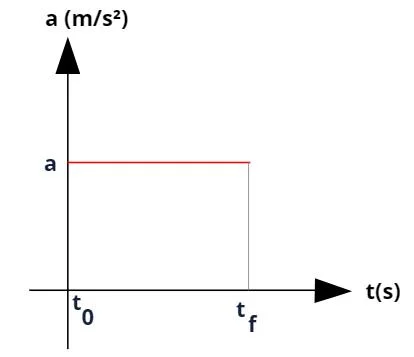
Figure (iv) Acceleration–Time Graph
- Horizontal line above X-axis → Constant acceleration
- Below X-axis → Retardation
- On X-axis → Zero acceleration
Interpretation
- Horizontal Line Above X-axis – Constant positive acceleration.
- Horizontal Line Below X-axis – Constant negative acceleration.
- Line on X-axis – Zero acceleration.
30. Graph Interpretation Skills
Students should carefully observe the shape and slope of a graph before drawing conclusions.
Quick Rules
- Steeper Distance-Time Graph – Greater speed.
- Steeper Position-Time Graph – Greater velocity.
- Steeper Velocity-Time Graph – Greater acceleration.
- Horizontal Graph – Quantity remains constant.
- Curved Graph – Quantity changes continuously.
31. Difference Between Motion Graphs
| Graph | Slope Represents | Area Represents |
|---|---|---|
| Position–Time | Velocity | Not Used |
| Distance–Time | Speed | Not Used |
| Velocity–Time | Acceleration | Displacement |
| Acceleration–Time | Rate of Change of Acceleration | Change in Velocity (Advanced Concept) |
32. Common Mistakes Made by Students
- Confusing Distance-Time and Position-Time Graphs – Remember that position includes direction, while distance does not.
- Ignoring the Slope – Always calculate or observe the slope before answering.
- Misinterpreting Curved Graphs – A curve usually indicates changing speed or velocity.
- Forgetting Units – Always write proper SI units on graph axes.
33. ATP Education Exam Booster
- Position–Time Graph → Slope = Velocity.
- Distance–Time Graph → Slope = Speed.
- Velocity–Time Graph → Slope = Acceleration.
- Velocity–Time Graph → Area under the graph = Displacement.
- Horizontal Line → Quantity remains constant.
- Straight Inclined Line → Uniform motion.
- Curved Line → Non-uniform motion.
ATP Education Tip
Graph-based questions are among the most scoring questions in CBSE examinations. Always remember these three golden rules: Distance-Time Graph → Speed, Position-Time Graph → Velocity, Velocity-Time Graph → Acceleration and Area → Displacement. Once these relationships are clear, most graph-based questions become easy to solve.
Describing Motion Around Us
Chapter 4. Describing Motion Around Us
This assignment is based on the complete chapter and follows the latest CBSE competency-based assessment pattern. It includes objective, descriptive, case-based and higher-order thinking questions to strengthen conceptual understanding and problem-solving skills.
Chapter Assignment
1. One Word Answer
- The change in the position of an object with time.
- A fixed point used to describe the position of an object.
- The total length of the actual path travelled.
- The shortest distance between the initial and final positions.
- The distance travelled per unit time.
- The displacement per unit time.
- The rate of change of velocity.
- Motion with constant speed.
- Motion along a circular path with constant speed.
- The SI unit of acceleration.
2. Fill in the Blanks
- Motion is described with respect to a __________ point.
- Distance is a __________ quantity.
- Displacement is a __________ quantity.
- Speed is measured in __________.
- Velocity depends on __________.
- Acceleration is the rate of change of __________.
- In uniform motion, acceleration is __________.
- The slope of a distance-time graph represents __________.
- The area under a velocity-time graph gives __________.
- Uniform circular motion has constant __________ but changing velocity.
3. True or False
- An object can be at rest for one observer and in motion for another.
- Distance can never be less than displacement.
- Velocity is a scalar quantity.
- Speed can never be negative.
- Displacement may be zero even when distance is not zero.
- Uniform motion means constant acceleration.
- The slope of a velocity-time graph gives acceleration.
- The area under a velocity-time graph gives displacement.
- In uniform circular motion, the direction of motion changes continuously.
- Acceleration is measured in m/s².
4. Match the Following
| Column A | Column B |
|---|---|
| Distance | Total Path Length |
| Displacement | Shortest Distance |
| Speed | Distance ÷ Time |
| Velocity | Displacement ÷ Time |
| Acceleration | Change in Velocity ÷ Time |
| Distance-Time Graph | Slope gives Speed |
| Position-Time Graph | Slope gives Velocity |
| Velocity-Time Graph | Slope gives Acceleration |
| Area under Velocity-Time Graph | Displacement |
| Uniform Circular Motion | Constant Speed |
5. Very Short Answer Questions
- Define motion.
- What is a reference point?
- Define distance.
- Define displacement.
- State the SI unit of speed.
- Define average velocity.
- What is acceleration?
- What is uniform motion?
- State one difference between speed and velocity.
- Why is velocity a vector quantity?
6. Short Answer Questions
- Differentiate between distance and displacement.
- Differentiate between speed and velocity.
- Explain the concept of a reference point with an example.
- Describe uniform and non-uniform motion with examples.
- Explain the importance of acceleration in daily life.
- Differentiate between average speed and average velocity.
- Explain why motion is relative.
- Describe the characteristics of uniform circular motion.
- Write any four applications of equations of motion.
- Explain how graphs help in studying motion.
7. Long Answer Questions
- Explain motion, reference point and position with suitable examples.
- Describe distance and displacement with a comparison table.
- Explain speed, velocity and acceleration along with their SI units and formulas.
- Describe uniform and non-uniform motion with suitable examples.
- Explain the graphical representation of motion.
- Describe the position-time, distance-time and velocity-time graphs.
- Explain the equations of motion and their applications.
- Describe uniform circular motion and explain why it is an accelerated motion.
- Explain the relationship between the slope and area of different motion graphs.
- Discuss the importance of studying motion in science and everyday life.
8. Case Study Questions
Case Study – 1
A car travels 120 km in 2 hours on a straight highway at a constant speed.
- What type of motion is shown by the car?
- Calculate its average speed.
- What will be the shape of its distance-time graph?
- Is the acceleration zero or non-zero?
Case Study – 2
A student walks 20 m east and then 20 m west, returning to the starting point.
- Calculate the total distance travelled.
- What is the displacement?
- Why are the values of distance and displacement different?
- Which quantity is a vector?
Case Study – 3
A cyclist increases his speed from 5 m/s to 15 m/s in 5 seconds.
- Has the cyclist accelerated or decelerated?
- Calculate the acceleration.
- Which graph can best represent this motion?
- Which physical quantity changes during this motion?
Case Study – 4
A satellite revolves around the Earth with constant speed in a circular orbit.
- What type of motion is shown by the satellite?
- Why is the satellite considered to be accelerating?
- Does its speed change?
- What changes continuously during its motion?
Case Study – 5
A student observes a horizontal line on a distance-time graph.
- What does the graph indicate?
- What is the speed of the object?
- Is the object moving or at rest?
- How will the graph change if the object starts moving with uniform speed?
9. Competency-Based Questions
- Why is a reference point necessary to describe motion?
- How can two objects have the same speed but different velocities?
- Why is displacement never greater than distance?
- How does acceleration improve vehicle safety analysis?
- Why is a velocity-time graph more informative than a distance-time graph?
- How can graphs help compare the motion of two vehicles?
- Why is motion in a circular path considered accelerated motion?
- How are equations of motion useful in sports and transportation?
- Why are SI units important while measuring motion?
- How do graphical representations make the study of motion easier?
10. HOTS Questions
- A person completes one full lap of a circular track. Explain why the distance is not zero but the displacement is zero.
- Can an object have zero velocity and still have non-zero acceleration? Justify your answer.
- Why is a person sitting inside a moving train considered both at rest and in motion at the same time?
- A car moves with constant speed around a circular track. Why is its velocity not constant?
- Can the average speed and average velocity of an object ever be equal? Explain with an example.
- How would traffic management become difficult if the concepts of speed and acceleration were ignored?
- Why is the slope of a graph considered more useful than only reading plotted points?
- How do motion graphs help scientists predict future motion?
- A vehicle returns to its starting point after a journey. Which quantities become zero and which remain non-zero? Explain.
- Why is understanding motion considered the foundation for studying higher concepts of Physics?
Why Choose CBSE Notes for Class 9?
Reading the complete textbook is essential for building knowledge, but revision notes help students organize that knowledge effectively. Our CBSE Revision Notes for Class 9 summarize every chapter by highlighting important concepts, definitions, keywords, formulas, examples, and important points that students should remember during examinations. This approach saves valuable study time and makes revision much easier.
Students often find it difficult to revise lengthy chapters before examinations. Our notes solve this problem by presenting important information in a structured format that is easy to understand and remember. Regular revision using these notes helps improve confidence and strengthens conceptual clarity.
Chapter-wise Study Material
Each chapter included in the CBSE Notes for Class 9 section is prepared according to the latest academic session. Every topic is explained in simple language while maintaining accuracy and completeness. Students can easily revise important concepts, learn key points, and strengthen their understanding of each chapter.
The notes are suitable for daily classroom learning, homework preparation, revision before examinations, and self-study. They also serve as an excellent companion to NCERT textbooks by presenting the most important information in an organized manner.

Explore CBSE Notes Class 9 Science Exploration
Chapter-wise NCERT Solutions for Class 6 to 12 prepared according to the latest CBSE syllabus.
English Medium

CBSE Notes Class 9 Science Exploration
Chapter Exploration: Entering the World of Secondary Science (CBSE NOTES)
Exploration: Entering the World of Secondary Science (Exploration)
Explore Now →
CBSE Notes Class 9 Science Exploration
Chapter Cell: The Building Block of Life (CBSE NOTES)
Cell: The Building Block of Life (Exploration)
Explore Now →
CBSE Notes Class 9 Science Exploration
Chapter Tissues in Action (CBSE NOTES)
Tissues in Action (Exploration)
Explore Now →
CBSE Notes Class 9 Science Exploration
Chapter Describing Motion Around Us (CBSE NOTES)
Describing Motion Around Us (Exploration)
Explore Now →
CBSE Notes Class 9 Science Exploration
Chapter Exploring Mixtures and their Separation (CBSE NOTES)
Exploring Mixtures and their Separation (Exploration)
Explore Now →
CBSE Notes Class 9 Science Exploration
Chapter How Forces Affect Motion (CBSE NOTES)
How Forces Affect Motion (Exploration)
Explore Now →
CBSE Notes Class 9 Science Exploration
Chapter Work, Energy, and Simple Machines (CBSE NOTES)
Work, Energy, and Simple Machines (Exploration)
Explore Now →
CBSE Notes Class 9 Science Exploration
Chapter Journey Inside the Atom (CBSE NOTES)
Journey Inside the Atom (Exploration)
Explore Now →
CBSE Notes Class 9 Science Exploration
Chapter Atomic Foundations of Matter (CBSE NOTES)
Atomic Foundations of Matter (Exploration)
Explore Now →
CBSE Notes Class 9 Science Exploration
Chapter Sound Waves: Characteristics and Applications (CBSE NOTES)
Sound Waves: Characteristics and Applications (Exploration)
Explore Now →
CBSE Notes Class 9 Science Exploration
Chapter Reproduction: How Life Continues (CBSE NOTES)
Reproduction: How Life Continues (Exploration)
Explore Now →
CBSE Notes Class 9 Science Exploration
Chapter Patterns in Life: Diversity and Classification (CBSE NOTES)
Patterns in Life: Diversity and Classification (Exploration)
Explore Now →
CBSE Notes Class 9 Science Exploration
Chapter Earth as a System: Energy, Matter, and Life (CBSE NOTES)
Earth as a System: Energy, Matter, and Life (Exploration)
Explore Now →Benefits of Using ATP Education Notes
- Latest CBSE syllabus based notes.
- Chapter-wise revision material.
- Easy-to-understand explanations.
- Important concepts and key points.
- Quick revision before examinations.
- Useful for school tests and annual exams.
- Available in Hindi and English Medium.
- Free educational resources for every student.
Your CBSE Notes Library Class 9:
Chapter-wise CBSE Notes for Class 6 to 12 prepared according to the latest CBSE syllabus.
HINDI MEDIUM
CBSE Class 9 Science Exploration
Class 9 Science Exploration CBSE Notes
अन्वेषण Open Notes
Explore Now →
Your CBSE Notes Library For Class 9
Chapter-wise CBSE Notes for Class 6 to 12 prepared according to the latest CBSE syllabus.
ENGLISH MEDIUM
NCERT Solutions Class 9 Science Exploration
Class 9 Science Exploration CBSE Notes
Exploration Open Book
Explore Now →Prepare with Confidence
Success in examinations depends on regular practice, conceptual understanding, and effective revision. Our Class 9 CBSE Notes are designed to help students study smarter instead of studying longer. By revising chapter-wise notes regularly, learners can improve their understanding, remember important concepts for a longer period, and write better answers during examinations.
Along with these notes, students can also explore NCERT Solutions, MCQ Questions, Online Tests, Important Questions, Study Materials, and other learning resources available on ATP Education. Together, these resources provide complete academic support for effective learning and better examination preparation.
Start exploring the CBSE Notes for Class 9 today and make your learning journey easier with well-organized chapter-wise notes, quick revision material, and reliable study resources prepared especially for CBSE students.
Benefits of Studying with Our CBSE Notes
- Chapter-wise Coverage: Every chapter is explained in a structured and easy-to-follow format.
- Latest CBSE Syllabus: Notes are prepared according to the latest CBSE curriculum and NCERT guidelines.
- Quick Revision: Revise important concepts, formulas, definitions, and key points in less time.
- Simple Language: Difficult topics are explained in clear and student-friendly language for better understanding.
- Concept-Based Learning: Focus on understanding concepts instead of memorizing answers.
- Exam-Oriented Preparation: Helps students prepare effectively for class tests, unit tests, half-yearly, annual, and board examinations.
- Subject-wise Organization: Easily access notes for Mathematics, Science, English, Hindi, Social Science, Physics, Chemistry, Biology, Economics, and more.
- Time-Saving Study Material: Well-organized notes reduce study time and improve learning efficiency.
- Improves Answer Writing: Learn important points and present answers in a better and more organized manner.
- Boosts Confidence: Regular revision strengthens concepts and increases confidence before examinations.
- Free Learning Resource: Access high-quality CBSE Notes without any subscription or hidden charges.
- Available in Hindi & English Medium: Study comfortably in your preferred medium with chapter-wise notes.